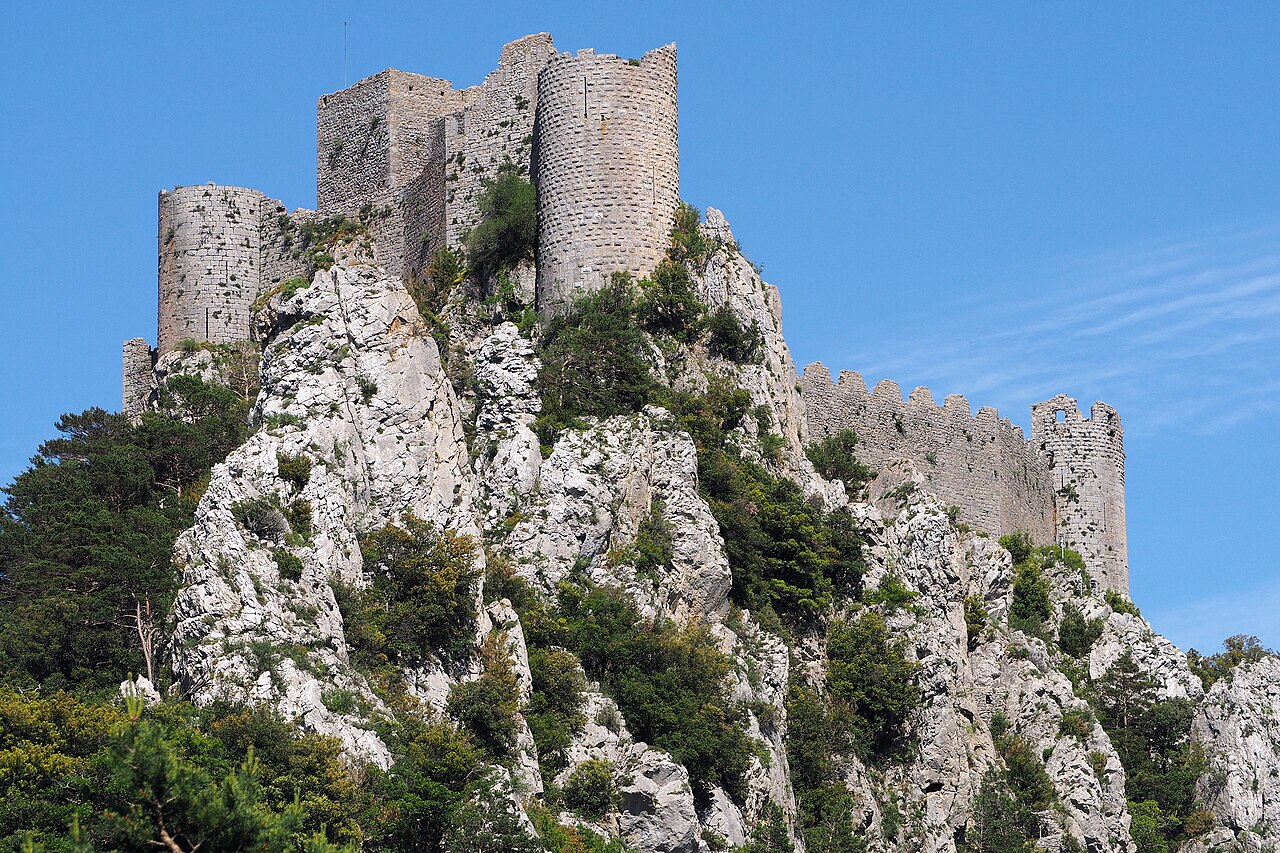
Château Vicomtal Saint-Pierre
The Château Vicomtal Saint-Pierre de Fenouillet is a significant ruined castle dating from the 11th century, located in the commune of Fenouillet in southern France. This High Medieval fortress played a notable role in the complex political and religious conflicts of the region, especially during the era of the Cathar movement and the Albigensian Crusade.
Historical context and Cathar connections
In the 12th century, the castle was under the control of Bertrand de Saissac, the Viscount of Fenouillet, who was a prominent vassal of the Viscount of Carcassonne. Bertrand is historically recognized for his Cathar beliefs and opposition to the Catholic Church, which was a defining feature of the religious tensions in the Languedoc region during that period. It is believed that the earliest Cathar preachers arrived in Fenouillet around this time, establishing the castle as a center of Cathar influence.
At the dawn of the 13th century, the surrounding territories of Toulouse, Foix, and Carcassonne became focal points of the crusade against the Cathars. Although Fenouillet itself was not a direct battlefield, it was deeply affected by the ensuing political and territorial upheavals. Bertrand de Saissac, aligned with the Trencavel family who were the Viscounts of Carcassonne, actively resisted the Albigensian Crusaders, placing the castle within the broader narrative of the Cathar wars.
Political changes and royal control
Following the Treaty of Corbeil in 1258, Fenouillet became a border region under the authority of the Viguiers appointed by the Kings of France. This transition marked a shift from local viscountal control to direct royal oversight. The nearby Castel Fizel was first mentioned in 1260, and records indicate that by 1262, the King of France had granted the castle as a fief to loyal vassals.
By 1272, Fenouillet was officially recognized as a royal fortress, and the adjacent castle of Sabarda received similar status by 1290. This period marks the gradual decline of the Château Vicomtal Saint-Pierre as a primary military site.
Architectural features and military significance
The castle was strategically built on a broad promontory, which offered natural defensive advantages. However, this location also posed challenges for defense, as the extensive perimeter required a sizable garrison to maintain effective control. The castle's keep, curtain walls, and gate structures were typical of High Medieval fortifications, designed to withstand sieges and serve as a stronghold for the viscounts.
During the 13th and 14th centuries, the castle was deliberately dismantled as part of a strategic military decision. A notable feature from this period is a ramp constructed against the keep's door, likely intended to facilitate the demolition process. This dismantling coincided with the transfer of military focus to the smaller, more manageable castle of Sabarda nearby.
Reasons for abandonment
The abandonment of Château Vicomtal Saint-Pierre as the main defensive site can be attributed to its large size and the limited manpower available for its defense. The royal garrisons assigned to the border were relatively small, making it impractical to defend such an extensive fortress without local support from the surrounding population of Castrum. Consequently, it was more feasible to modernize and strengthen the smaller castle of Sabarda, which could be more effectively managed and defended.
Legacy and current condition
Today, the Château Vicomtal Saint-Pierre remains a ruined castle, with visible remnants that reflect its medieval origins and turbulent history. Its ruins offer valuable insights into the architectural and military strategies of the High Medieval period in the Languedoc region. The site is a point of interest for historians and visitors intrigued by the Cathar heritage and the complex feudal dynamics of southern France during the Middle Ages.
Despite its ruined state, the castle's location and remaining structures continue to evoke the historical significance of Fenouillet as a frontier zone during a time of religious and political conflict. The castle's story is intertwined with the broader narrative of the Cathar crusades, royal consolidation of power, and the evolution of medieval fortifications in France.
Frequently asked questions (FAQ)
- How do I get to Château Vicomtal Saint-Pierre?
- Château Vicomtal Saint-Pierre is located in Fenouillet, France, easily accessible by car or public transport. The nearest train station is in Carcassonne, from where you can take a bus or taxi to reach the castle.
- What is the historical significance of Château Vicomtal Saint-Pierre?
- Château Vicomtal Saint-Pierre dates back to the medieval period and played a crucial role in the defense of the region. It showcases the architectural styles of its time and reflects the rich history of the Languedoc area.
- When was Château Vicomtal Saint-Pierre built?
- The construction of Château Vicomtal Saint-Pierre began in the 12th century, with various renovations and expansions occurring over the centuries. Its enduring structure highlights the craftsmanship of the medieval builders.
- Can I take photos inside the castle?
- Yes, visitors are allowed to take photos inside Château Vicomtal Saint-Pierre, but please respect any areas where photography may be restricted. Capturing the stunning architecture and historical artifacts is encouraged during your visit.
- Why is Château Vicomtal Saint-Pierre a popular tourist destination?
- Château Vicomtal Saint-Pierre attracts visitors due to its rich history, stunning architecture, and picturesque views of the surrounding landscape. The castle offers a glimpse into the past and provides a unique experience for history enthusiasts and casual tourists alike.
- Is it possible to schedule a guided tour of the castle?
- Yes, guided tours of Château Vicomtal Saint-Pierre are available and highly recommended for a deeper understanding of its history and architecture. Tours can be booked in advance through the castle's official website or at the visitor center.
- What are the opening hours for Château Vicomtal Saint-Pierre?
- Château Vicomtal Saint-Pierre is typically open from 10 AM to 6 PM, with extended hours during the summer months. It is advisable to check the official website for any seasonal changes or special closures before your visit.
- What are the ticket prices for visiting the castle?
- Ticket prices for Château Vicomtal Saint-Pierre are generally affordable, with discounts for students and seniors. Children under a certain age may enter for free, making it a great option for family outings.
- What is the best time to visit Château Vicomtal Saint-Pierre?
- The best time to visit Château Vicomtal Saint-Pierre is during the spring and early autumn when the weather is mild, and the gardens are in full bloom. Additionally, fewer crowds during these seasons allow for a more enjoyable experience.
- Are there any nearby attractions to visit after touring the castle?
- Yes, there are several nearby attractions, including the beautiful vineyards of the Languedoc region and the historic town of Carcassonne. Visitors can also explore local hiking trails and enjoy the stunning natural landscapes surrounding the castle.
Information
Loading map...
Visitor reviews
No reviews yet. Been here? Write the first review and help other travelers!
Write the first reviewVisited this castle? Share your experience
Your review helps other travelers and adds first-hand knowledge to our encyclopedia.