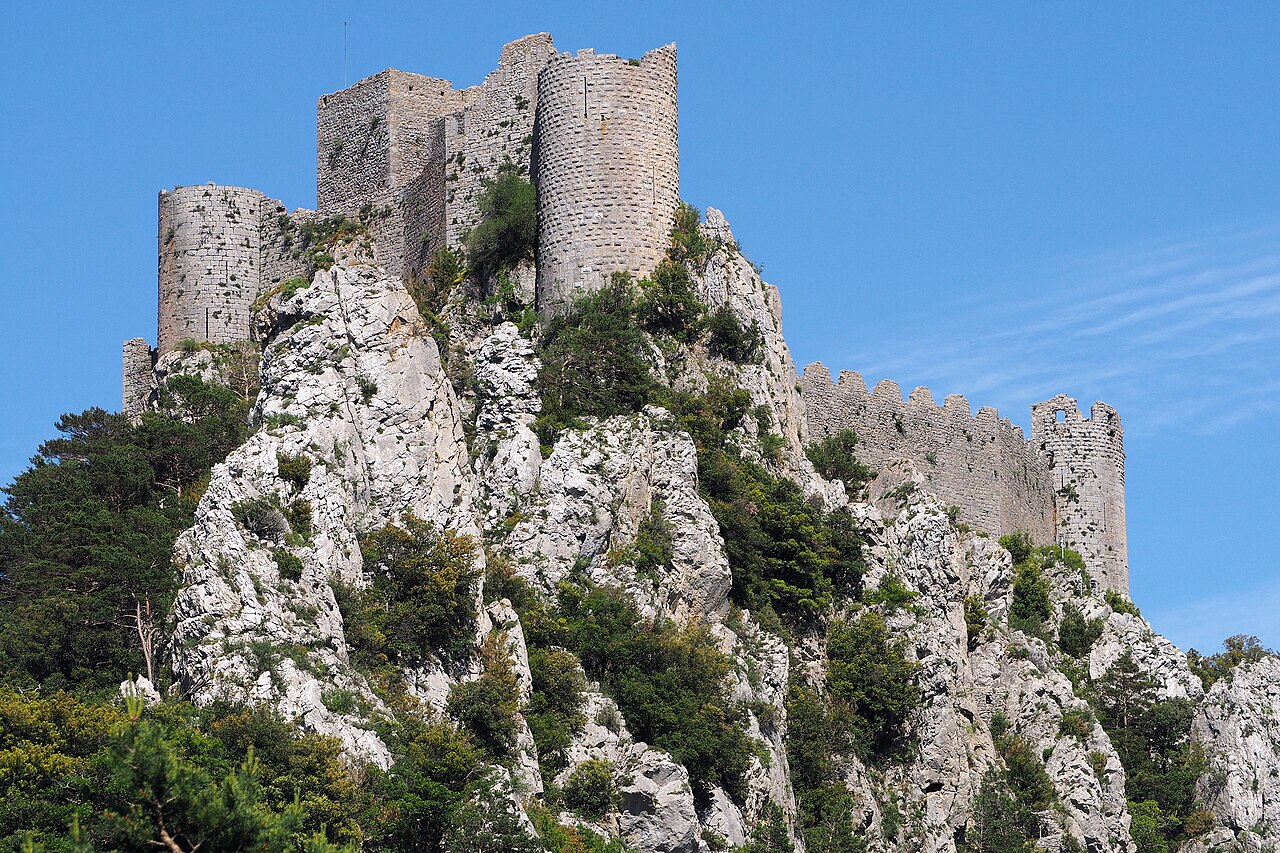
Château Vicomtal Saint-Pierre de Fenouillet
The Château Vicomtal Saint-Pierre de Fenouillet is a notable medieval fortress situated in the commune of Fenouillet, within the Pyrénées-Orientales department of southern France. Constructed in the 11th century by the viscounts of Fenouillèdes, this hill castle was strategically positioned on a hillside overlooking key communication routes. Its location allowed the viscounts to exert control over the surrounding territory, serving both defensive and administrative functions during the High Medieval period.
The historical significance of Château Vicomtal Saint-Pierre de Fenouillet
As a seat of local power, the castle was part of a larger fortified settlement or castrum, which consolidated the viscounts' authority in the region. The castle's role extended beyond military defense to include governance and management of the surrounding lands. The viscount of Fenouillèdes, a feudal lord, oversaw the castle and its domain, reflecting the feudal structure prevalent in medieval France.
In the early 12th century, the construction of the nearby Château de Sabarda facing the Château Vicomtal Saint-Pierre de Fenouillet highlights the continued military and political importance of this area. This proximity of fortifications suggests a network of defensive sites controlling strategic routes and territories in the Pyrénées-Orientales. Alongside the Château de Sabarda and Castel Fizel, the castle formed part of a cluster of medieval fortresses that underscored the region's feudal complexity and the need for territorial defense.
Through the centuries, the castle adapted to changing political and social circumstances but retained its significance within the feudal landscape. Although specific records of battles or sieges at the castle are scarce, its enduring presence indicates its role as a local stronghold and administrative center.
In recognition of its historical and cultural value, the castle and its associated castral settlement were officially listed as a historic monument on October 27, 2015. Since 2000, ongoing archaeological excavations have revealed multiple layers of the site’s development, shedding light on medieval construction techniques and the daily life of its inhabitants. The castle is currently owned and managed by the local commune, ensuring its preservation and continued study.
Architectural features and layout
The ruins of the Château Vicomtal Saint-Pierre de Fenouillet are located on a hillside, with a distinctive terraced construction that follows the natural slope of the terrain. This stepped design provided both structural stability and a tactical advantage, enabling defenders to monitor the surrounding landscape effectively.
Remnants of the castle include sections of the outer defensive walls that once enclosed the complex, offering protection against invaders. These walls delineate the perimeter of the fortress and reflect typical medieval military architecture aimed at fortifying vulnerable points.
Within the enclosure, archaeological remains reveal traces of various interior buildings, indicating the castle's functional diversity. One of the most significant surviving features is a vaulted cellar, constructed using curved stonework typical of medieval masonry. This cellar likely served as a storage space for food, supplies, or valuables, essential for sustaining the castle's occupants during sieges or long periods of isolation.
A prominent element of the site is the remains of an 11th-century Romanesque church dedicated to Saint-Pierre. This ecclesiastical structure, characterized by its rounded arches and solid masonry, underscores the religious dimension of the castle complex. The church's presence within the enclosure highlights the integration of spiritual life with military and administrative functions in medieval fortifications.
The castle's religious and cultural role
The Romanesque church of Saint-Pierre within the castle grounds is a testament to the castle's dual role as both a military fortress and a center of religious activity. Romanesque architecture, prevalent in the 11th century, is distinguished by its massive quality, thick walls, and semicircular arches, all of which are evident in the church's remains. This church would have served the spiritual needs of the castle's inhabitants and the surrounding community, playing a key role in the social fabric of the feudal era.
Religious structures within castles were common, reflecting the intertwined nature of faith and governance during the Middle Ages. The church at Château Vicomtal Saint-Pierre de Fenouillet also symbolizes the viscounts' patronage and their role in promoting ecclesiastical presence in their domain.
Archaeological research and preservation efforts
Since the year 2000, systematic archaeological excavations have been conducted at the site, uncovering a wealth of information about the castle's construction phases, architectural evolution, and daily life of its medieval occupants. These investigations have revealed the complexity of the castral settlement, including its defensive structures, domestic buildings, and religious facilities.
The archaeological work has been instrumental in documenting the castle's historical layers, from its initial 11th-century foundations to later modifications. Preservation of the ruins is overseen by the local commune, which is committed to maintaining the site's integrity and facilitating public access for educational and cultural purposes.
The castle's designation as a historic monument in 2015 further supports conservation initiatives, ensuring that this important heritage site receives the attention and protection it merits. Visitors to the site can appreciate the scenic views offered by its hillside location, as well as the tangible connection to the medieval past embodied in its remaining structures.
Context within the region's medieval fortifications
The Château Vicomtal Saint-Pierre de Fenouillet is part of a broader network of medieval fortifications in the Pyrénées-Orientales region. Alongside the ruins of Château de Sabarda and Castel Fizel, it forms a cluster of castles that historically guarded strategic routes and controlled territorial boundaries.
This concentration of castles reflects the feudal fragmentation and the need for local lords to defend their holdings against rivals and external threats. The proximity of these sites illustrates the military and political dynamics of the region during the Middle Ages, where power was exercised through the construction and maintenance of fortified strongholds.
Today, these ruins collectively contribute to the understanding of medieval life and defense systems in southern France, offering insights into the architectural styles, construction methods, and historical developments of the era.
Frequently asked questions (FAQ)
- When was Château Vicomtal Saint-Pierre de Fenouillet built?
- The castle was constructed in the 11th century by the viscounts of Fenouillèdes as a strategic medieval fortress.
- What architectural style characterizes the castle?
- The castle features Romanesque architecture, especially evident in the remains of the 11th-century church of Saint-Pierre within its enclosure.
- What remains can visitors see at the castle site?
- Visitors can see the terraced hillside ruins, sections of outer defensive walls, a vaulted cellar, and the remains of the Romanesque church dedicated to Saint-Pierre.
- Is the castle open to the public?
- The castle is owned by the local commune and is accessible to visitors, with archaeological excavations enhancing the understanding of the site.
- What is the significance of the nearby Château de Sabarda?
- Château de Sabarda, built in the early 12th century facing Château Vicomtal Saint-Pierre, indicates a network of medieval fortifications controlling the region.
Information
Current owner
Local commune
Loading map...
Visitor reviews
No reviews yet. Been here? Write the first review and help other travelers!
Write the first reviewVisited this castle? Share your experience
Your review helps other travelers and adds first-hand knowledge to our encyclopedia.