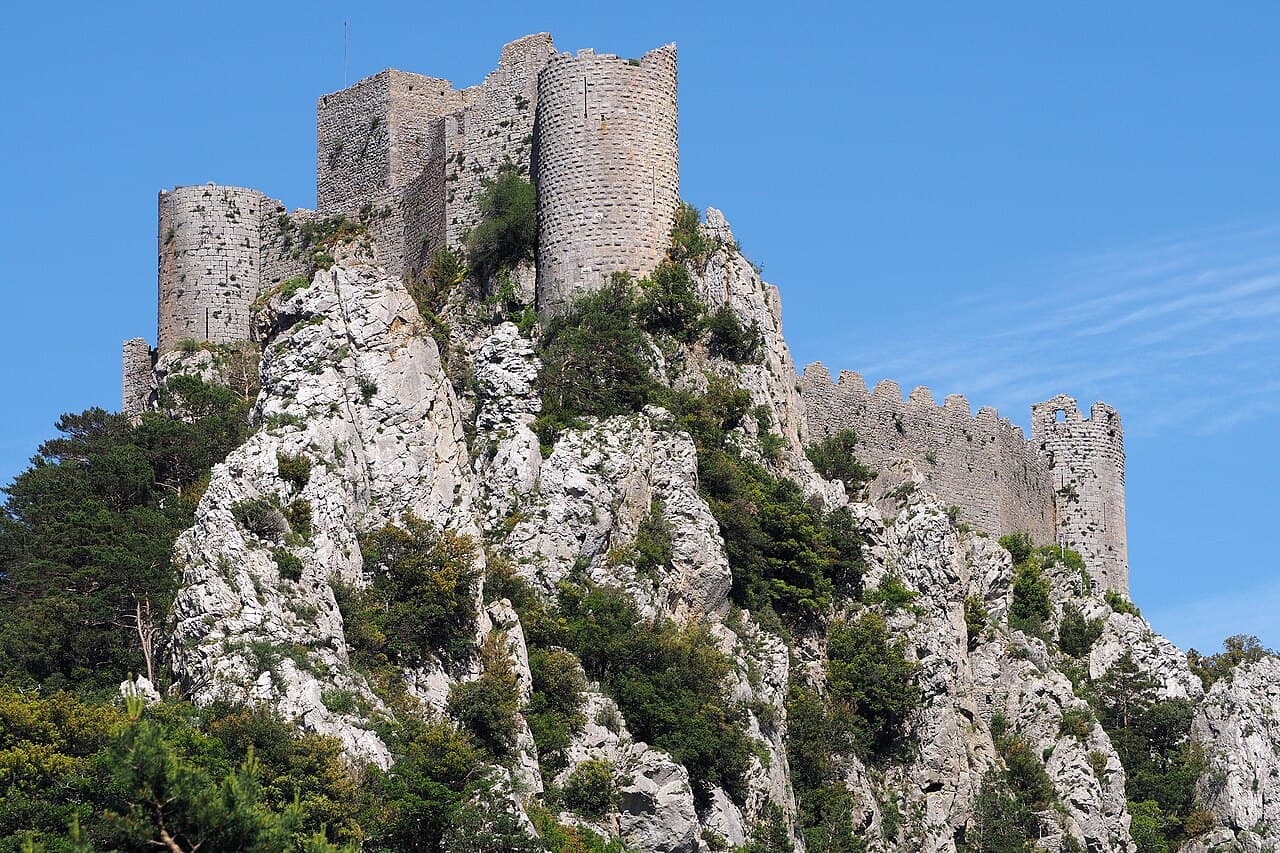
Château de Puilaurens — France castle

Château de Puilaurens

Château de Puilaurens: historic Cathar hill castle in France
Lapradelle-Puilaurens, Occitanie, France
High Medieval (11th–13th c.)
Restored

Château de Puilaurens stands as a remarkable example of a medieval hill castle with deep historical roots tied to the Cathar wars and the turbulent history of southern France. Perched on a rocky spur above the Boulzane Valley and the villages of Lapradelle and Puilaurens, this fortress commands sweeping views of the surrounding landscape, emphasizing its strategic importance since the High Medieval period.

The castle's origins trace back to a fortified site mentioned as early as 958, when King Lothair confirmed a donation including the valley and referenced a fortified church dedicated to Saint-Laurent on Mont Ardu. This early mention suggests the location served as a defensive refuge during the Carolingian era, providing protection to local inhabitants. The castle as it is known today began to take shape in the early 13th century, with the first recorded castellan, Pierre Catala, documented in 1217.

Historical significance and cathar connections

Château de Puilaurens is famously one of the so-called Cathar castles, a group of fortresses associated with the Cathar religious movement and the Albigensian Crusade. The castle was initially under the control of the Abbey of Saint-Michel de Cuxa before becoming Aragonese property in 1162, which placed it outside the immediate reach of the Crusaders during the Cathar wars. This location allowed it to serve as a refuge for Cathars and faidits—nobles dispossessed for opposing the Crusaders, including notable figures like Guillaume de Peyrepertuse.

Throughout the early 13th century, the fortress was a stronghold resisting Catholic forces. It was defended by Pierre Catala and later by his son Roger Catala, as well as by Cathar military commander Chabert de Barbaira, who was the last defender of the Occitan cause. The castle sheltered Cathar deacons and "perfects"—fully initiated members of the Cathar faith—after the fall of Montségur, the last major Cathar stronghold. It is believed that Puilaurens finally surrendered around 1255, likely contemporaneous with the fall of Queribus.

Transition to french royal control and military role

By the mid-13th century, Puilaurens Castle was ceded to the French crown, with its possession ratified by the Treaty of Corbeil in 1258, which moved the Aragonese border southwards. King Louis IX recognized the castle's strategic value and ordered renovations around 1255 to reinforce the southern frontier against Aragonese incursions. These improvements shaped much of the castle's current layout.

In 1260, the castle was garrisoned by 25 sergeants under the command of Odon de Monteuil, marking it as the largest royal garrison on France's southern border at the time. Records from 1263 detail the delivery of provisions and armaments, including crossbows, bolts, shields, and helmets, highlighting the castle's military preparedness. Further fortifications were added during the reign of Philip III (1270–1285) to adapt to evolving military technologies.

Puilaurens formed part of the defensive network known as the "Five Sons of Carcassonne," a series of fortresses strategically placed on steep rocky peaks to guard the frontier. Despite several attacks and two sieges by Aragonese forces, the castle remained unconquered until 1636, when Spanish troops briefly seized it amid the Franco-Spanish conflicts.

Architectural features and fortifications

The castle exemplifies a medieval mountain fortress with a layout adapted to the rugged terrain. Its fortifications consist of a lower bailey and an upper citadel, enclosed by thick curtain walls that follow the natural contours of the rocky ridge stretching west to east. The walls rise to heights of 8 to 10 meters, punctuated by semicircular towers at each end providing commanding views and defensive positions.

Access was originally via a ramp on the southwest side, built into a fissure in the rock and protected by multiple independent fortifications and towers. Post-14th-century adaptations for firearms included the construction of a barbican, an additional fortified gateway guarding the main entrance. Today, visitors reach the citadel by a modern pedestrian bridge that replaces the original removable wooden ramp and drawbridge.

Within the inner courtyard, measuring approximately 60 by 25 meters, lie remnants of the castellan’s quarters housed in a quadrangular tower featuring a fireplace and wooden furnishings, likely dating from the 16th century. The castle also contains a cistern carved into the rock for water storage, accessed by a partially underground passage defended by narrow arrow slits. A smaller postern gate overlooks an external cistern, highlighting the importance of water management in the fortress's design.

The western section preserves the notable White Lady's Tower, a round tower linked by local tradition to Blanche de Bourbon, niece of King Philip IV of France. Architecturally, this tower features ribbed vaulted ceilings supported by prism-shaped corbels and a cruciform arch, with a vertical conduit enabling communication between floors.

The castle's battlements and curtain walls remain largely intact, with crenellations providing defensive cover. Latrines and cisterns within the upper enclosure reflect the functional needs of the garrison. A narrow gallery carved into the rock near the northern tower may have served as storage or food preservation space. Additionally, a network of underground passages connects the main keep to the riverbed below, believed to date from the Cathar period and possibly used for secure movement or religious purposes.

Decline and preservation

Following its capture by Spanish troops in 1636, Puilaurens Castle lost military significance after the Treaty of the Pyrenees in 1659 fixed the border further south along the Pyrenees crest. The fortress was gradually abandoned, with only a small garrison remaining until the French Revolution. Subsequently, the castle fell into ruin.

Today, Puilaurens is recognized for its cultural and historical importance as one of the Cathar castles and is listed as a monument historique by the French Ministry of Culture since 1902. Its restoration has preserved much of the structure, allowing visitors to explore its dramatic setting and appreciate its architectural and historical significance.

Visitor experience and access

The castle is accessible via a path from the nearby town of Axat, inviting visitors to traverse the steep terrain to reach the fortress perched nearly 700 meters above sea level. The site offers panoramic views of the Fenouillèdes region and the Boulzane valley, including distant landmarks such as the Pic de Bugarach.

Exploring the castle provides insight into medieval military architecture adapted to mountainous landscapes, the history of the Cathar movement, and the shifting political borders of medieval France and Aragon. The preserved towers, walls, and underground galleries create a vivid impression of the fortress's defensive capabilities and its role in regional history.

Frequently asked questions (FAQ)

How do I get to Château de Puilaurens?
Château de Puilaurens is located in Lapradelle-Puilaurens, France, approximately 30 kilometers southwest of Carcassonne. Visitors can reach the castle by car, and there is parking available nearby. Public transport options may be limited, so driving is recommended for convenience.
What is the historical significance of Château de Puilaurens?
Château de Puilaurens is a prominent example of a medieval castle built in the 13th century, primarily serving as a Cathar stronghold during the Albigensian Crusade. It played a crucial role in the defense against French royal forces and is a vital part of the region's history. The castle is recognized for its connection to the Cathar movement and its strategic location overlooking the surrounding landscape.
When was Château de Puilaurens built?
Construction of Château de Puilaurens began in the early 13th century, around 1255, as part of the fortifications against the Cathar heresy. It was completed in stages over the following decades, reflecting the architectural styles of the time. The castle has withstood various sieges and remains a testament to medieval military architecture.
Can I take guided tours of Château de Puilaurens?
Yes, guided tours are available at Château de Puilaurens, providing visitors with in-depth information about its history and architecture. These tours are typically led by knowledgeable guides who can share fascinating stories and insights. It is advisable to check the schedule in advance, as tour availability may vary.
Why is Château de Puilaurens a popular tourist destination?
Château de Puilaurens attracts visitors due to its stunning panoramic views of the surrounding countryside and its rich historical context. The castle's dramatic ruins and well-preserved architecture offer a glimpse into the medieval past, making it a favorite for history enthusiasts and photographers alike. Additionally, its location in the beautiful Corbières region enhances the overall visitor experience.
Is it possible to visit Château de Puilaurens in winter?
Yes, Château de Puilaurens is open for visits during the winter months, though opening hours may be limited compared to the summer season. Visitors should check the official website for specific winter hours and any seasonal events. The winter landscape can provide a unique and serene atmosphere for exploring the castle.
What are the ticket prices for Château de Puilaurens?
Ticket prices for Château de Puilaurens are generally affordable, with discounts available for children and students. As prices may vary, it is best to check the official website for the most up-to-date information. Group rates may also be offered, making it a great option for educational visits.
What are the opening hours of Château de Puilaurens?
Château de Puilaurens typically opens to visitors from 10 AM to 6 PM during the summer months, with shorter hours in the winter. It's recommended to check the castle's official website for the most accurate and current opening hours. Seasonal variations may apply, so planning ahead is advisable.
Are there any nearby attractions to Château de Puilaurens?
Yes, visitors to Château de Puilaurens can explore several nearby attractions, including the beautiful village of Lagrasse and the stunning landscapes of the Corbières region. The picturesque town of Carcassonne, known for its medieval fortress, is also just a short drive away. These sites offer additional historical and cultural experiences to enhance your visit.

Photo gallery

Château de Puilaurens
Click to view

Photo by BlueBreezeWiki•CC BY-SA 3.0

1 photo • Click any image to view in full screen

Information

Hill Castle

Sources & official resources

Verify the information above using these authoritative references.

Loading map...

Visitor reviews

No reviews yet. Been here? Write the first review and help other travelers!

Write the first review

Visited this castle? Share your experience

Your review helps other travelers and adds first-hand knowledge to our encyclopedia.

Write a review

(5/5)

0/2000 characters

Your review will be visible after admin approval

Nearby castles

6.7 km

Château Vicomtal Saint-Pierre

Fenouillet, France

The Château Vicomtal Saint-Pierre de Fenouillet is a significant ruined castle dating from the 11th century, located in the commune of Fenouillet in southern France. This High Medieval fortress played a notable role in the complex political and religious conflicts of the region, especially during the era of the Cathar movement and the Albigensian Crusade. Historical context and Cathar connections In the 12th century, the castle was under the control of Bertrand de Saissac, the Viscount of Fenouillet, who was a prominent vassal of the Viscount of Carcassonne. Bertrand is historically recognized for his Cathar beliefs and opposition to the Catholic Church, which was a defining feature of the religious tensions in the Languedoc region during that period. It is believed that the earliest Cathar preachers arrived in Fenouillet around this time, establishing the castle as a center of Cathar influence. At the dawn of the 13th century, the surrounding territories of Toulouse, Foix, and Carcassonne became focal points of the crusade against the Cathars. Although Fenouillet itself was not a direct battlefield, it was deeply affected by the ensuing political and territorial upheavals. Bertrand de Saissac, aligned with the Trencavel family who were the Viscounts of Carcassonne, actively resisted the Albigensian Crusaders, placing the castle within the broader narrative of the Cathar wars. Political changes and royal control Following the Treaty of Corbeil in 1258, Fenouillet became a border region under the authority of the Viguiers appointed by the Kings of France. This transition marked a shift from local viscountal control to direct royal oversight. The nearby Castel Fizel was first mentioned in 1260, and records indicate that by 1262, the King of France had granted the castle as a fief to loyal vassals. By 1272, Fenouillet was officially recognized as a royal fortress, and the adjacent castle of Sabarda received similar status by 1290. This period marks the gradual decline of the Château Vicomtal Saint-Pierre as a primary military site. Architectural features and military significance The castle was strategically built on a broad promontory, which offered natural defensive advantages. However, this location also posed challenges for defense, as the extensive perimeter required a sizable garrison to maintain effective control. The castle's keep, curtain walls, and gate structures were typical of High Medieval fortifications, designed to withstand sieges and serve as a stronghold for the viscounts. During the 13th and 14th centuries, the castle was deliberately dismantled as part of a strategic military decision. A notable feature from this period is a ramp constructed against the keep's door, likely intended to facilitate the demolition process. This dismantling coincided with the transfer of military focus to the smaller, more manageable castle of Sabarda nearby. Reasons for abandonment The abandonment of Château Vicomtal Saint-Pierre as the main defensive site can be attributed to its large size and the limited manpower available for its defense. The royal garrisons assigned to the border were relatively small, making it impractical to defend such an extensive fortress without local support from the surrounding population of Castrum. Consequently, it was more feasible to modernize and strengthen the smaller castle of Sabarda, which could be more effectively managed and defended. Legacy and current condition Today, the Château Vicomtal Saint-Pierre remains a ruined castle, with visible remnants that reflect its medieval origins and turbulent history. Its ruins offer valuable insights into the architectural and military strategies of the High Medieval period in the Languedoc region. The site is a point of interest for historians and visitors intrigued by the Cathar heritage and the complex feudal dynamics of southern France during the Middle Ages. Despite its ruined state, the castle's location and remaining structures continue to evoke the historical significance of Fenouillet as a frontier zone during a time of religious and political conflict. The castle's story is intertwined with the broader narrative of the Cathar crusades, royal consolidation of power, and the evolution of medieval fortifications in France.

High Medieval (11th–13th c.)
Details
6.7 km

Château Vicomtal Saint-Pierre de Fenouillet

, France

The Château Vicomtal Saint-Pierre de Fenouillet is a notable medieval fortress situated in the commune of Fenouillet, within the Pyrénées-Orientales department of southern France. Constructed in the 11th century by the viscounts of Fenouillèdes, this hill castle was strategically positioned on a hillside overlooking key communication routes. Its location allowed the viscounts to exert control over the surrounding territory, serving both defensive and administrative functions during the High Medieval period. The historical significance of Château Vicomtal Saint-Pierre de Fenouillet As a seat of local power, the castle was part of a larger fortified settlement or castrum, which consolidated the viscounts' authority in the region. The castle's role extended beyond military defense to include governance and management of the surrounding lands. The viscount of Fenouillèdes, a feudal lord, oversaw the castle and its domain, reflecting the feudal structure prevalent in medieval France. In the early 12th century, the construction of the nearby Château de Sabarda facing the Château Vicomtal Saint-Pierre de Fenouillet highlights the continued military and political importance of this area. This proximity of fortifications suggests a network of defensive sites controlling strategic routes and territories in the Pyrénées-Orientales. Alongside the Château de Sabarda and Castel Fizel, the castle formed part of a cluster of medieval fortresses that underscored the region's feudal complexity and the need for territorial defense. Through the centuries, the castle adapted to changing political and social circumstances but retained its significance within the feudal landscape. Although specific records of battles or sieges at the castle are scarce, its enduring presence indicates its role as a local stronghold and administrative center. In recognition of its historical and cultural value, the castle and its associated castral settlement were officially listed as a historic monument on October 27, 2015. Since 2000, ongoing archaeological excavations have revealed multiple layers of the site’s development, shedding light on medieval construction techniques and the daily life of its inhabitants. The castle is currently owned and managed by the local commune, ensuring its preservation and continued study. Architectural features and layout The ruins of the Château Vicomtal Saint-Pierre de Fenouillet are located on a hillside, with a distinctive terraced construction that follows the natural slope of the terrain. This stepped design provided both structural stability and a tactical advantage, enabling defenders to monitor the surrounding landscape effectively. Remnants of the castle include sections of the outer defensive walls that once enclosed the complex, offering protection against invaders. These walls delineate the perimeter of the fortress and reflect typical medieval military architecture aimed at fortifying vulnerable points. Within the enclosure, archaeological remains reveal traces of various interior buildings, indicating the castle's functional diversity. One of the most significant surviving features is a vaulted cellar, constructed using curved stonework typical of medieval masonry. This cellar likely served as a storage space for food, supplies, or valuables, essential for sustaining the castle's occupants during sieges or long periods of isolation. A prominent element of the site is the remains of an 11th-century Romanesque church dedicated to Saint-Pierre. This ecclesiastical structure, characterized by its rounded arches and solid masonry, underscores the religious dimension of the castle complex. The church's presence within the enclosure highlights the integration of spiritual life with military and administrative functions in medieval fortifications. The castle's religious and cultural role The Romanesque church of Saint-Pierre within the castle grounds is a testament to the castle's dual role as both a military fortress and a center of religious activity. Romanesque architecture, prevalent in the 11th century, is distinguished by its massive quality, thick walls, and semicircular arches, all of which are evident in the church's remains. This church would have served the spiritual needs of the castle's inhabitants and the surrounding community, playing a key role in the social fabric of the feudal era. Religious structures within castles were common, reflecting the intertwined nature of faith and governance during the Middle Ages. The church at Château Vicomtal Saint-Pierre de Fenouillet also symbolizes the viscounts' patronage and their role in promoting ecclesiastical presence in their domain. Archaeological research and preservation efforts Since the year 2000, systematic archaeological excavations have been conducted at the site, uncovering a wealth of information about the castle's construction phases, architectural evolution, and daily life of its medieval occupants. These investigations have revealed the complexity of the castral settlement, including its defensive structures, domestic buildings, and religious facilities. The archaeological work has been instrumental in documenting the castle's historical layers, from its initial 11th-century foundations to later modifications. Preservation of the ruins is overseen by the local commune, which is committed to maintaining the site's integrity and facilitating public access for educational and cultural purposes. The castle's designation as a historic monument in 2015 further supports conservation initiatives, ensuring that this important heritage site receives the attention and protection it merits. Visitors to the site can appreciate the scenic views offered by its hillside location, as well as the tangible connection to the medieval past embodied in its remaining structures. Context within the region's medieval fortifications The Château Vicomtal Saint-Pierre de Fenouillet is part of a broader network of medieval fortifications in the Pyrénées-Orientales region. Alongside the ruins of Château de Sabarda and Castel Fizel, it forms a cluster of castles that historically guarded strategic routes and controlled territorial boundaries. This concentration of castles reflects the feudal fragmentation and the need for local lords to defend their holdings against rivals and external threats. The proximity of these sites illustrates the military and political dynamics of the region during the Middle Ages, where power was exercised through the construction and maintenance of fortified strongholds. Today, these ruins collectively contribute to the understanding of medieval life and defense systems in southern France, offering insights into the architectural styles, construction methods, and historical developments of the era.

High Medieval (11th–13th c.)
Details
8.6 km

Château du Bezu

Le Bézu, France

Château du Bézu, also known as Les Tiplies, is a ruined medieval castle perched on a hilltop near the small village of Le Bézu in southern France. This castle is historically significant as a Cathar stronghold during the turbulent period of the Albigensian Crusade in the early 13th century. Although local legend associates it with the Knights Templar and claims it was a refuge for Templar treasure following their persecution by King Philip IV of France in 1307, there is no substantial evidence to support this connection. Instead, the castle's origins and primary historical role are closely tied to the Cathar heresy and the military conflicts of the High Medieval period. Historical context and significance The Château du Bézu was constructed in the 11th century, placing it firmly within the High Medieval era, a time marked by the rise of feudalism and frequent regional conflicts in southern France. It served as a defensive fortress for the Cathars, a religious group considered heretical by the Catholic Church. The castle's strategic location on a hilltop provided commanding views of the surrounding landscape, which was crucial for surveillance and defense during the Albigensian Crusade (1209–1229), a brutal campaign launched by the Catholic Church to eradicate Catharism in the Languedoc region. Architecture and structural features Though now in ruins, Château du Bézu originally featured typical elements of a hill castle designed for defense and control. Its elevated position on rocky terrain exemplifies the hill castle type, maximizing natural defensive advantages. The remains suggest a compact fortress with thick stone walls, remnants of defensive towers, and possibly a keep or donjon that would have served as the last refuge during sieges. The castle's construction utilized local stone, blending into the rugged landscape, which helped conceal it from enemies. Defensive design The castle's fortifications likely included battlements and arrow slits to allow defenders to repel attackers efficiently. Its hilltop location made direct assault difficult, forcing besieging forces to contend with steep approaches and limited access points. While detailed architectural plans are scarce due to the ruinous state, the surviving structures and the site's topography indicate a strong emphasis on defense rather than residential comfort. Legends and cultural heritage Local folklore enriches the castle's mystique, with tales of hauntings and supernatural phenomena. One particularly enduring legend speaks of a silver bell that rings at midnight on the anniversary of the Templars' arrest in 1307. This story, while unverified, reflects the castle's place in popular imagination as a site of mystery and historical intrigue. The association with the Templars, despite lacking documentary proof, adds to the castle's allure for visitors and researchers interested in medieval history and esoteric traditions. Current status and visiting information Today, Château du Bézu stands as a ruined fortress accessible to the public. Visitors can explore the remnants of its walls and towers while enjoying panoramic views of the surrounding countryside. The site is valued both for its historical importance and its scenic setting. Preservation efforts focus on maintaining the ruins and ensuring safe access for tourists. The castle's evocative atmosphere, combined with its rich history, makes it a compelling destination for those interested in medieval architecture and the Cathar legacy.

High Medieval (11th–13th c.)
Details

