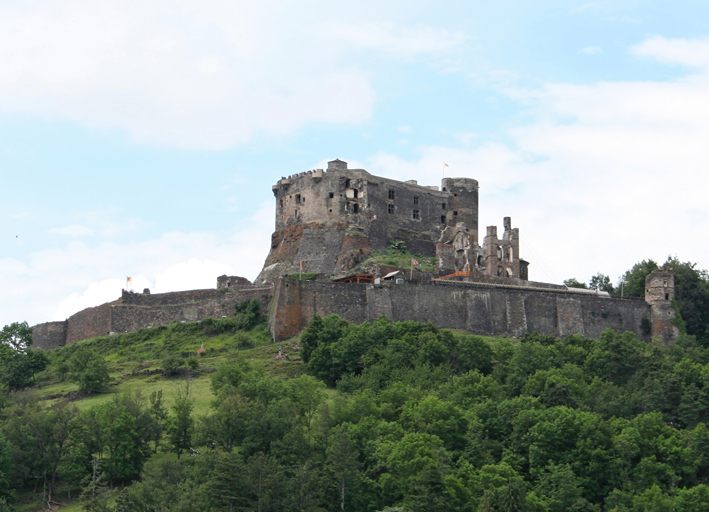
Château d’Opme
The Château d’Opme stands as a remarkable example of a medieval hill castle that has evolved through centuries of French history, combining military architecture with Renaissance elegance. Located in Romagnat, within the historic region of Auvergne in central France, this castle was originally constructed at the end of the 11th century to control a vital mountain pass along an ancient Gallo-Roman road connecting Clermont-Ferrand to Le Puy-en-Velay. Its strategic position allowed the castle to oversee important communication and trade routes, making it a key stronghold in the region.
Medieval origins and strategic importance
Initially, the Château d’Opme was built by medieval builders as a fortress to defend the mountain pass and the surrounding territory. It was part of the holdings of the Counts of Auvergne before passing into the hands of the Dauphins of Auvergne. The castle’s military function was paramount during the High and Late Middle Ages, serving as a defensive bastion against rival lords and external threats.
During the 13th century, the castle underwent significant fortification improvements. One of its original corner towers was replaced by a taller, square keep, reflecting the changing demands of medieval warfare and the need for enhanced surveillance and defense. This keep was crenellated and designed to provide a commanding view of the surrounding landscape, reinforcing the castle’s role as a military stronghold.
Conflicts and military history
The Château d’Opme was a contested site during the Hundred Years’ War, a prolonged conflict between England and France from the 14th to 15th centuries. In 1381, English forces captured the castle, demonstrating its strategic value. However, it was retaken by French troops in 1393 under the leadership of prominent military commanders Jean II Le Meingre (Boucicaut) and Louis de Sancerre. This episode underscores the castle’s continued military significance during this turbulent period of French history.
Renaissance transformation under an influential owner
The early 17th century marked a turning point for the Château d’Opme when it was acquired by Antoine de Ribeyre, Treasurer of France under King Louis XIII, in 1612. Ribeyre transformed the fortress into a refined residence, indicative of the shift in castle use from purely military to domestic and ceremonial purposes during the Renaissance.
His renovations included the addition of a ceremonial entrance, a grand interior staircase, and large mullioned windows that brought natural light into the living spaces, enhancing comfort and aesthetic appeal. Ribeyre also developed two terraced gardens that remain a highlight of the château today. The upper terrace features a French formal garden divided into four lawn sections surrounding a large circular basin and fountain, while the lower terrace includes a kitchen and flower garden centered on a Renaissance fountain attributed to the renowned architect Jean Androuet du Cerceau, dating from 1617.
The gardens and landscape architecture
The gardens of the Château d’Opme are a testament to early 17th-century landscape design. They are arranged on terraces overlooking a valley, connected by a distinctive double-spiral stone staircase that links the upper and lower gardens. The presence of an alley of linden trees, some over 300 years old, adds to the historic atmosphere of the grounds.
These gardens have received official recognition, including classification in 1969 and the Jardin remarquable label in 2004, highlighting their cultural and horticultural significance. The château’s farm and reservoir were also registered as historic sites in 2010, preserving the broader estate’s heritage.
Role during world war ii and modern heritage preservation
In the 20th century, the Château d’Opme gained renewed historical importance during World War II. From 1940 to 1941, it served as a base for General Jean de Lattre de Tassigny, who established a training school for officers of the Free French forces. This role connected the château to the modern history of France’s resistance and liberation efforts, adding a layer of 20th-century military heritage to the site.
Recognized as a historic monument since 1916, the château has been carefully preserved to maintain its architectural and historical integrity. Since 1993, a museum dedicated to General de Lattre de Tassigny operates within the château’s inner courtyard, offering visitors insights into both the castle’s medieval past and its 20th-century significance.
Architectural features and current condition
The Château d’Opme is built around an interior courtyard and originally included five towers, of which three remain today. The castle’s layout is characteristic of medieval military architecture, with thick stone walls and defensive features such as battlements and crenellations.
The square keep added in the 13th century is the tallest structure, designed for defense and surveillance. The 17th-century renovations introduced residential elements, including wide mullioned windows and a grand interior staircase, marking a clear transition from fortress to elegant home. These features reflect the changing role of castles in early modern France.
The château’s terraces overlook a valley, with the gardens and landscape features enhancing the site’s aesthetic and historic value. The double-spiral staircase connecting the terraces is a distinctive architectural element, demonstrating the blend of functional and decorative design.
Today, the château and its gardens are well preserved, maintaining their historic layout and ornamental features. The combination of medieval fortifications and Renaissance residential enhancements offers visitors a comprehensive view of the castle’s long history of adaptation and use.
Visitor experience and cultural significance
Visitors to the Château d’Opme can explore the castle’s medieval structures alongside its Renaissance gardens and learn about its varied roles through French history. The museum dedicated to General de Lattre de Tassigny provides a unique perspective on the château’s 20th-century military importance.
The site’s designation as a historic monument and its gardens’ recognition as Jardin remarquable underscore its cultural heritage value. The château remains a significant landmark in the Auvergne region, attracting those interested in medieval architecture, Renaissance art, and French military history.
Information
Website
Visit websiteSources & official resources
Verify the information above using these authoritative references.
Loading map...
Visitor reviews
No reviews yet. Been here? Write the first review and help other travelers!
Write the first reviewVisited this castle? Share your experience
Your review helps other travelers and adds first-hand knowledge to our encyclopedia.