
Murol Castle
Murol Castle, also known as Château de Murol, is a remarkable hill castle located above the village of Murol in the Puy-de-Dôme department within the Auvergne-Rhône-Alpes region of France. This castle stands prominently on a volcanic basalt outcrop, commanding strategic views over the surrounding landscape including the Couze Valley, Lake Chambon, and the distant Monts Dore volcanic range. Its position atop this natural rock formation was chosen to control important regional crossroads dating back to Roman times, underscoring its enduring military and administrative significance.
The origins of Murol Castle trace back to the 12th century, with the earliest fortifications established to oversee three vital routes connecting Limagne, Le Mont-Dore, and Clermont-Ferrand. Over the centuries, the castle evolved from a medieval fortress into a complex residence with architectural elements spanning from the Romanesque through the Renaissance and later neo-Gothic influences. The castle's layered history is reflected in its diverse structures, including a large circular keep (donjon), two chapels, fortified curtain walls with almond-shaped bastions, and a Renaissance pavilion with a hanging garden.
Early history and medieval fortifications
Archaeological evidence suggests human activity on the basalt promontory since the Neolithic era, highlighting the site's long-standing strategic importance. The first documented castle construction likely began in the 12th century, with defensive walls and a small settlement forming the initial stronghold. The castle was initially built in the Romanesque style, as seen in the stone masonry and vaulted chapels dating from the 11th to 13th centuries.
In the late 14th century, Guillaume II de Murol (also known as Guillaume de Sam) played a pivotal role in strengthening the castle's defenses. He constructed the imposing circular keep, a second chapel, and expanded the eastern buildings. These additions enhanced both the military capability and the residential comfort of the fortress. The keep served as the last refuge during sieges and symbolized the lord's authority over the region.
Religious significance and chapels
The castle complex includes two chapels: an older one from the 11th or 12th century and a funerary chapel built by Guillaume II de Murol at the end of the 14th century. These chapels feature Romanesque architectural elements such as rounded arches, thick walls, and stone vaulting. Murals discovered in the chapel date from the 13th to 15th centuries, illustrating the site's religious importance and the integration of spiritual life within the castle walls.
Renaissance transformations and later history
Ownership of Murol Castle passed to the prominent d’Estaing family in the 15th century through the marriage of Jehanne de Murol to Gaspard d’Estaing. This transition marked a new phase of architectural and functional development. During the 16th century, under the direction of François I d’Estaing, the castle underwent significant modernization to adapt to evolving military technologies and residential needs.
François I d’Estaing initiated the construction of a vast bastioned curtain wall featuring almond-shaped towers designed to mount light artillery, reflecting the introduction of gunpowder weaponry in castle defenses. He also began building a Renaissance pavilion at the foot of the basalt outcrop, which included a large hanging garden. Although this pavilion was never completed, its remaining facade showcases decorative moldings and pilasters characteristic of Renaissance architecture.
During the turbulent French Wars of Religion in the late 16th century, Murol Castle endured several sieges by Catholic League forces but remained unconquered. Unlike many other fortresses, it was spared destruction during Cardinal Richelieu's disarmament campaigns in the 17th century, likely due to the d’Estaing family's influence at the royal court.
Decline and restoration
Following its military and residential peak, Murol Castle gradually lost its strategic importance and fell into disuse. By the late 18th century, during the French Revolution, the castle was repurposed as a prison and later became a hideout for bandits. In the 19th century, it suffered further degradation as locals quarried its stones for other building projects.
The castle was declared a historical monument in 1889, which helped safeguard its remains. Although ownership transferred to the local commune, the castle remained partially in ruins until the late 19th century when architect Louis Bruyère, a student of Viollet-le-Duc, undertook an extensive restoration. This restoration introduced neo-Gothic architectural elements, including pointed roofs on towers, reworked battlements, and a grand entrance with a drawbridge and round tower. Decorative gargoyles were added, blending historical styles with Romantic revival aesthetics.
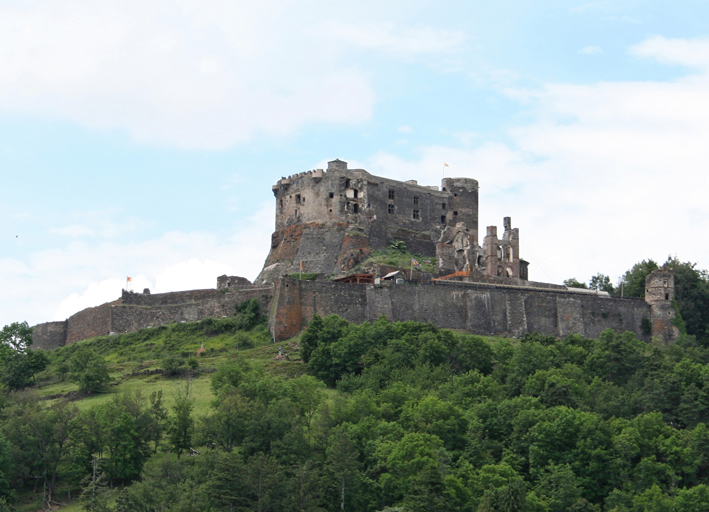
Photo by Pascal Godat • CC BY-SA 3.0
Architectural features and layout
Murol Castle's layout is strongly influenced by the natural basalt rock outcrop on which it stands, resulting in a polygonal inner enclosure with walls approximately 10 meters high. The castle is composed of several distinct zones:
- The inner ward contains the large circular keep, two chapels, and residential buildings connected by curtain walls.
- The outer courtyard houses the Renaissance pavilion and remnants of auxiliary structures such as a kitchen and bakery, complete with large chimneys and ovens essential for sustaining the castle's inhabitants.
- The bastioned curtain wall surrounds the base of the basalt outcrop, featuring almond-shaped towers designed for artillery defense.
Access to the inner ward is gained through a fortified gate adorned with the coats of arms of the Murol and d’Estaing families, symbolizing the castle's lineage. Spiral staircases allow visitors to ascend to the ramparts and the top of the keep, offering panoramic views of the surrounding volcanic landscape.
Cultural significance and modern use
Murol Castle holds a significant place in French cultural heritage. It has inspired literary figures such as Guy de Maupassant, who described the castle's imposing ruins in his 1883 short story "Humble drame," and George Sand, who featured it in her 1859 novel "Jean de la Roche." These works highlight the castle's evocative presence and its role as a symbol of medieval grandeur and romantic decay.
Today, Murol Castle is owned by the local commune and has been developed as a tourist destination. Although privately owned and not open to the public for interior visits, the castle hosts guided tours and cultural events that recreate medieval life, including martial arts demonstrations and son et lumière shows. Its well-preserved fortifications and dramatic setting continue to attract visitors interested in medieval architecture, military history, and the scenic beauty of the Auvergne region.
Murol Castle exemplifies the evolution of a medieval fortress adapting to changing military technologies and residential needs over centuries. Its combination of Romanesque chapels, medieval keeps, Renaissance pavilions, and neo-Gothic restorations offers a unique architectural palimpsest that tells the story of French history from the Middle Ages through the modern era.
Frequently asked questions (FAQ)
- How do I get to Murol Castle?
- Murol Castle is located in the Auvergne region of France, easily accessible by car or public transport. The nearest major city is Clermont-Ferrand, which is about 35 kilometers away. Buses and local train services can help you reach the castle from nearby towns.
- What is the historical significance of Murol Castle?
- Murol Castle, built in the 12th century, played a vital role in the military defense of the region during the Middle Ages. It was strategically positioned to oversee trade routes and protect against invasions. Today, it stands as a remarkable example of medieval architecture and a testament to the region's rich history.
- When was Murol Castle built?
- Construction of Murol Castle began in the late 12th century and continued into the 13th century. Its design evolved over the years to adapt to changing military needs and architectural styles. The castle has been preserved and restored, allowing visitors to step back in time and experience its medieval grandeur.
- Can I take photographs inside Murol Castle?
- Yes, visitors are welcome to take photographs throughout Murol Castle, both inside and outside. Capturing the stunning views and intricate details of the architecture is encouraged. However, please be respectful of other visitors and avoid using flash in certain areas.
- Why is Murol Castle a popular tourist destination?
- Murol Castle attracts visitors for its stunning vistas, rich history, and impressive architecture. The castle hosts various events and reenactments that bring its history to life, making it an engaging experience for all ages. Its picturesque setting amidst the volcanic landscapes of the Auvergne adds to its charm.
- Is it possible to access Murol Castle with a wheelchair?
- While Murol Castle strives to accommodate all visitors, some areas may be challenging to navigate for those using wheelchairs due to the castle's historic structure and uneven terrain. It is recommended to contact the castle staff in advance to inquire about accessibility options and available facilities.
- What are the opening hours of Murol Castle?
- Murol Castle is typically open to visitors from April to November, with varying hours based on the season. During the peak summer months, the castle often opens earlier and closes later to accommodate tourists. Check the official website for the most current hours before planning your visit.
- What are the ticket prices for Murol Castle?
- Ticket prices for Murol Castle vary depending on age and group size, with discounts available for children and families. An average adult ticket costs around €8, while children under a certain age may enter for free or at a reduced rate. It’s advisable to check online for any special promotions or guided tour packages.
- What are some nearby attractions to Murol Castle?
- In addition to Murol Castle, visitors can explore the beautiful Monts Dore region, which offers hiking trails, lakes, and stunning natural scenery. The charming village of Murol itself has quaint shops and restaurants to enjoy. Nearby, the volcanic landscapes of the Parc Naturel Régional des Volcans d'Auvergne provide further outdoor activities and exploration opportunities.
Photo gallery

Information
Website
Visit websiteSources & official resources
Verify the information above using these authoritative references.
Loading map...
Visitor reviews
No reviews yet. Been here? Write the first review and help other travelers!
Write the first reviewVisited this castle? Share your experience
Your review helps other travelers and adds first-hand knowledge to our encyclopedia.