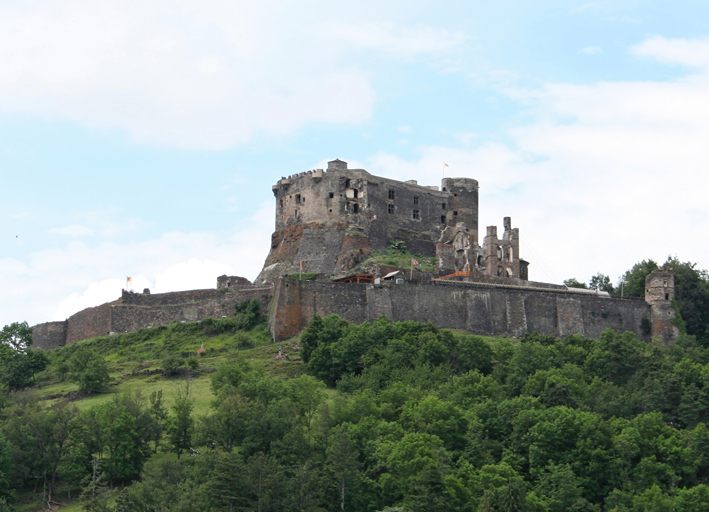
Château de Montrognon
The Château de Montrognon stands as a remarkable example of medieval fortification in the Hauts-de-France region of France. Constructed in the late 12th century by Robert I of the Montrognon de Salvert family, this hill castle was strategically positioned on a volcanic hill, or puy, rising to 699 meters above sea level. Its location offered commanding views of the surrounding landscape, a crucial defensive advantage during the turbulent Middle Ages. The castle's history is deeply intertwined with the noble lineage of the Montrognon family, who were vassals and relatives of the dauphins of Auvergne, linking the castle to the broader feudal network of the region.
Medieval origins and feudal significance
The Château de Montrognon was more than just a military fortress; it served as the administrative center of the seigneurie held by the Montrognon de Salvert family. The castle's construction in the late 12th century reflects the architectural and defensive needs of the period, characterized by robust stone walls and a prominent circular donjon. This donjon, dating from the castle's initial phase, featured three vaulted floors, each designed for specific functions such as storage, living quarters, and defense. The vaulted ceilings not only provided structural strength but also fire resistance, an essential feature for medieval keeps.
During the 13th and early 14th centuries, a small village developed at the foot of the castle's donjon. This settlement housed people likely under the lordship of the castle's owners, illustrating the castle's role as a local power hub. However, the village's existence was precarious, as it succumbed to a combination of hardships including plague outbreaks and raids by routiers, mercenary bands prevalent in the late medieval period. By the late 14th century, these adversities led to the village's abandonment, reflecting the broader social and military instability of the time.
Architectural features and defensive structures
The castle's defensive design was typical of hill castles of the era. It was enclosed by a trapezoidal fortified enceinte, surrounded by a deep ditch that enhanced its protection against attackers. The walls were reinforced with semi-engaged turrets, small towers partially embedded into the curtain walls, providing flanking fire and observation points. These turrets were topped with battlements, crenellated parapets allowing defenders to shield themselves while firing arrows or other projectiles.
Access to the castle was controlled through a western gate, defended by a drawbridge spanning the ditch. This mechanism allowed defenders to isolate the castle during sieges effectively. Inside the enceinte, buildings were arranged around a central courtyard, which included a cistern for collecting and storing rainwater, a vital resource during prolonged attacks or sieges. These structures supported the daily life of the castle's inhabitants and the operational needs of the fortress.
The circular donjon
The most prominent surviving feature of the Château de Montrognon is its circular donjon, a distinctive architectural element dating back to the castle's original construction phase. The tower's circular shape was advantageous in deflecting projectiles and minimizing blind spots for defenders. Its three vaulted floors provided secure and fireproof chambers, while the top platform served as a lookout point, offering extensive views over the surrounding countryside. This donjon exemplifies the military architectural innovations of the late 12th century, combining functionality with imposing presence.
Decline and destruction in the early modern period
The castle's fortunes declined significantly in the 17th century. In 1633, as part of Cardinal Richelieu's efforts to consolidate royal power and diminish the influence of feudal lords, the Château de Montrognon was deliberately dismantled and partially destroyed. This campaign targeted many noble strongholds to prevent uprisings and reinforce centralized authority in France.
Subsequent centuries saw further deterioration. A tower collapse in 1828 and severe windstorms in February 1840 caused substantial damage to the remaining structures, including parts of the main keep. The local population then repurposed stones from the ruins for building materials, accelerating the castle's physical decline.
Modern history and archaeological significance
A dramatic episode in the castle's recent history occurred in 1884 when two treasure hunters sought a rumored Templar treasure hidden within the ruins. A collapse trapped them, resulting in one fatality and a prolonged rescue operation for the survivor. This event highlights the enduring mystique and cultural fascination surrounding the Château de Montrognon.
Today, the site is valued not only for its historical and architectural heritage but also for its ecological importance. The castle stands amid a wooded area of conifers atop the volcanic puy, with surrounding slopes supporting Mediterranean dry grasslands rich in orchid species. The area is protected by the Conservatoire d’espaces naturels d’Auvergne and designated within the Natura 2000 network, underscoring its environmental significance.
Archaeological remains provide insights into medieval defensive strategies and noble life in the Auvergne region. The combination of natural and cultural heritage makes the Château de Montrognon a site of considerable interest for historians, architects, ecologists, and visitors alike.
Frequently asked questions (FAQ)
- What are the opening hours of Château de Montrognon?
- Château de Montrognon is open to visitors from 10 AM to 6 PM daily during the peak season, which runs from April to October. In the off-peak months, the castle is open from 11 AM to 4 PM on weekends only. It’s advisable to check the official website for any special holiday hours.
- Can I purchase tickets in advance for Château de Montrognon?
- Yes, tickets for Château de Montrognon can be purchased in advance through the official website. This is highly recommended during peak tourist seasons to avoid long queues and ensure your preferred time slot.
- When was Château de Montrognon built?
- Château de Montrognon was constructed in the late 12th century and has undergone several renovations over the centuries. Its architecture reflects a blend of medieval and Renaissance styles, making it a fascinating subject for history enthusiasts.
- What is the historical significance of Château de Montrognon?
- Château de Montrognon played a pivotal role in regional politics during the Middle Ages and served as a strategic stronghold. The castle has witnessed numerous historical events, including wars and treaties, making it an important landmark in French history.
- Is it possible to access Château de Montrognon with a wheelchair?
- Yes, Château de Montrognon is committed to accessibility and offers facilities for visitors with disabilities. There are ramps and designated pathways that allow wheelchair users to explore the castle and its grounds comfortably.
- What are the nearby attractions to Château de Montrognon?
- Visitors to Château de Montrognon can enjoy several nearby attractions, including the picturesque village of Montrognon and the beautiful gardens of Parc du Château. Additionally, the region offers hiking trails and local wine tours that showcase the area's rich heritage.
- When is the best time to visit Château de Montrognon?
- The best time to visit Château de Montrognon is during the spring and early autumn when the weather is mild and the gardens are in full bloom. These seasons also feature fewer crowds, allowing for a more enjoyable and intimate experience.
- What are the ticket prices for Château de Montrognon?
- Ticket prices for Château de Montrognon are €10 for adults, €5 for students, and free for children under 12. Special rates are available for groups and family packages, making it an affordable destination for all visitors.
Information
Loading map...
Visitor reviews
No reviews yet. Been here? Write the first review and help other travelers!
Write the first reviewVisited this castle? Share your experience
Your review helps other travelers and adds first-hand knowledge to our encyclopedia.