Château de Trémazan
Château de Trémazan is a significant example of an early medieval castle located in the commune of Landunvez in the Finistère département of Brittany, France. Perched on a rocky outcrop below the coastal road and hidden from the sea, this castle's ruins reveal a layered history spanning several centuries. Originally constructed around the 10th century, the castle was built on the site of an earlier castellum dating back to the 6th century, indicating the strategic importance of this location since the early Middle Ages.
Historical background and the du Chastel family
The castle's history is deeply intertwined with the du Chastel (or Châtel) family, a noble Breton dynasty that established Château de Trémazan as their principal residence for several centuries. Although the precise origins of the family remain somewhat obscure, they rose to prominence over time, becoming one of the four most influential families within the Viscounty of Léon. This elevated status reflects the family's significant political and social influence in medieval Brittany.
The castle itself witnessed turbulent periods, including its destruction in 1220 during the war against the Duke of Brittany. It was subsequently rebuilt around 1250 by Bernard du Châtel, reflecting the resilience and strategic importance of the fortress. By the end of the 16th century, the elder branch of the du Chastel family died out due to the absence of a male heir, marking a turning point in the castle's history.
Architectural features and construction phases
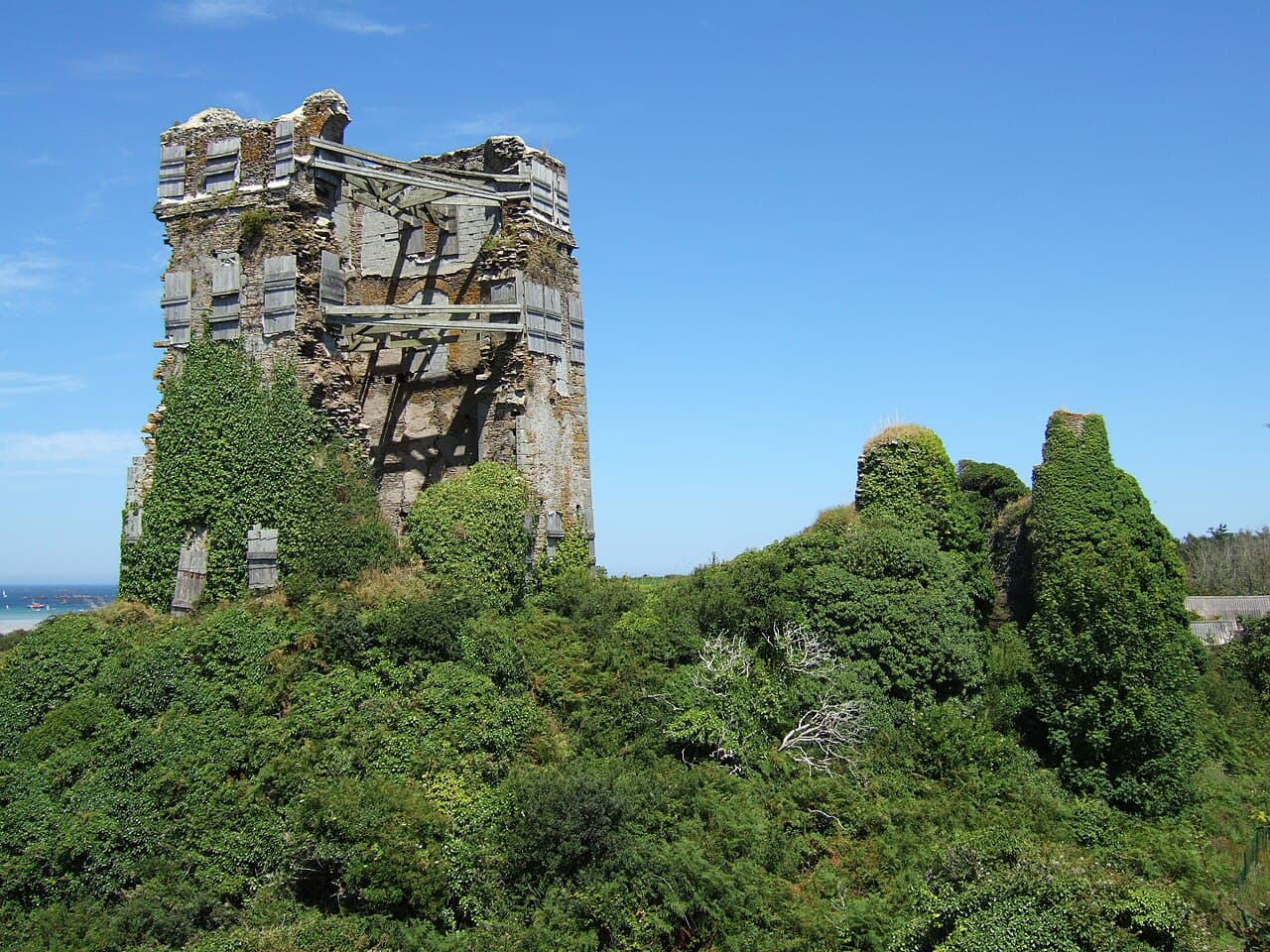
The castle's remains primarily date from the 13th and 14th centuries, although the site retains vestiges from earlier and later periods. The most prominent surviving structure is the 12th-century square keep, which originally stood as the central fortified tower. This keep was partially collapsed during the harsh winter of 1995, which exposed its interior and revealed a habitable tower comprising four floors, each containing a single chamber. This layout reflects the typical design of medieval keeps, emphasizing vertical defense and residential functionality.
Additional ruins include several towers and the outer enceinte (defensive walls) dating from the 13th, 14th, and 15th centuries. These fortifications illustrate the evolution of military architecture at the site, adapting to changing defensive needs over centuries. The castle's construction in stone around the 10th century marked a transition from earlier wooden fortifications, enhancing its durability and defensive capabilities.
Structural details revealed by archaeological study
Following the partial collapse of the keep, archaeological investigations have provided valuable insights into the castle's construction techniques and internal organization. The exposed chambers demonstrate the castle's dual role as both a military stronghold and a noble residence. The presence of multiple floors within the keep allowed for separation of functions, including storage, living quarters, and defensive positions.
Dendrochronological studies conducted on timber samples from the castle beams have further refined the dating of various construction phases, confirming the timeline of the castle's development and renovations. These scientific analyses contribute to a more precise understanding of the castle's architectural evolution.
Role in regional history and cultural significance
Château de Trémazan played an important role in the medieval history of Brittany, particularly within the context of the Viscounty of Léon. The du Chastel family's prominence and their association with the castle underscore its status as a seat of power and influence. According to legend, Tanneguy du Chastel, a notable figure who founded the abbey at Saint-Mathieu, was born at the castle, linking it to significant religious and cultural developments in the region.
After the French Revolution, the castle was sold as national property and subsequently abandoned during the 18th century. Its decline reflects the broader changes in French society and the diminished military importance of such fortifications in the modern era.
Preservation efforts and current condition
Today, Château de Trémazan stands as ruined remains that attract interest from historians, archaeologists, and visitors. The site is classified as an archaeological ruin, with key structures partially preserved but largely in a state of decay. The non-profit organization S.O.S Château de Trémazan is dedicated to preserving the castle and promoting awareness of its historical significance.
Preservation efforts focus on stabilizing the remaining structures, preventing further deterioration, and facilitating archaeological research. These initiatives aim to safeguard the castle's legacy and enhance public understanding of Brittany's medieval heritage.
Visiting Château de Trémazan
The castle is accessible to visitors interested in medieval architecture and Breton history. Its location below the coastal road offers a unique perspective on the region's landscape and historical defensive strategies. While the castle is in ruins, the site provides an evocative glimpse into the past, with the square keep and surrounding walls serving as tangible links to the medieval era.
Frequently asked questions (FAQ)
- When was Château de Trémazan originally built?
- Château de Trémazan was originally constructed around the 10th century on the site of an earlier 6th-century castellum.
- What is the historical significance of the du Chastel family in relation to the castle?
- The du Chastel family built Château de Trémazan and made it their principal residence, becoming one of the most influential noble families in the Viscounty of Léon.
- What remains of the castle can visitors see today?
- Visitors can see the ruins of the 12th-century square keep, several towers, and the outer defensive walls dating from the 13th to 15th centuries.
- Is Château de Trémazan accessible to the public?
- Yes, the castle ruins are accessible to visitors interested in medieval history and architecture, although facilities may be limited due to its ruined condition.
- Who is responsible for preserving Château de Trémazan?
- The non-profit association S.O.S Château de Trémazan works to preserve the castle and promote knowledge of its history.
Photo gallery

Photo by Caerbannog•Public domain
Information
Loading map...
Visitor reviews
No reviews yet. Been here? Write the first review and help other travelers!
Write the first reviewVisited this castle? Share your experience
Your review helps other travelers and adds first-hand knowledge to our encyclopedia.