Château de Salm
Château de Salm is a striking example of a medieval hill castle located in the Hauts-de-France region of France. Constructed between 1205 and 1225 under the direction of Henry III, Count of Salm, this fortress was strategically built on a rocky sandstone outcrop rising between 809 and 812 meters above sea level. The castle's location on a natural spur provided significant defensive advantages, making it a formidable stronghold during the High and Late Medieval periods.
The castle was originally established by the noble Salm family, who were influential in the region and traced their lineage to the Luxembourg dynasty. Henry III held the role of advocate for the Abbey of Senones, overseeing and protecting the abbey's interests, which included valuable industrial enterprises such as salt extraction and iron forges during the 13th century. This economic activity was closely linked to the castle's function as both a military and administrative center.
Throughout the centuries, Château de Salm underwent significant architectural evolution, reflecting changes in military technology and regional power dynamics. In the 14th century, the castle's defenses were enhanced with the addition of towers flanking the original shield wall. Around 1400, major upgrades included the construction of a massive D-shaped shield tower with walls up to three meters thick, designed to withstand cannon fire. This period also saw the addition of a fortified barbican and a new gatehouse, which replaced earlier defensive structures.
Architectural features and layout
The castle extends approximately 120 meters in length and 50 meters in width across several terraces. The core of the fortress is dominated by a robust shield wall facing southwest, which protected the main residential buildings and an exceptional vaulted cistern featuring a rare double-arched ceiling. This cistern was vital for water storage during sieges, demonstrating advanced planning for prolonged defense.
Adjacent to the curtain walls on the northwest and northeast sides stood the palas, or palace, notable for its refined architectural decoration, indicative of the noble status of its occupants. The highest point of the castle is marked by the bergfried, a tall keep separated from the main enclosure by two neck ditches, which served as additional defensive trenches.
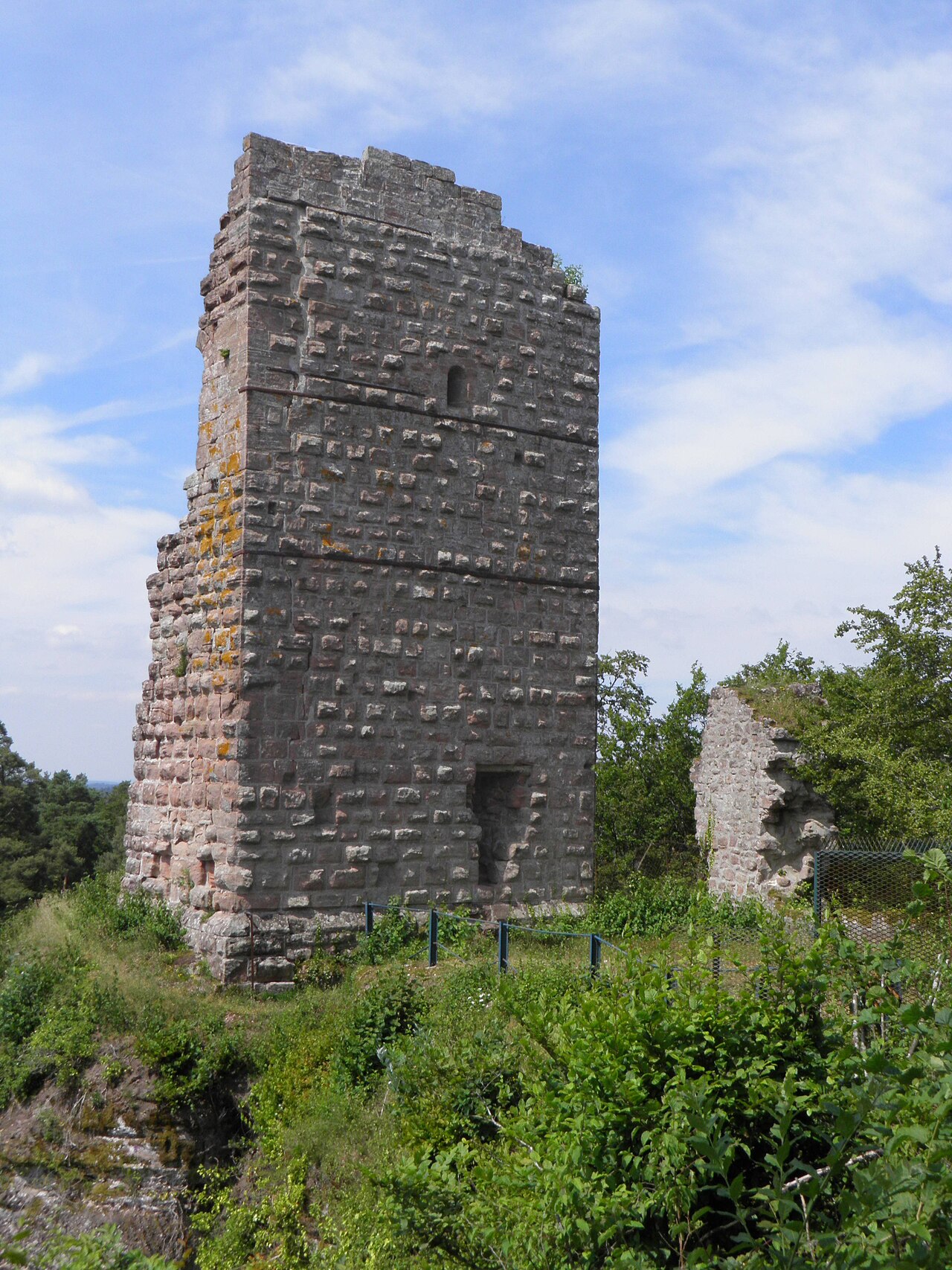
The shield tower constructed in the early 15th century remains partially preserved up to the first-floor level, featuring a large breach likely caused by historical attacks. The castle also includes a postern gate and extensive outer courtyards, or bassecours, dating from the late 14th century, which supported expanded functions beyond pure defense, including economic activities.
Historical significance and ownership
Château de Salm's history is intertwined with the complex relationships between secular nobility and ecclesiastical authorities. After Henry IV sold the castle to the Bishop of Metz in 1258 due to financial pressures, it was later regained as a hereditary fief, highlighting the turbulent politics of the region. The castle was significant enough to be mentioned by the Lorraine poet and musician Jacques Bretel in 1285, underscoring its cultural as well as strategic importance.
In the 14th and 15th centuries, the castle was not only a military fortress but also a hub for industrial production, including metalworking and pottery. The acquisition of the lower Bruche valley by Jean de Salm in 1366 further enhanced the castle's economic and strategic role. However, the castle's fortunes declined in the late 15th century, possibly due to destruction during campaigns involving Duke Charles the Bold of Burgundy.
Decline, ruin, and preservation efforts
By the mid-16th century, records consistently describe Château de Salm as a ruin. The site attracted noble visitors in the 18th century, including Prince Constantin Alexander of Salm-Salm and the Prince of Hohenlohe-Schillingsfürst, who left an inscription in 1779. The castle's remains were later exploited as a source of building stone after the French annexation in 1793.
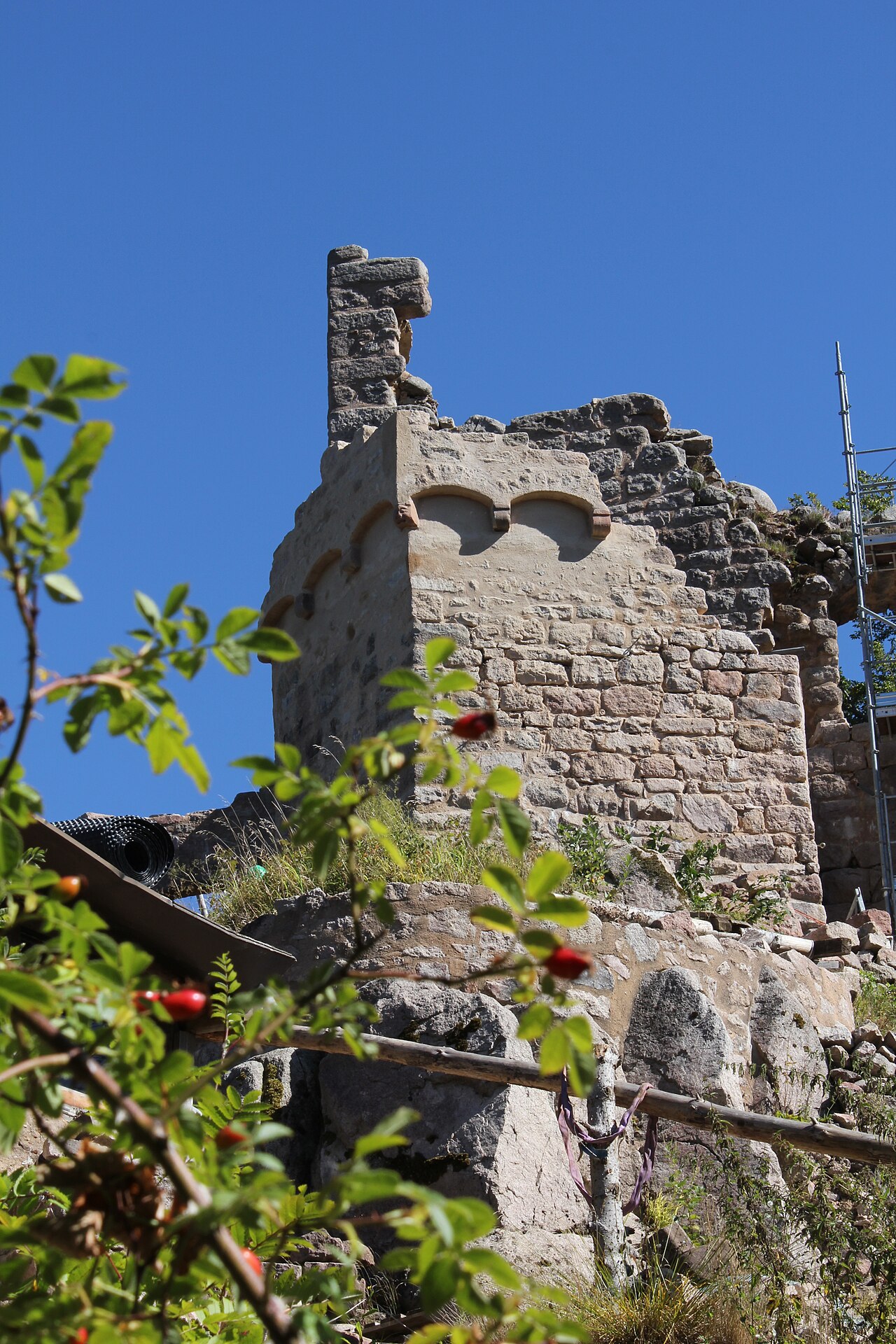
During World War I, the elevated ruins served as a strategic observation post for German forces, which led to French artillery bombardment in 1914. The castle was officially recognized as a historic monument on 6 December 1898 by the German imperial authorities. Restoration and archaeological efforts began in the early 21st century, led by the association Veilleurs de Salm, which has uncovered new information about the castle's construction phases and historical use.
Architectural remains and archaeological discoveries
The ruins consist primarily of red sandstone blocks with preserved elements such as the smooth ashlar facing on the shield tower's base and the vaulted cistern chamber. Visible features include doorways, window slits, and 13th-century cruciform arrow slits used by crossbowmen. Evidence also suggests the presence of a chapel within the castle walls, consistent with its role as a noble residence.
Archaeological work since 2004 has revealed previously unknown walls and clarified the sequence of construction phases, though the fragmentary state of the ruins means the full layout remains difficult to interpret. The castle's combination of defensive architecture and industrial heritage makes it a unique site for understanding medieval fortifications and economic history in the region.
Information
Website
Visit websiteSources & official resources
Verify the information above using these authoritative references.
Loading map...
Visitor reviews
No reviews yet. Been here? Write the first review and help other travelers!
Write the first reviewVisited this castle? Share your experience
Your review helps other travelers and adds first-hand knowledge to our encyclopedia.