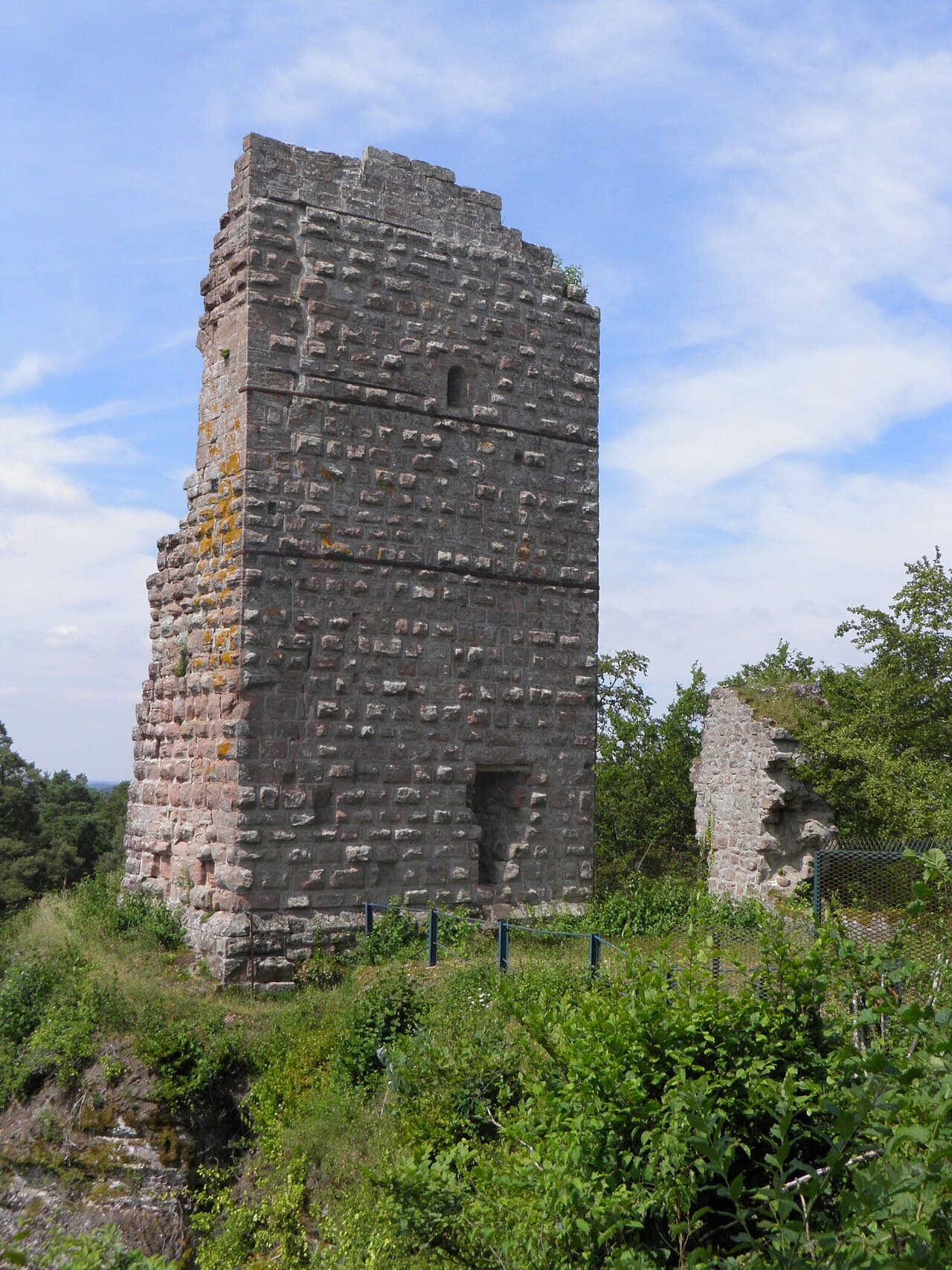
Château de Pierre-Percée
The Château de Pierre-Percée, meaning "pierced rock castle," is a notable medieval ruin located in the commune of Pierre-Percée, within the Meurthe-et-Moselle département of northeastern France. This castle is distinguished by a remarkable well, approximately 30 meters deep, hewn directly into the rock, which not only provided water but also lent its name to both the castle and the surrounding village. The site stands as a testament to the strategic and architectural ingenuity of the High Medieval period.
The origins and early history of Château de Pierre-Percée
The castle's early history is closely tied to the influential noble families of the region. In the early 12th century, the site was under the possession of Agnès, countess of Bar, who was the widow of the count of Langenstein. She subsequently married Hermann II, Count of Salm, himself the son of Hermann I, King of Germania (Eastern Francia). The Counts of Salm held the territory, which included the towns of Badonviller—which later became the capital of the county—and Blâmont, as hereditary property for several centuries.
Political conflicts and sieges in the 12th century
Around 1134, Hermann II allied with the Duke of Lorraine in a conflict against the Count of Bar and Stephan of Bar, the Bishop of Metz, who was also a member of the Bar family. Hermann II was killed in battle near the Château de Frouard. Following his death, the Château de Pierre-Percée endured a prolonged siege lasting about a year. The castle eventually fell into the hands of the Bishop of Metz after the death of Hermann's eldest son, marking a significant shift in regional power.
Architectural features and strategic importance
The castle was constructed on a rocky outcrop, utilizing the natural defenses provided by the terrain. The most striking architectural feature is the deep well carved into the rock, which was crucial for sustaining the garrison during sieges. The castle's walls, towers, and battlements were designed to maximize defensive capabilities, typical of High Medieval fortifications in this region of France.
Layout and construction techniques
The castle's design reflects the military architecture of the 12th century, with thick stone walls and limited access points to enhance defense. The use of the natural rock formation not only provided a strong foundation but also a vantage point over the surrounding landscape. Although much of the structure is now in ruins, archaeological studies have revealed the remains of curtain walls, gatehouses, and living quarters that once formed the castle complex.
Later history and destruction during the Thirty Years' War
After the 12th-century siege, the castle remained an important stronghold for the Counts of Salm for several centuries. However, by the time of the Thirty Years' War (1618-1648), the castle was deserted and no longer maintained as a military fortress. During this conflict, the castle was destroyed by Franco-Swedish troops, leaving it in the ruined state that visitors see today.
Post-war status and preservation
Following its destruction, the Château de Pierre-Percée was not rebuilt and gradually fell into ruin. Today, it is recognized as a significant historical site and is classified as a monument historique by the French Ministry of Culture. The castle is state property and serves as an archaeological site that offers insights into medieval military architecture and regional history.
Visiting the Château de Pierre-Percée
The ruins of Château de Pierre-Percée attract visitors interested in medieval history, architecture, and scenic views of the Lorraine region. The site offers an evocative glimpse into the past through its remaining structures and the impressive rock-cut well. Visitors can explore the ruins and learn about the castle's role in the feudal conflicts of the Middle Ages and its eventual decline during the early modern period.
While the castle is in a ruined state, its dramatic setting and historical significance make it a compelling destination for those fascinated by France's medieval heritage. The surrounding area also provides opportunities for hiking and exploring other historical landmarks in the Meurthe-et-Moselle département.
Frequently asked questions (FAQ)
- What is the historical significance of Château de Pierre-Percée?
- Château de Pierre-Percée was a strategic medieval fortress held by the Counts of Salm and involved in regional conflicts during the 12th century. Its deep rock well and prolonged siege history highlight its military importance.
- Can visitors explore the ruins of Château de Pierre-Percée?
- Yes, visitors can explore the ruins which include remnants of walls, towers, and the famous rock-cut well. The site offers scenic views and insight into medieval fortifications.
- When was Château de Pierre-Percée destroyed?
- The castle was destroyed during the Thirty Years' War (1618-1648) by Franco-Swedish troops after it had been deserted for some time.
- Is Château de Pierre-Percée protected as a historic monument?
- Yes, it is listed as a monument historique by the French Ministry of Culture and is state property, ensuring its preservation as a cultural heritage site.
- What architectural features are notable at Château de Pierre-Percée?
- Notable features include the deep well carved into the rock, thick defensive walls, and the castle's strategic placement on a rocky outcrop typical of High Medieval military architecture.
Photo gallery

Information
Current owner
State property
Loading map...
Visitor reviews
No reviews yet. Been here? Write the first review and help other travelers!
Write the first reviewVisited this castle? Share your experience
Your review helps other travelers and adds first-hand knowledge to our encyclopedia.



