Château de Rochechouart
The Château de Rochechouart is a remarkable hill castle located in the commune of Rochechouart, within the département of Haute-Vienne, France. Perched atop a rocky promontory at the confluence of the Graine and Vayres rivers, this fortress commands a strategic vantage point that has shaped its long and varied history. Originally established by the medieval viscounts of Limoges around the year 1000, the castle evolved through centuries of construction, conflict, and restoration, reflecting the shifting architectural styles and defensive needs from the High Medieval period onward.
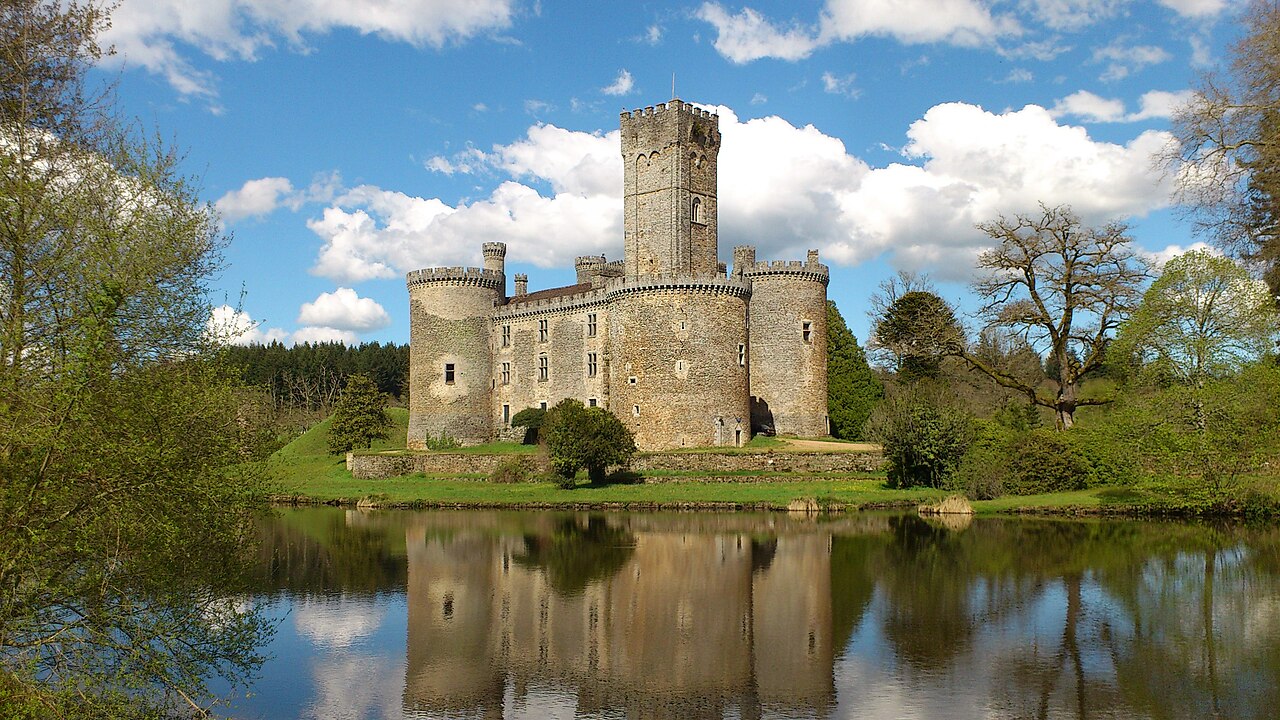
Constructed primarily in the 13th century, the castle's core was developed by the viscounts of Rochechouart, a cadet branch of the Limoges family. A key figure in its early architectural history was Aymeric VI (1170–1230), who built the imposing central keep and the main gatehouse, complete with a drawbridge. These fortifications exemplify the military architecture of the period, designed to secure the lordship's control over the region and to withstand sieges.
Medieval origins and architectural evolution
The castle's initial construction in the 12th and 13th centuries established its defensive core, including the donjon or keep, which served as both a fortified residence and a stronghold. The entrance châtelet with its flanking towers and drawbridge provided controlled access, essential for medieval defense. Over time, the castle expanded and adapted, notably after the Hundred Years’ War (1337–1453), when it was rebuilt with a distinctive pentagonal layout. This redesign reflected advances in military architecture and the transition toward more comfortable noble residences.
Defense and residence in the late medieval period
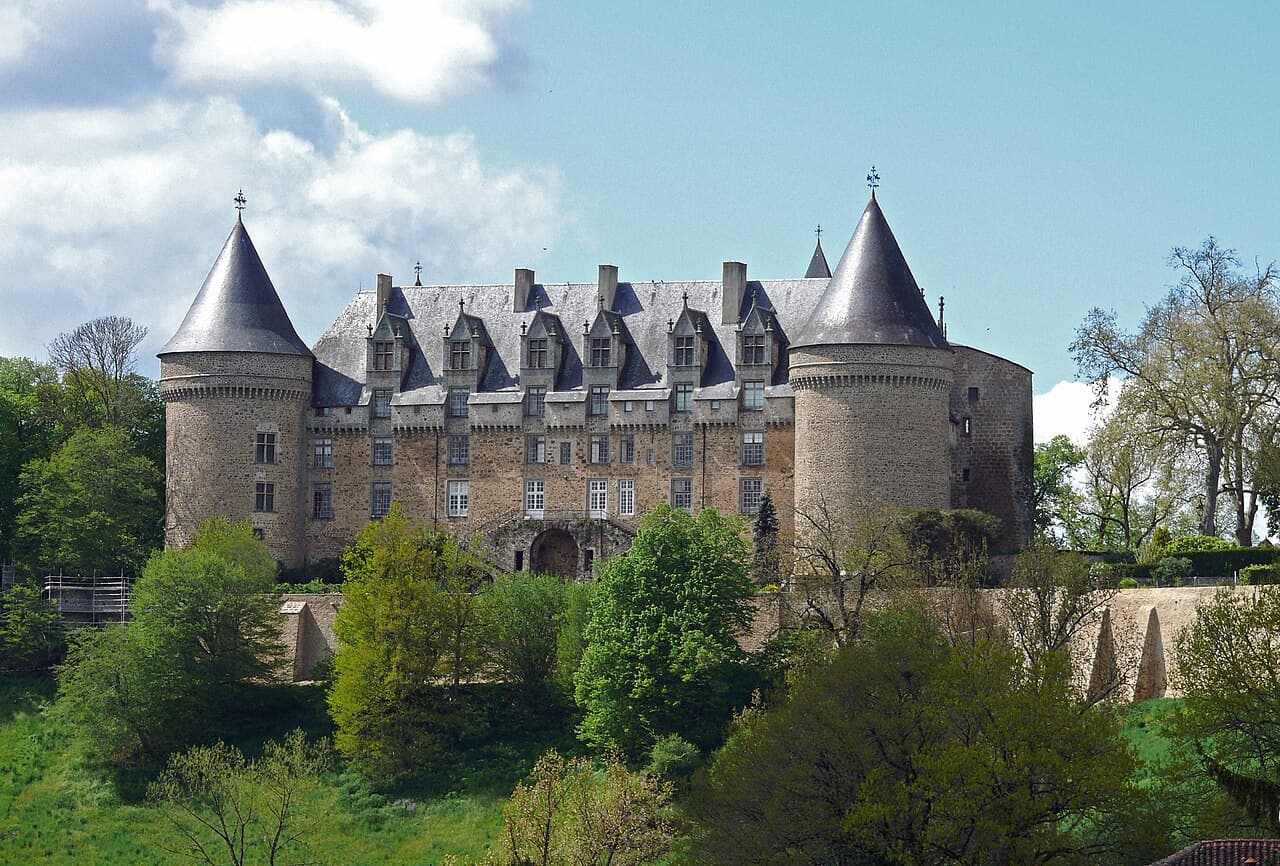
The pentagonal plan allowed for improved defensive coverage and created a more complex internal courtyard. The main residential wing, or corps de logis, was enhanced with large windows and dormer openings, signaling a shift from purely military functions to noble habitation. Architectural details such as the gallery supported by twisted torsade columns demonstrate the castle's evolving aesthetic, drawing parallels with other Renaissance-influenced châteaux like Château d’Oiron.
Renaissance transformations and noble patronage
In the early 16th century, Jean de Rochechouart-Ponville undertook significant restoration and modernization, introducing Renaissance stylistic elements to the castle. This period saw the addition of decorative frescoes and murals, including the early 16th-century polychrome frescoes in the hunting room, which vividly depict a detailed deer hunt, and the grisaille murals in the Hercules room, painted to resemble sculptural reliefs. These artistic features highlight the castle's role as a noble residence that balanced defense with refined cultural expression.
Impact of the french revolution and subsequent uses
The French Revolution brought considerable damage to the Château de Rochechouart. Revolutionaries partially demolished two towers on the southeast façade by removing their upper sections, a symbolic act against feudal power. The castle was also repurposed as a prison in 1793, marking a shift from noble residence to state use. In 1836, ownership transferred to the Haute-Vienne department, and restoration efforts in the late 1850s adapted the building for civic functions, including housing the subprefecture and town hall.
20th-century preservation and cultural significance
During the 20th century, the castle's courtyard featured a German 77mm cannon as a war memorial, reflecting the region's engagement with modern history. From 1889 to 1991, the Château de Rochechouart hosted archaeological exhibits organized by the Société des Amis des sciences et des arts de Rochechouart, before these collections were relocated to Chassenon in 2011. Since 2015, extensive restoration has focused on preserving the castle’s exterior facades, ensuring its status as a protected monument historique under the French Ministry of Culture.
Today, the castle serves as a contemporary art museum, showcasing works by artists such as Raoul Hausmann and others from the international art scene, blending historical heritage with modern cultural expression. The site also preserves a small 15th-century cannon used historically for ceremonial salutes, symbolizing its martial past.
Architectural features and natural surroundings
The Château de Rochechouart’s architecture reveals layers of history through its surviving elements. The 12th-century keep remains a dominant feature, alongside the 13th-century entrance châtelet with its fortified gateway and drawbridge. While some towers have been partially demolished, the pentagonal layout and the corps de logis with large windows and dormers illustrate the castle’s adaptation over time.
Inside, the castle retains valuable Renaissance interior decoration, including the hunting room frescoes and grisaille murals in the Hercules room. The courtyard’s gallery with its twisted columns adds a distinctive decorative touch, linking the castle to broader Renaissance architectural trends in France.
The castle is surrounded by notable natural features, including caves and rock formations that serve as protected habitats for bats, designated as Zones Naturelles d’Intérêt Écologique Faunistique et Floristique (ZNIEFF). This ecological significance is part of the larger Rochechouart-Chassenon astrobleme nature reserve, an area shaped by a meteorite impact crater, adding geological interest to the site’s cultural and historical importance.
Historical legacy and cultural heritage
Maintained for nearly eight centuries by the viscounts of Rochechouart, the castle played a significant role in regional politics and military history. It was a key stronghold during the Hundred Years’ War, with family members fighting alongside famed French commanders like Bertrand du Guesclin and Joan of Arc. The castle's transformation over time from a fortified medieval fortress to a Renaissance noble residence and later a civic building reflects broader trends in French history.
Declared a monument historique by the French Ministry of Culture, the Château de Rochechouart today stands as a testament to the layered history of French medieval and Renaissance architecture, noble life, and modern cultural adaptation. Its preservation and ongoing use as a museum ensure that this heritage remains accessible and relevant.
Frequently asked questions (FAQ)
- How do I get to Château de Rochechouart?
- Château de Rochechouart is conveniently located in the town of Rochechouart, France. You can reach it by car via the N141 road or take a train to the nearest station and then a local bus or taxi to the castle.
- What is the historical significance of Château de Rochechouart?
- Château de Rochechouart dates back to the 12th century and is known for its significant role in the region's defense during the medieval period. It has witnessed various historical events and has been a symbol of the local nobility.
- When was Château de Rochechouart built?
- Construction of Château de Rochechouart began in the 12th century, around 1170, and it has undergone several renovations and expansions over the centuries. The castle reflects various architectural styles, showcasing its historical evolution.
- Can I visit Château de Rochechouart year-round?
- Yes, Château de Rochechouart is open to visitors throughout the year, although the opening hours may vary by season. It’s advisable to check the official website for specific hours and any seasonal events.
- Why is the architecture of Château de Rochechouart unique?
- The architecture of Château de Rochechouart combines elements of medieval fortifications with Renaissance influences, making it a fascinating study in historical design. Its distinct conical towers and defensive walls set it apart from other castles in the region.
- Is it possible to access Château de Rochechouart with a wheelchair?
- Château de Rochechouart strives to be accessible to all visitors. While some areas may have limited access due to the castle's historical structure, there are facilities and staff available to assist visitors with mobility challenges.
- What are the ticket prices for Château de Rochechouart?
- Ticket prices for Château de Rochechouart are quite reasonable, typically ranging from €5 to €10 for adults, with discounts available for children, students, and seniors. Special rates may apply for guided tours or group visits.
- What is the best time to visit Château de Rochechouart?
- The best time to visit Château de Rochechouart is during the spring and early autumn months when the weather is pleasant and the gardens are in full bloom. Additionally, visiting during weekdays can help you avoid larger crowds.
- Are there any nearby attractions to Château de Rochechouart?
- Yes, several nearby attractions include the picturesque village of Rochechouart itself and the stunning Limousin countryside. The region is also known for its hiking trails and local vineyards, providing plenty of options for a full day of exploration.
Photo gallery

Information
Website
Visit websiteSources & official resources
Verify the information above using these authoritative references.
Loading map...
Visitor reviews
No reviews yet. Been here? Write the first review and help other travelers!
Write the first reviewVisited this castle? Share your experience
Your review helps other travelers and adds first-hand knowledge to our encyclopedia.