Château de Montbrun
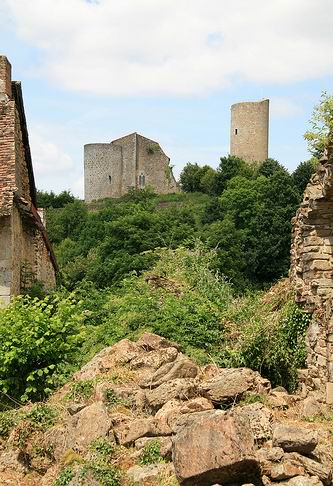
The Château de Montbrun is a significant medieval hill castle located in the commune of Dournazac, within the Haute-Vienne département of France. Its origins date back to the 11th century, when the site was initially fortified with a high motte, an earthwork typical of early medieval defensive structures. This early fortification laid the groundwork for what would evolve into a formidable stone castle by the 12th century, marking a transition from timber to durable stone architecture. The castle's strategic position within a deep valley and its integration with natural water defenses reflect its role in guarding the borders of the Duchy of Aquitaine during a turbulent period of regional conflict.
Early history and medieval significance
The earliest known fortification at Montbrun was established in the 11th century with the construction of a motte, a raised earth mound designed to support a wooden or stone keep. This motte remains visible today and is notable for its underground galleries carved into the rock, featuring small cavities whose exact purpose is uncertain but are traditionally associated with storage or defense. By the 12th century, the castle was rebuilt in stone, including a tall Romanesque keep approximately 40 meters square. This keep became a central defensive and residential feature, embodying the architectural style and military needs of the time.
The lords of Montbrun were involved in notable historical events, such as the 1199 siege of nearby Château de Châlus-Châbrol, where Pierre Brun, lord of Montbrun, served as co-commander of the garrison. This siege is historically important as it was during this conflict that King Richard the Lionheart of England was fatally wounded, linking Montbrun to a pivotal moment in medieval European history.
15th-century reconstruction and architectural features
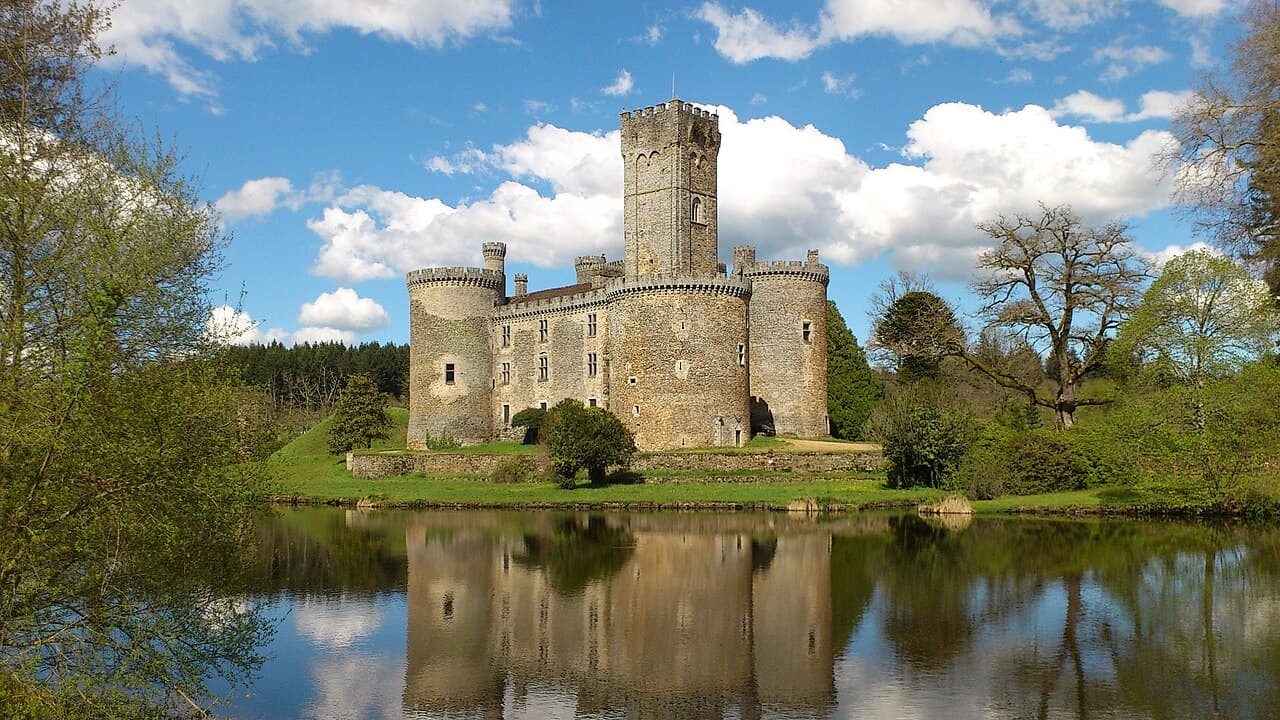
Following significant damage by fire, the castle underwent extensive reconstruction in the 15th century. This phase introduced architectural elements characteristic of late medieval fortifications, including a large main residence flanked by four imposing round towers at each corner. These towers provided enhanced defense but also reflected a shift toward greater residential comfort, as evidenced by the inclusion of large mullioned windows that allowed more natural light into the interior spaces.
The castle's defensive system was further strengthened by the addition of machicolations atop the Romanesque keep in the 14th century. These openings between the corbels of the parapet allowed defenders to drop projectiles or boiling substances on attackers below. Surrounding the main structure is a moat fed by natural ponds, which date from between the 12th and 14th centuries. This water defense enhanced the castle's security and integrated the fortress with its natural environment.
Later history, decline, and restoration
Despite its robust medieval construction, the Château de Montbrun faced challenges during the French Revolution, when it was looted and suffered damage. The 19th century saw initial restoration efforts aimed at preserving the castle's architectural heritage. However, a devastating fire in 1917 caused further destruction, necessitating substantial 20th-century restoration work.
From 1995, the castle was transformed into a private residence by Maarten Joost Lamers, a Dutch owner who undertook comprehensive restoration to revive the castle's historic character while integrating modern amenities. The interior now spans approximately 3,500 square meters and features luxurious accommodations such as a jacuzzi, sauna, fifteen bedrooms with private bathrooms, and several reception rooms including a two-story library and music room. These updates respect the castle's medieval fabric while providing contemporary comfort.
The castle's interiors were officially designated as a historic monument in 1946, with the exterior and grounds receiving protected status in 1990. Today, the Château de Montbrun stands as a well-preserved example of a high medieval hill castle that has adapted through centuries of conflict, decay, and restoration, maintaining its role as a cultural landmark within the region.
Architectural layout and natural setting
The castle is situated on a raised insular platform composed of metamorphic augen gneiss rock, a durable stone native to the local geology. This natural foundation contributes to the castle's stability and regional architectural identity. The moat and surrounding ponds, remnants of medieval water defenses, encircle the platform, creating a natural barrier that complements the man-made fortifications.
The castle's rectangular plan is typical of late medieval fortifications, with the main residence anchored by four large round towers at each corner. The juxtaposition of the narrow Romanesque keep against one of these towers creates a distinctive silhouette. Behind the main building lie the remains of the milites castri or knights' houses, which served as residences and administrative centers for the lord's retainers during the late medieval period.
Defensive features
Key defensive elements include the high walls, the moat, and the machicolated keep. The machicolations, added in the 14th century, allowed defenders to protect the base of the walls effectively. The round towers provided flanking fire along the curtain walls, a common feature in 15th-century castle design. The large mullioned windows, while enhancing interior light, indicate a balance between defense and residential comfort in the castle's later phases.
Interior and modern adaptations
The castle's interior has been carefully updated to blend historical architecture with modern living standards. The inclusion of a jacuzzi, sauna, and multiple reception rooms demonstrates a commitment to luxury while preserving the castle's medieval ambiance. The two-story library and music room highlight the cultural functions the castle serves today as a private residence and heritage site.
Cultural and heritage importance
The Château de Montbrun is recognized for its architectural and historical significance within the Haut-Limousin Regional Natural Park and the broader cultural landscape of the Haute-Vienne region. Its preservation as a historic monument underscores its value as a tangible link to the medieval past and the evolution of castle architecture in France.
As a private residence that welcomes interest from historians, architects, and visitors, the castle contributes to the understanding of medieval fortifications and their adaptation over time. Its combination of natural defenses, medieval military architecture, and later residential enhancements offers insight into the changing needs and tastes of its inhabitants across centuries.
Frequently asked questions (FAQ)
- What is the historical significance of Château de Montbrun?
- Château de Montbrun dates back to the 15th century and is a remarkable example of medieval architecture in France. It played a vital role in local history, serving as a stronghold during various conflicts and showcasing the evolution of fortification techniques over the centuries.
- When is the best time to visit Château de Montbrun?
- The best time to visit Château de Montbrun is during the spring and fall months when the weather is mild and the surrounding landscape is particularly beautiful. Additionally, these seasons often see fewer tourists, allowing for a more intimate experience of the castle and its grounds.
- Can I access Château de Montbrun with a wheelchair?
- While Château de Montbrun has made efforts to be accessible, certain areas may present challenges for wheelchair users due to the castle's historic architecture. It's recommended to contact the site in advance to inquire about accessibility options and any specific accommodations that may be available.
- What are the opening hours of Château de Montbrun?
- Château de Montbrun is typically open to visitors from 10 AM to 6 PM during the peak tourist season, which runs from April to October. It's advisable to check the official website or contact the castle directly for any seasonal variations in hours before planning your visit.
- Is it possible to take guided tours of Château de Montbrun?
- Yes, guided tours are available at Château de Montbrun, offering visitors a chance to learn about the castle's rich history and architectural features. These tours are conducted by knowledgeable guides who provide valuable insights and can answer any questions you may have during your visit.
- What are the ticket prices for Château de Montbrun?
- Ticket prices for Château de Montbrun vary depending on age and group size, with discounts often available for children, students, and seniors. It is recommended to check the castle's official website for the most up-to-date pricing information and any special promotions.
- Are there any nearby attractions to Château de Montbrun?
- Yes, there are several attractions near Château de Montbrun, including beautiful hiking trails, charming local villages, and other historical sites. Visitors can explore the surrounding areas to experience the rich culture and natural beauty of the region.
Photo gallery

Information
Website
Visit websiteSources & official resources
Verify the information above using these authoritative references.
Loading map...
Visitor reviews
No reviews yet. Been here? Write the first review and help other travelers!
Write the first reviewVisited this castle? Share your experience
Your review helps other travelers and adds first-hand knowledge to our encyclopedia.