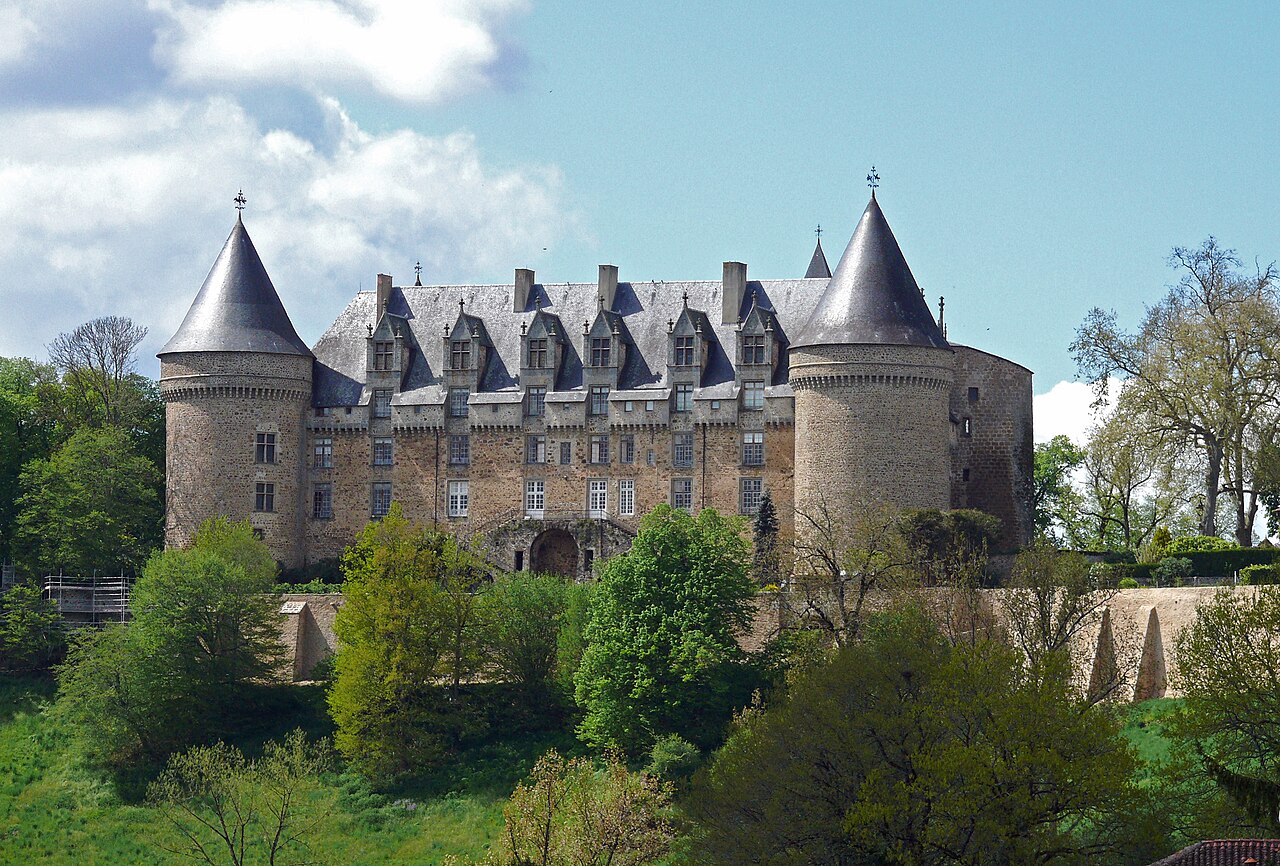
Château de Rochebrune
The Château de Rochebrune stands as a remarkable example of medieval military architecture combined with later Renaissance adaptations, located in the municipality of Étagnac in the Hauts-de-France region of northern France. Constructed initially in the 11th century, this hill castle was strategically positioned on a modest plateau approximately 261 meters above sea level, overseeing important medieval routes connecting Limoges, Angoulême, and Niort. Its location at a crossroads underscored its vital role in regional defense and control during the Middle Ages and beyond.
The castle's origins trace back to Jourdain I, a nobleman who began its construction with the erection of the first tower before departing for the First Crusade and dying in Jerusalem in 1099. Over the subsequent century, his descendants expanded the fortress by adding three round corner towers, each approximately nine meters in diameter and topped with distinctive pointed conical roofs known as "poivrières" or pepperpot roofs. These towers, along with the thick defensive walls measuring about two meters in thickness, created a formidable stronghold designed to withstand sieges and protect the surrounding lands.
Medieval architecture and defensive features
The castle's rectangular layout measures roughly 43 by 36 meters and originally included four wings enclosing a courtyard, with each corner fortified by the aforementioned round towers. The walls featured narrow arrow slits strategically positioned to allow defenders to cover overlapping fields of fire, effectively eliminating blind spots and enhancing the castle's defensive capabilities. A water-filled moat, ranging from five to ten meters wide, surrounded the entire structure, further deterring attackers and restricting access.
Originally, a walkway along the battlements connected the towers, enabling guards to move swiftly between bastions during times of threat. This feature was later removed during modifications in the post-medieval period. One of the castle's wings, enclosing part of the courtyard, was demolished in 1808, marking a significant change in the castle's structure and use.
Historical significance and ownership through centuries
Throughout its history, Château de Rochebrune played a pivotal role in regional conflicts, especially during the French Wars of Religion in the 16th century. By 1561, it was under the control of Blaise de Monluc, a Catholic marshal renowned for his staunch opposition to Protestant forces. Rochebrune, alongside nearby fortresses at Chabanais and Confolens, formed a defensive line that sought to halt Protestant advances from the south. However, in 1569, the castle suffered significant damage when Protestant troops set it ablaze.
Following this destruction, Blaise de Monluc's daughter-in-law initiated renovations that transformed the fortress from a purely military installation into a more comfortable noble residence. This included replacing the original defensive walkway with large windows that allowed natural light to flood the interior spaces, reflecting Renaissance influences and the evolving needs of castle inhabitants.
Ownership of Rochebrune passed through several noble families over the centuries. The Escoubleau de Sourdis family inherited the castle through marriage, and later it came into the possession of the Colbert family when Angélique Charlotte d'Escoubleau de Sourdis married François Gilbert Colbert, Marquis de Saint-Pouange. In 1702, Louis XIV elevated the surrounding lands to a marquisate in recognition of this distinguished lineage.
Modifications and preservation in the modern era
During the 18th century, the Colbert-Chabanais family continued to adapt the castle to more comfortable living standards. They enlarged windows to increase interior illumination and replaced the original drawbridge with a wider bridge, improving access to the estate. In 1805, the castle was acquired by Count Pierre Dupont de l’Étang, a notable general of the Napoleonic era. His grandson later bequeathed the property to Count de Richemont, an ancestor of the current owner, Henri de Richemont.
Under the First French Empire, a landscaped park was established around the castle, complementing its transformation from fortress to noble residence. The castle's roofs, now covered with slate tiles, replaced earlier flat tiles as part of ongoing preservation efforts. The interior boasts a remarkable painted ceiling dated to 1581, featuring the coats of arms of the Montluc and Rochechouart families, linking the castle's decor to its historical proprietors.
Today, Château de Rochebrune is recognized as a protected historic monument, a status granted in 1959 that ensures the preservation of its medieval and post-medieval architectural heritage. The castle, its moat, facades, and adjacent outbuildings remain well-preserved, offering visitors a tangible connection to France's rich feudal and noble past.
Architectural highlights and visitor experience
Visitors to Château de Rochebrune can explore its imposing round towers with their characteristic pepperpot roofs, the thick defensive walls with their carefully designed arrow slits, and the remnants of the water-filled moat that once provided formidable protection. The castle's evolution from a military fortress to a noble residence is evident in the large windows and interior decorations that replaced some of the original defensive features.
The castle's location on a plateau offers scenic views of the surrounding Hauts-de-France countryside, emphasizing its historical role as a vantage point for surveillance and defense. The combination of medieval fortifications and Renaissance modifications makes Château de Rochebrune a fascinating site for those interested in the development of castle architecture and the history of French nobility.
Frequently asked questions (FAQ)
- What is the historical significance of Château de Rochebrune?
- Château de Rochebrune is renowned for its strategic location and architectural beauty, reflecting the rich history of the region. Built in the 12th century, it played a pivotal role in the feudal conflicts of medieval France and stands as a testament to the era's architectural innovations.
- When was Château de Rochebrune built?
- Château de Rochebrune was constructed in the early 12th century, making it one of the oldest castles in the region. Its enduring structure showcases the historical evolution of castle architecture over the centuries.
- Can I visit Château de Rochebrune?
- Yes, visitors are welcome to explore Château de Rochebrune. The castle offers guided tours that provide insight into its history and architecture, making for an enriching experience.
- What are the opening hours for Château de Rochebrune?
- Château de Rochebrune is typically open to the public from 10 AM to 6 PM, with extended hours during peak tourist season. It is advised to check the official website for any seasonal changes or special closing days.
- Is it possible to access Château de Rochebrune with mobility aids?
- The castle is committed to accessibility and offers facilities for visitors with mobility challenges. However, certain areas may have limited access due to the historical nature of the structure, so it’s best to inquire beforehand.
- What is the best time to visit Château de Rochebrune?
- The best time to visit Château de Rochebrune is during the spring and early fall when the weather is pleasant and the surrounding gardens are in full bloom. These seasons also tend to have fewer crowds, allowing for a more enjoyable experience.
- Are there any nearby attractions to visit along with Château de Rochebrune?
- Yes, visitors can explore several nearby attractions, including the picturesque village of Rochebrune and scenic hiking trails in the surrounding countryside. These sites provide a perfect complement to your visit to the castle.
- What are the ticket prices for visiting Château de Rochebrune?
- Ticket prices for Château de Rochebrune are generally affordable, with discounts available for students and seniors. It's advisable to purchase tickets in advance during peak tourist season to ensure entry.
Information
Website
Visit websiteSources & official resources
Verify the information above using these authoritative references.
Loading map...
Visitor reviews
No reviews yet. Been here? Write the first review and help other travelers!
Write the first reviewVisited this castle? Share your experience
Your review helps other travelers and adds first-hand knowledge to our encyclopedia.