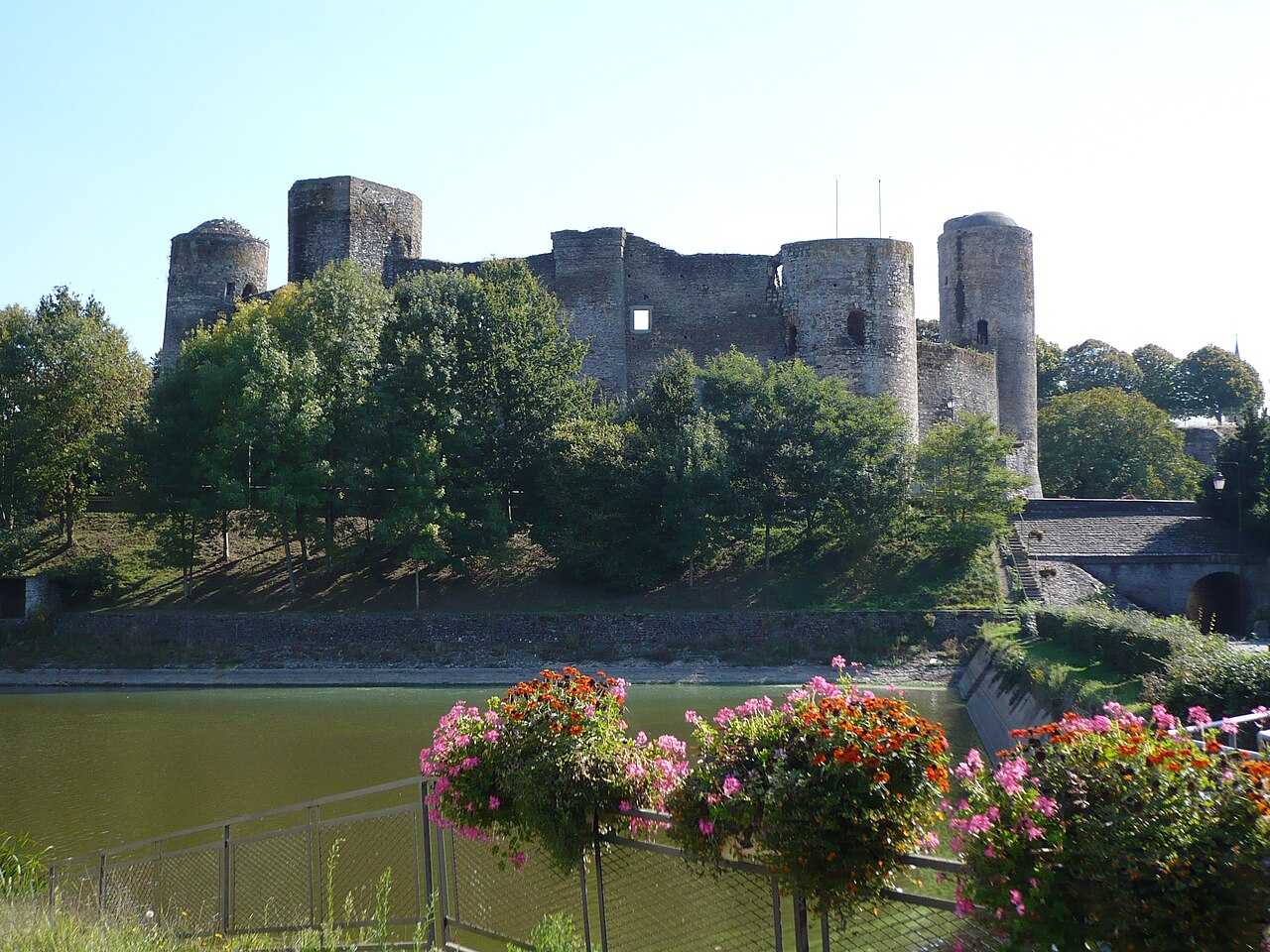
Château de Pouancé
Château de Pouancé is a significant medieval fortress located in the town of Pouancé, within the region of Ombrée d'Anjou in western France. This castle occupies a strategic position on the historic border between the old province of Anjou and Brittany, serving as a key defensive stronghold against Breton incursions. Covering an extensive area of approximately three hectares, it is often referred to as the 'second castle of Anjou' due to its impressive size, which is slightly smaller than that of the renowned castle of Angers. Alongside the remains of the town's medieval walls, the castle forms a substantial fortified complex that reflects the military architecture of the High medieval period.
Historical context and strategic importance
The site of Château de Pouancé was originally fortified in the 11th century, with the castle itself constructed primarily between the 12th and 15th centuries. Its location was crucial as it stood on the Breton march, the frontier zone between the Duchy of Brittany and the County of Anjou. This positioning made it a frontline defense against Brittany, directly facing the Breton castle of Châteaubriant. Throughout its history, Château de Pouancé was a focal point of conflict, particularly during the Hundred Years' War when it was besieged multiple times. The castle's fortifications were continually strengthened to withstand these attacks, reflecting its enduring military significance.
Architecture and fortifications
The castle's architecture is a composite of styles and construction phases spanning several centuries. Its defensive structures include robust curtain walls, towers, and a moat system, which together create a formidable barrier against invaders. The castle's walls and towers were designed to provide overlapping fields of fire and to resist siege engines common in medieval warfare. The complex also features inner courtyards and residential quarters, indicating its dual role as both a fortress and a noble residence.
Defensive features
The curtain walls are punctuated by multiple round and square towers, which served as vantage points for archers and lookouts. The moat, fed by nearby water sources, added an extra layer of protection by hindering enemy approach. Gatehouses and drawbridges controlled access to the castle, allowing defenders to manage entry points effectively. These elements exemplify typical High medieval military architecture adapted to the specific strategic needs of the Breton-Anjou border.
Role in regional conflicts
Château de Pouancé played a prominent role during the Hundred Years' War, a prolonged conflict between England and France that lasted from 1337 to 1453. The castle's location made it a target for sieges and military operations, as control of the fortress meant dominance over the surrounding territory. Later, in the late 15th century, it was involved in the Mad War (La Guerre Folle), a series of feudal uprisings and conflicts in France. These events tested the castle's defenses and underscored its strategic importance in regional power struggles.
Decline and restoration efforts
Following the turbulent medieval period, Château de Pouancé fell into decline during the 16th century. The castle suffered damage and was gradually abandoned, losing its military relevance as warfare evolved and political borders stabilized. By the 18th century, the fortress was completely deserted and began to deteriorate. However, in the 1960s, local resident Louis Bessière initiated restoration efforts that saved the castle from further ruin. These efforts, supported by volunteers and amateur archaeologists, helped preserve the structure, although comprehensive archaeological surveys remain limited.
Current status and visitor information
Today, Château de Pouancé is owned by the town of Pouancé and is recognized as a monument historique since 7 July 1926. The castle is open to visitors during the summer months, offering a glimpse into medieval military architecture and the history of the Anjou-Brittany border region. Despite the lack of extensive archaeological excavation, the castle remains an important cultural and historical landmark, attracting tourists interested in medieval fortifications and French heritage.
Archaeological challenges
Over the past four decades, volunteers have conducted amateur excavations at the site, but the lack of deep, systematic archaeological research means that many aspects of the castle's original structure and development remain unclear. This presents opportunities for future studies to uncover more about the castle's construction phases and its role in medieval warfare.
Frequently asked questions (FAQ)
- When was Château de Pouancé built?
- Château de Pouancé was primarily constructed between the 12th and 15th centuries, with initial fortifications dating back to the 11th century.
- What is the historical significance of Château de Pouancé?
- The castle served as a key defensive fortress on the border between Anjou and Brittany, playing important roles during the Hundred Years' War and the Mad War.
- Is Château de Pouancé open to visitors?
- Yes, the castle is owned by the town of Pouancé and is open to visitors during the summer months, offering tours of its medieval structures.
- What architectural features does Château de Pouancé have?
- The castle includes curtain walls, towers, a moat, gatehouses, and inner courtyards, reflecting typical High medieval military architecture.
- Has Château de Pouancé been restored?
- The castle was partially restored starting in the 1960s by Louis Bessière and volunteers, preserving it from further ruin.
Information
Opening hours
Summer months
Current owner
Town of Pouancé
Loading map...
Visitor reviews
No reviews yet. Been here? Write the first review and help other travelers!
Write the first reviewVisited this castle? Share your experience
Your review helps other travelers and adds first-hand knowledge to our encyclopedia.