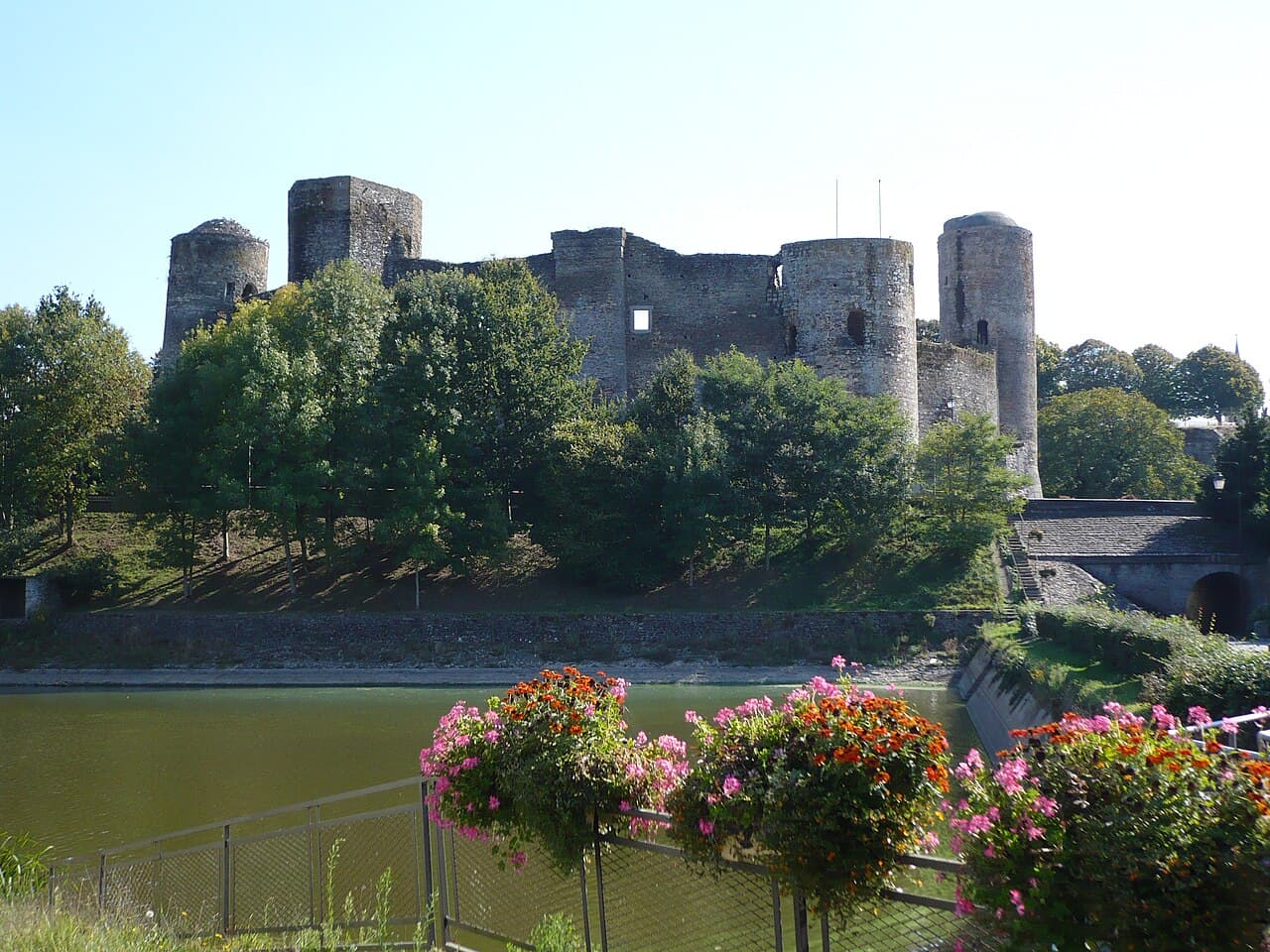
Castle of Pouancé
The Castle of Pouancé stands as a remarkable example of medieval military architecture in western France. Located in the town of Pouancé within the historic province of Anjou, this hill castle occupies a commanding position on a natural schist rock outcrop overlooking the Verzée river and Saint-Aubin pond. Its strategic placement at the border of Anjou and Brittany made it a vital fortress controlling the contested Breton March from the 11th century onward.
Historically, the site was fortified as early as the mid-11th century, with records from 1049 to 1060 referencing troops stationed there under the count of Anjou. The castle evolved over several centuries, primarily between the 12th and 15th centuries, reflecting the shifting political and military landscape of medieval France. Its role as a frontier stronghold against Brittany shaped its extensive fortifications and complex defensive systems.
Early history and construction
Before the castle's construction, the area showed signs of earlier settlement, including fragments of Merovingian-era sarcophagi embedded in local church walls. The initial fortifications likely began as simple earthworks and wooden structures, gradually replaced by stone as the need for stronger defenses grew. The castle was built by the medieval lords of Anjou to secure their western border and protect against Breton incursions.
Ownership of the fortress passed through several noble families, including Hervé de Martigné, a vassal of the count of Rennes, and later the La Guerche family through marriage alliances. During the late 12th century, the lords of Pouancé rebelled against Plantagenet authority, resulting in military setbacks and partial destruction of the castle. Despite these challenges, the family maintained influence in the region into the 13th century, overseeing nearby lordships such as Martigné, La Guerche, and Segré.
Medieval fortifications and architectural features
Castle layout and defensive structures
The castle covers approximately three hectares within an oval-shaped enclosure defined by a robust curtain wall punctuated by six cylindrical towers and three main entrances. The fortification is divided into two baileys—the lower and upper baileys—arranged on different levels and separated by dry moats carved into natural rock faults. The walls are primarily constructed from local schist stone rubble bonded with mortar, with granite used in key architectural elements, illustrating typical medieval masonry techniques adapted to available materials.
Access to the lower bailey is through the Tour Porche, a 15th-century gate tower featuring two vaulted doorways, one for carriages and a smaller pedestrian gate later blocked. This tower was expanded in the 17th century for residential use, compromising some original defensive features such as portcullis grooves and drawbridge mechanisms which are no longer visible today.
The upper bailey was secured by a fortified gatehouse (châtelet) on a bridge supported by three piers, likely equipped originally with a drawbridge. This gatehouse includes two narrow U-shaped towers attached to smaller circular turrets containing spiral staircases. Two smaller posterns at the north and south ends of the moat system provided additional controlled access points, with the southern postern notably retaining granite arches, portcullis chambers, and original iron fittings.
Towers and bastions
The castle's towers vary in age and function. The Tour du Moulin and Tour Saint-Antoine date from the 13th century, with the latter featuring three floors, a vaulted dome roof, and staggered arrow slits for defense. The Tour Heptagonale, built in the 15th century, is notable for its seven-sided shape and artillery openings designed for small cannons, reflecting advancements in military technology. The Grosse Tour, or main tower, from the 14th century, includes a truncated summit and interior features such as a fireplace and latrine.
The Tour de la Dame Blanche, dating from the late 12th or 13th century, is a solid tower with a spiral staircase and a vaulted dome roof preserved through late 20th-century cement work. The nearby Tour Criminelle, now collapsed, once had a vaulted upper floor with a central opening.
Defensive upgrades in the 15th century included a thick-walled bastion in the lower bailey with multiple firing openings and spiral staircases. Flanking the moats are two moineaux, specialized bulwarks designed to enhance defense with artillery openings and smoke ventilation, one fully excavated and the other partially buried under later infill.
A covered defensive passage called the caponnière adjoins the Grosse Tour, featuring multiple levels with firing slits and cannon openings. This passage provided protected access to the Dame Blanche postern and includes reused medieval architectural fragments such as 15th-century red granite quatrefoil windows.
Historical significance and military role
The Castle of Pouancé played a significant role during the Hundred Years’ War and subsequent conflicts. It endured multiple sieges, including a 1379 assault by Breton forces possibly aided by betrayal. Pierre II of Valois enhanced the fortress with the construction of the main tower and installation of machicolations, enabling defenders to attack assailants directly below the walls.
In 1432, a major siege by over 6,000 Breton and English troops followed the imprisonment of the Bishop of Nantes by Jean II of Alençon. Despite heavy artillery bombardment, the siege ended through negotiation after five weeks. An English siege a decade later caused damage to the town but was lifted swiftly.
Breton forces captured and burned the castle in 1467 during Franco-Breton hostilities, but French troops recaptured it in 1468, establishing Pouancé as a strategic base against Brittany. Monarchs such as Louis XI and military leaders like Louis de la Trémoille used the fortress as an assembly point for campaigns in the late 15th century. This era saw significant fortification enhancements, including a heptagonal tower, bastions, covered passages, and distinctive defensive bulwarks.
During the 16th century Wars of Religion, the castle was held by the Cossé-Brissac family and occupied by Catholic League forces and later troops loyal to the Duke of Mercœur until 1598.
Decline, restoration, and modern status
From the 17th century onward, the castle gradually lost its military and residential functions. Defensive structures were dismantled, moats filled, and parts of the gatehouse destroyed. Domestic buildings and workshops were constructed within the castle grounds, accelerating its decay. Despite this, sporadic occupancy continued until the late 18th century.
In the 20th century, the castle's historical importance was recognized, leading to archaeological investigations and restoration efforts beginning in the 1960s. These efforts uncovered numerous architectural features and artifacts, including artillery balls and a rare 15th-century silver coin. Since 1978, the castle has been managed by the Pouancé municipality, with ongoing conservation work preserving its medieval military heritage.
Today, the Castle of Pouancé is a prominent heritage landmark, second in importance in Anjou only to the castle at Angers. It is open to visitors during summer months and remains a testament to the region's turbulent medieval history and architectural evolution.
Frequently asked questions (FAQ)
- How do I get to the Castle of Pouancé?
- The Castle of Pouancé is located in the town of Pouancé, France. It is accessible by car, and there are parking facilities nearby. If you prefer public transport, check local bus schedules that connect to the town.
- What is the historical significance of the Castle of Pouancé?
- The Castle of Pouancé dates back to the 11th century and played a crucial role in the defense against invasions during the Middle Ages. It was strategically positioned to control the borders between Brittany and Anjou. Today, it stands as a testament to the architectural and military history of the region.
- When was the Castle of Pouancé built?
- Construction of the Castle of Pouancé began in the early 11th century, around 1020, under the direction of the Count of Anjou. Over the centuries, it underwent various renovations and expansions, reflecting different architectural styles. The castle's enduring presence highlights its importance throughout French history.
- Can I take guided tours of the castle?
- Yes, guided tours are available for visitors, providing an in-depth look at the castle’s history and architecture. These tours often include access to areas that are not open to the public during regular visiting hours. It's recommended to check the castle's official website for tour schedules and booking information.
- Why is the architecture of the Castle of Pouancé unique?
- The architecture of the Castle of Pouancé showcases a mix of Romanesque and Gothic styles, making it a fascinating study for architecture enthusiasts. Its strategic design includes fortified walls, towers, and a moat, all of which served defensive purposes. This blend of styles reflects the castle's evolution over centuries.
- Is it possible to visit the Castle of Pouancé with children?
- Absolutely! The Castle of Pouancé is family-friendly and offers educational experiences suitable for children. There are often activities and exhibitions designed to engage younger visitors, making it a great outing for families.
- What are the opening hours for the Castle of Pouancé?
- The Castle of Pouancé typically opens to visitors from April to October, with varying hours depending on the season. It's advisable to check the castle's official website for the most current opening times before planning your visit.
- What are the ticket prices for the Castle of Pouancé?
- Ticket prices for the Castle of Pouancé are generally affordable, with discounts available for students and seniors. Children under a certain age may enter for free. For the latest pricing information, please visit the castle's official website or box office.
- When is the best time to visit the Castle of Pouancé?
- The best time to visit the Castle of Pouancé is during the spring and early fall when the weather is pleasant, and the surrounding gardens are in bloom. This period also tends to have fewer crowds, allowing for a more enjoyable experience. Special events and exhibitions are often held during these seasons, enhancing your visit.
- Are there nearby attractions to explore after visiting the Castle of Pouancé?
- Yes, there are several nearby attractions worth exploring, including the charming town of Pouancé with its local shops and cafes. Nature lovers may enjoy the surrounding countryside and hiking trails. Additionally, other historical sites in the region are easily accessible for a full day of exploration.
Photo gallery

Information
Website
Visit websiteSources & official resources
Verify the information above using these authoritative references.
Loading map...
Visitor reviews
No reviews yet. Been here? Write the first review and help other travelers!
Write the first reviewVisited this castle? Share your experience
Your review helps other travelers and adds first-hand knowledge to our encyclopedia.



