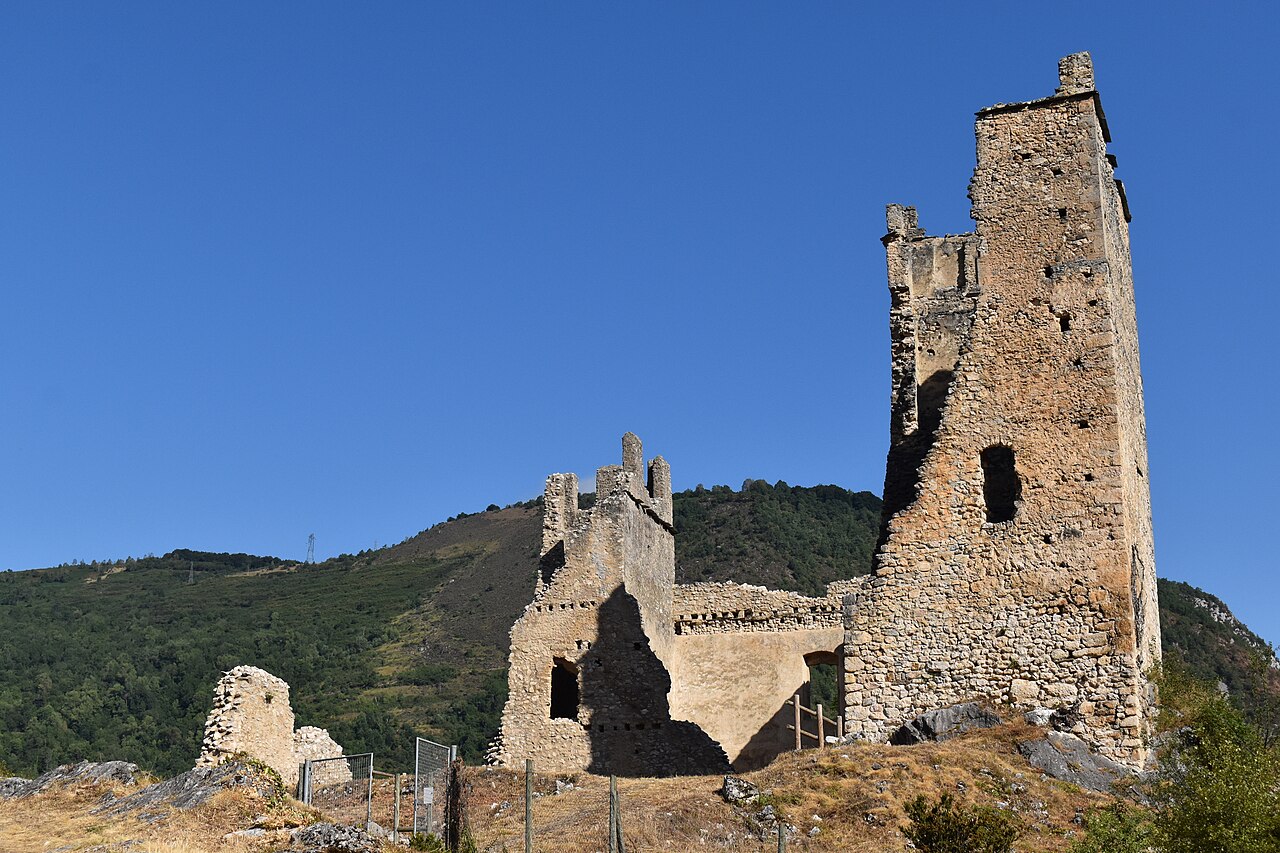
Château de Montréal-de-Sos
The Château de Montréal-de-Sos is a remarkable medieval hill castle located in the commune of Auzat, within the Ariège department of southwestern France. This fortress, perched on a karstic rocky spur at an altitude of approximately 881 meters, commands views over the village of Olbier and the expansive Vicdessos valley. Constructed near the end of the 12th century by the Counts of Foix, the castle served as a crucial comital stronghold overseeing the upper valley and played a pivotal role in regional defense and administration during the High and Late Medieval periods.
Historical significance and role in the region
Throughout the 13th and 14th centuries, the château was a key center for asserting the counts' authority over the surrounding territory. Its strategic position was not only militarily advantageous but also economically significant, particularly in relation to the local iron industry. The castle oversaw mining and metalworking activities centered at Rancié in Sem, helping regulate this vital resource that contributed to the region's economic network. The castle's control over these industries underscores its importance beyond mere military functions, highlighting its role in the economic infrastructure of medieval Ariège.
In the early 15th century, the Counts of Foix undertook the deliberate dismantling or slighting of parts of the castle. This was a strategic move to prevent its use by hostile forces during a period of regional fortification reorganization. Following this slighting, the castle ceased to function as a major military or administrative center, marking the end of its active role in regional power dynamics.
Archaeological importance and prehistoric context
Archaeological investigations led by historian Florence Guillot between 2001 and 2017 have revealed that the site of Château de Montréal-de-Sos has been continuously occupied for over two millennia. The earliest occupation phase dates back to the late Iron Age, possibly representing an oppidum—a fortified settlement typical of the final period of the La Tène culture. This long span of human activity highlights the site's enduring strategic and cultural significance.
Nearby prehistoric monuments, such as the dolmen of Sem, further attest to the area's importance in ancient times. Local traditions and 19th-century discoveries mention decorative wall paintings depicting the Holy Grail and Holy Lance, objects often associated with the legendary Knights Templar. While these connections add to the castle's mystique, they remain unconfirmed by archaeological evidence and should be regarded as part of the site's rich folklore rather than established history.
Architectural layout and defensive features
The castle's remains extend over an area of about 8,000 square meters, forming an elongated parallelogram approximately 150 meters in length oriented northwest to southeast. The site is enclosed by a large outer enceinte dating from the late 12th or early 13th century. This fortified wall was supported by wooden posts that carried a chemin de ronde, or wall walk, enabling defenders to patrol and defend the perimeter effectively.
Interestingly, this outer enclosure also functioned as a water retention structure near the summit's lowest point, a feature that influenced the accumulation of archaeological deposits on the site. The enceinte was flanked by two prominent towers: the Tour du Barri at the northwestern end, with some walls still standing, and the Tour du Campanal at the southeastern end, guarding the main entrance. These towers provided crucial defensive coverage and controlled access to the fortress.
The castle's central aristocratic zone is dominated by a donjon, or main keep, constructed on a motte—an artificial earth mound—near the highest point of the site at about 978 meters elevation. This elevated position, known as the caput castri (Latin for "head of the castle"), is unusual for the Ariège region and emphasizes the donjon's importance within the complex.
The terrain consists of a series of broad terraces separated by narrow vertical steps, adapting to the natural contours of the rock. The highest terrace lies to the northwest, with lower terraces wrapping around the eastern and southeastern flanks. Access to the summit is primarily from the southeast via a mule track, supplemented by fortified cave entrances or porches carved into the cliffs. Some of these rock-cut passageways could be securely barred, enhancing the fortress's defensive capabilities.
Archaeological discoveries and material culture
Excavations at the base of the donjon have revealed a well-preserved archaeological sequence spanning the castle's two-century occupation without interruption. Among the artefacts uncovered was a hand-operated mill used for grinding, alongside a diverse assemblage of medieval objects including pottery shards, bone tools, metalwork fragments, and coins. These finds provide valuable insights into the daily life and material culture of the castle's inhabitants during its active period.
The combination of architectural remains and rich archaeological deposits makes Château de Montréal-de-Sos a site of great historical and cultural importance. It offers a unique window into the medieval period in the Ariège region, illustrating the interplay between military architecture, economic control, and long-term human occupation.
Frequently asked questions (FAQ)
- When was Château de Montréal-de-Sos built?
- Château de Montréal-de-Sos was constructed near the end of the 12th century by the Counts of Foix as a strategic stronghold.
- What is the historical significance of Château de Montréal-de-Sos?
- The castle played a key role in controlling the upper Vicdessos valley and overseeing the local iron industry during the 13th and 14th centuries.
- What remains can visitors see at Château de Montréal-de-Sos?
- Visitors can explore the ruins of the outer enceinte, two defensive towers, the donjon on a motte, and fortified cave entrances carved into the cliffs.
- Is Château de Montréal-de-Sos associated with the Knights Templar?
- Local tradition mentions wall paintings depicting the Holy Grail and Holy Lance linked to the Knights Templar, but these claims lack archaeological confirmation.
- What archaeological discoveries have been made at the site?
- Excavations revealed a continuous occupation sequence with medieval artefacts such as pottery, metalwork, coins, and a hand-operated grinding mill.
Information
Loading map...
Visitor reviews
No reviews yet. Been here? Write the first review and help other travelers!
Write the first reviewVisited this castle? Share your experience
Your review helps other travelers and adds first-hand knowledge to our encyclopedia.