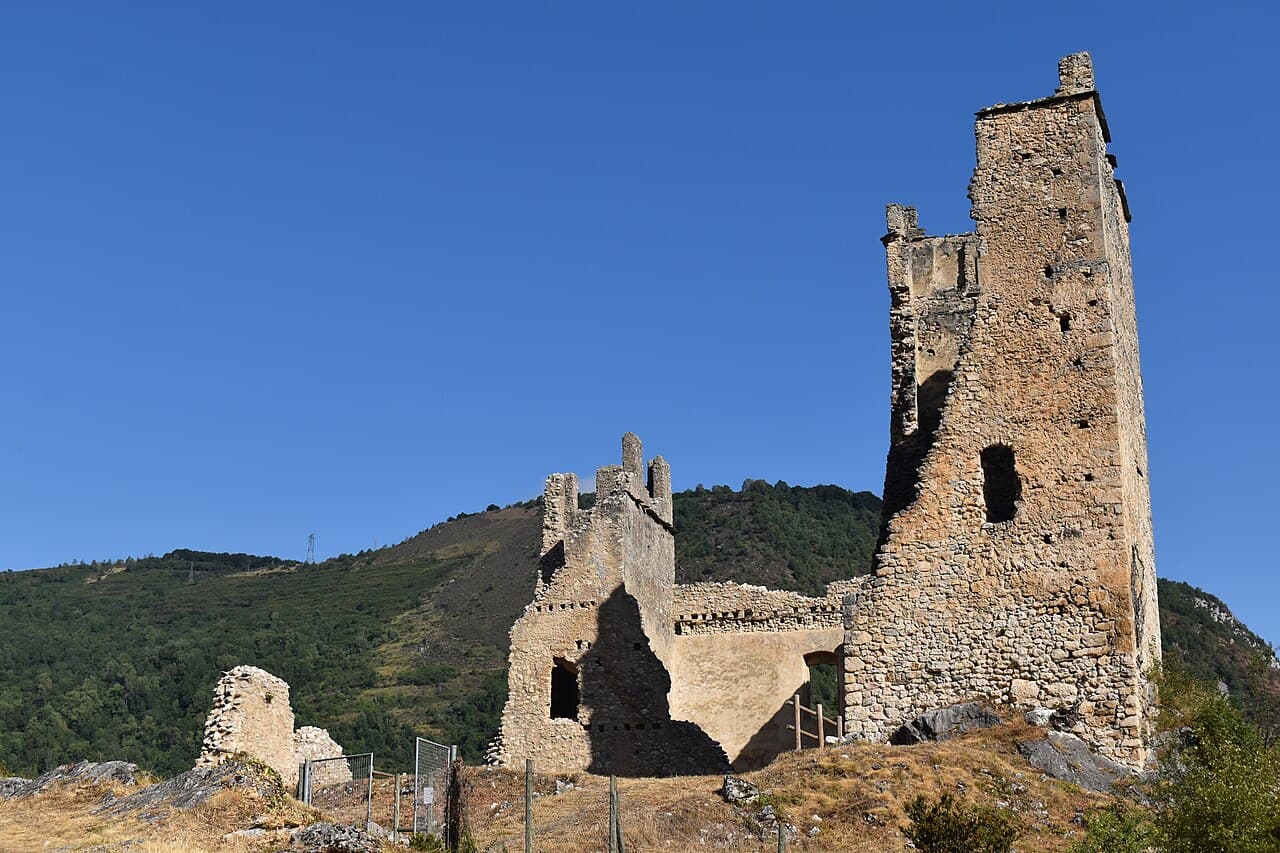
Château de Miglos
Château de Miglos is a 13th-century medieval hill castle located in the commune of Miglos, in the Ariège department of the Occitanie region in southern France. Perched on a limestone promontory at an elevation of around 750 to 779 meters, the castle commands sweeping views over the Vicdessos Valley and surrounding landscapes. Its strategic position enabled control over important medieval routes and served as a defensive stronghold for the County of Foix.
The castle's historical significance is closely tied to the turbulent period of the Albigensian Crusade and the religious conflicts involving the Cathars. First documented in 1213, the castle was dependent on the counts of Foix and functioned as a place of passage and refuge for Cathar Perfects and believers. The lords of Miglos played notable roles in these conflicts, with Arnaud de Miglos imprisoned following the 1244 Siege of Montségur due to his support for the Cathar cause.
Historical context and ownership
The castle appears in records from the early 13th century, linked to Raymond-Roger, Count of Foix. During this era, Château de Miglos was part of a network of fortifications protecting the County of Foix amidst the religious and political upheavals of the High Middle Ages. The castle's allegiance was complex, balancing ties between the Catholic Church and the King of Aragon.
In 1311, Gaston I, Count of Foix, stripped the Miglos family of their holdings due to their Cathar sympathies, transferring the castle to Bernard de Son (also known as Bernard d’Usson), who carried out restoration work in 1320. Over subsequent centuries, ownership passed through several noble families, including the Rabats, d’Arnave, du Léon, Louvie, de Béon, de Goth, and the de Montaut family by the early 17th century.
The 17th century saw the castle deliberately damaged under the orders of Cardinal Richelieu, as part of a broader campaign to dismantle feudal fortresses. Further destruction occurred during the French Revolution, and the site was plundered again in 1830 during the Guerre des Demoiselles, a social uprising in the region.
In the late 20th century, local residents acquired the ruins and later transferred ownership to municipal authorities. Since 1999, conservation efforts have focused on stabilizing the remaining structures. The castle has been officially listed as a national historic monument of France since the late 1980s, recognizing its cultural and historical importance.
Architectural features and layout
The castle's footprint is roughly elliptical, measuring about 100 meters in length and 30 meters across, with the core buildings covering approximately 600 square meters. It is constructed primarily of local limestone, characteristic of the region's geology.
The keep and towers
At the southeast side stands the castle's centerpiece: a rectangular keep (donjon) originally four stories tall and about 19 to 20 meters high, with walls over one meter thick. This imposing tower served as a last line of defense and a residence. Although partly collapsed between 1948 and 1949, early 20th-century photographs show it largely intact, with visible structural cracks. Recent restoration has involved lime injections to strengthen the masonry.
On the northwest edge, a second square tower rises approximately 15 meters high, featuring battlements and containing a dungeon at ground level. Defensive walls connect this tower to the keep, enclosing a section with at least two rooms.
Defensive walls and residential areas
The eastern side of the castle once included a hall with arrow slits (meurtrières) designed to protect the approach. The lord's residence was located towards the northern part of the complex, indicating a clear spatial organization separating defensive and domestic functions.
Cultural significance and preservation
The castle's association with the Cathar movement and its role in the religious conflicts of the 13th century make it a site of considerable historical interest. Its ruins provide insight into the military architecture and feudal society of the High Medieval period in southern France.
Despite centuries of damage from deliberate demolition, revolution, and social unrest, the castle's ruins remain a prominent landmark. Ongoing conservation efforts aim to stabilize the masonry and prevent further deterioration, ensuring the site's legacy endures.
Today, Château de Miglos stands as a testament to the complex history of the region, reflecting themes of faith, power, and resistance. Visitors can explore the ruins and appreciate the castle's commanding views and architectural remnants that illustrate its strategic importance.
Visiting château de miglos
The castle is accessible to the public as a ruin, offering a unique glimpse into medieval fortification and Cathar history. Its elevated location provides panoramic views of the surrounding valleys and villages, making it a rewarding destination for history enthusiasts and hikers alike.
Visitors should be prepared for uneven terrain and limited facilities, as the site is primarily preserved as an archaeological ruin. Guided tours or informational signage may be available seasonally, enhancing understanding of the castle's historical context and architectural features.
Exploring the castle offers insight into the medieval defensive strategies and the turbulent history of the County of Foix, enriching appreciation for this remarkable hill castle ruin in the heart of the Occitanie region.
Frequently asked questions (FAQ)
- What are the opening hours of Château de Miglos?
- Château de Miglos is open to visitors from 10 AM to 6 PM during the peak season, which runs from April to September. In the off-season, the castle operates shorter hours, typically from 10 AM to 4 PM. It is advisable to check the official website for any changes in hours or special closures.
- How do I get to Château de Miglos?
- Château de Miglos is located in the picturesque village of Miglos in France. The easiest way to reach the castle is by car, as public transport options are limited. There is parking available near the entrance, and visitors can enjoy a scenic walk to the castle itself.
- Is it possible to take guided tours of Château de Miglos?
- Yes, guided tours are available at Château de Miglos, providing visitors with in-depth information about the castle's history and architecture. These tours typically last about an hour and are led by knowledgeable guides. It is recommended to book in advance, especially during peak tourist season.
- What is the historical significance of Château de Miglos?
- Château de Miglos dates back to the 13th century and played a crucial role in the defense of the region during the Middle Ages. The castle's strategic location allowed it to oversee important trade routes and provide protection against invaders. Its rich history makes it a fascinating site for history enthusiasts and tourists alike.
- When is the best time to visit Château de Miglos?
- The best time to visit Château de Miglos is during the late spring and early autumn months, specifically from May to June and September to October. During these times, the weather is typically pleasant, and the crowds are thinner compared to the peak summer months. This allows for a more enjoyable experience while exploring the castle and its surroundings.
- Can I bring my children to Château de Miglos?
- Absolutely! Château de Miglos is family-friendly and welcomes visitors of all ages. There are various activities and educational opportunities for children to engage with, making it a great outing for families looking to explore history together.
- What are the ticket prices for Château de Miglos?
- Tickets for Château de Miglos are reasonably priced, with discounts available for children, seniors, and groups. As of the latest update, adult tickets are around €8, while children under 12 can enter for free. It's advisable to check the official website for current pricing and any special offers.
- Are there any nearby attractions to visit while at Château de Miglos?
- Yes, there are several nearby attractions worth visiting, including the beautiful Parc Naturel Régional des Pyrénées Ariégeoises and the charming village of Tarascon-sur-Ariège. Both locations offer stunning natural scenery and additional historical sites, making it easy to plan a full day of exploration.
- Is Château de Miglos accessible for individuals with mobility challenges?
- Château de Miglos has made efforts to improve accessibility for all visitors. While some areas may be challenging due to the castle's historical structure, there are pathways and facilities designed to accommodate those with mobility challenges. It's best to contact the castle directly for detailed accessibility information before your visit.
Photo gallery

Information
Website
Visit websiteSources & official resources
Verify the information above using these authoritative references.
Loading map...
Visitor reviews
No reviews yet. Been here? Write the first review and help other travelers!
Write the first reviewVisited this castle? Share your experience
Your review helps other travelers and adds first-hand knowledge to our encyclopedia.



