Château de Montgilbert
The Château de Montgilbert stands as a remarkable example of a medieval hill castle strategically positioned in the historic region of Auvergne, France. Constructed in the mid-13th century, between 1250 and 1259, this fortress was established by the Saint-Gérand family to control a vital junction where the regions of Auvergne, Forez, and Bourbonnais converged. Its location atop a rocky hill at 565 meters elevation allowed commanding views over the Vareille brook and the surrounding landscape, making it a formidable defensive stronghold during the High Medieval period.
The castle's strategic importance was underscored during its early history when it came under the ownership of the Aycelin family around 1280, a wealthy bourgeois lineage from Auvergne that rose to nobility. Later, the castle passed through marriage to the de Vienne family, reflecting the common medieval practice of property transfer among noble houses. Throughout the Hundred Years' War, from 1434 to 1439, the castle was occupied by Rodrigue de Villandrando, a Spanish mercenary loyal to King Charles VII. This period saw significant military upgrades to the castle, including adaptations to withstand emerging artillery technologies, marking an evolution in its defensive architecture.
Architectural design and fortifications
The Château de Montgilbert is characterized by its concentric defensive layout, with two enclosures adapted to the rugged terrain of its rocky hilltop. The outer enceinte surrounds the basse-cour, a lower courtyard that historically housed servants and support functions. In the 15th century, this outer wall was reinforced to accommodate artillery defense, featuring thick walls with cannon openings and a robust bastion that blocked the original vulnerable entrance.
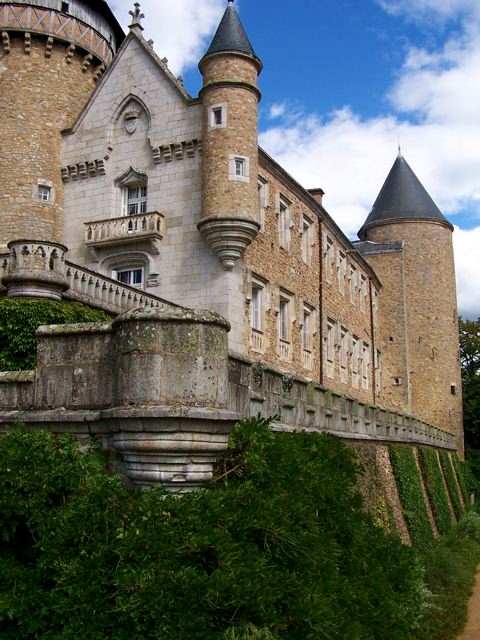
The inner enceinte forms a roughly square plan, defined by four round towers at each corner. These towers contain vaulted chambers, including a chapel, emphasizing the castle's dual role as a military and residential complex. Originally, there were also square towers at the midpoints of the curtain walls, but most have been lost over time. The walls were topped with a chemin de ronde, a covered walkway that allowed defenders to patrol safely along the battlements.
Access to the upper courtyard was controlled by a heavily fortified gate equipped with a portcullis and flanked by two châtelets, small defensive towers. This courtyard contained the lord's residence, including a large hall for formal gatherings, a kitchen with a wide fireplace, and essential service buildings such as storage cellars, a grain silo, and a water cistern. A covered gallery provided sheltered passage along the residence.
15th-century modifications
During the 15th century, several architectural enhancements were made to improve living conditions and defense. Windows were added to bring natural light into the chambers, walls were adorned with murals, and a ramp was constructed to access a smaller secondary gate or postern within the lordly residence. These adaptations reflect the castle's transition from a purely military fortress to a more comfortable noble residence.
Historical significance and ownership
The castle's history is marked by its role in regional power dynamics and military conflicts. The Saint-Gérand and Aycelin families were instrumental in its initial establishment and development. The de Vienne family continued its noble lineage, while the Saulx-Tavannes family acquired it during the Renaissance period. Although the castle gradually lost its status as a primary residence, it remained a symbol of feudal authority in the region.
By the late 17th century, the castle fell into neglect as the owning families, including the des Bravards d’Eyssat Duprat, preferred more modern and comfortable residences such as the nearby Château du Mayet-de-Montagne. The French Revolution marked a turning point when the last owner, Étienne Marie des Bravards d’Eyssat Duprat, fled, and the castle was confiscated and sold as national property between 1793 and 1794.
Decline and preservation efforts
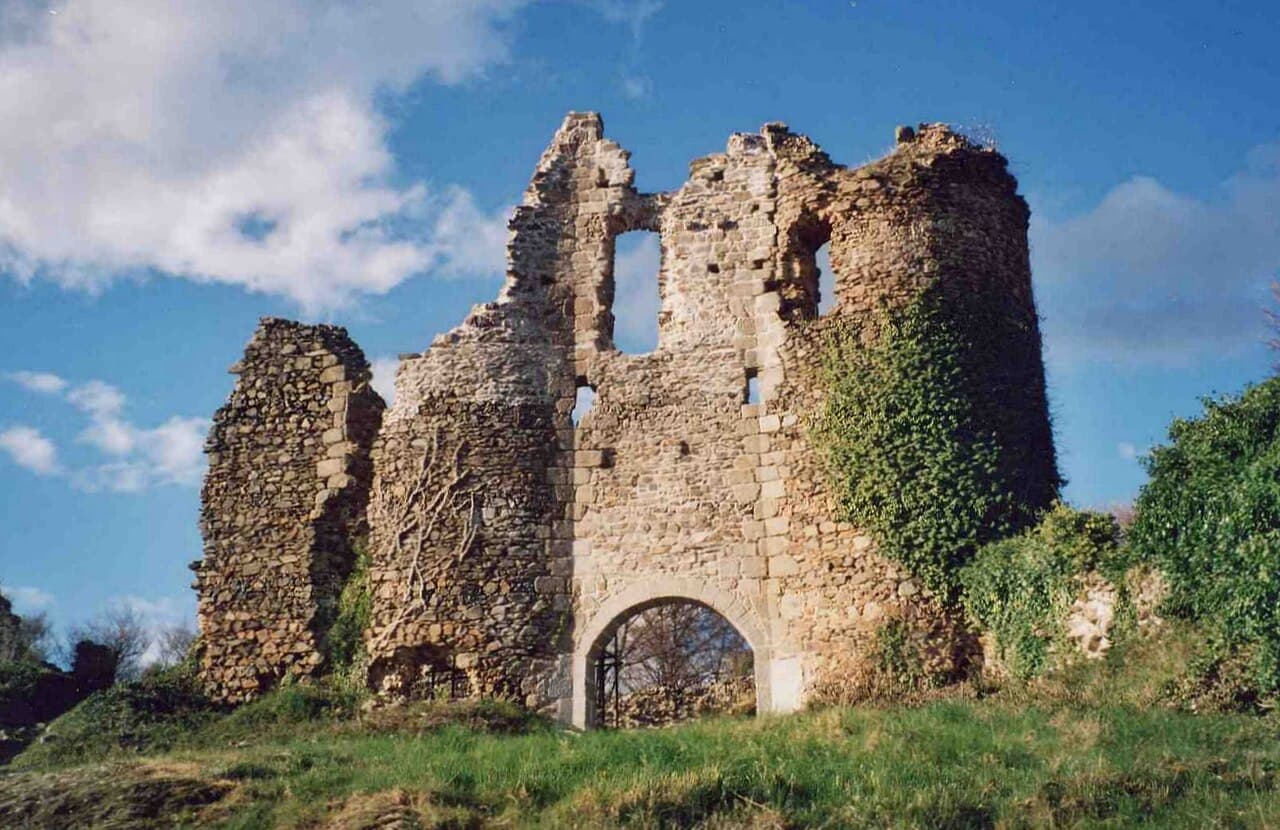
Following its confiscation, the castle suffered significant deterioration. In the 19th century, local inhabitants quarried stones from the ruins, accelerating its decline. Archaeological discoveries in 1867 uncovered Gallo-Roman bronze objects near the site, though no earlier architectural remains have been confirmed. The castle was officially recognized as a historic monument on October 11, 1930.
Since 1974, a dedicated association has undertaken ongoing restoration and preservation efforts to stabilize the ruins and protect the site. These efforts have allowed visitors to appreciate the castle's historical footprint, its medieval architecture, and its significance in the regional history of Auvergne.
Visitor experience and site features
Today, visitors to the Château de Montgilbert can explore the remains of its vaulted chambers, round towers, and the remnants of its fortifications. The castle’s position on a rocky hill provides scenic views of the surrounding countryside and the Sichon river valley. Interpretive signage and guided tours help contextualize the castle's historical and architectural importance.
The site exemplifies the evolution of medieval military architecture, from its 13th-century origins through 15th-century artillery adaptations, offering insight into the changing nature of feudal defense strategies and noble life in France. Preservation efforts continue to ensure that this important cultural landmark remains accessible and informative for future generations.
Frequently asked questions (FAQ)
- How do I get to Château de Montgilbert?
- Château de Montgilbert is located in Ferrières-sur-Sichon, France, and can be reached by car or public transport. The nearest major city is Clermont-Ferrand, approximately 45 kilometers away. Local signage will guide you to the castle once you are in the vicinity, making it relatively easy to find.
- What are the opening hours for Château de Montgilbert?
- The castle is typically open to visitors from 10 AM to 6 PM during the peak season, which runs from April to October. However, it is advisable to check the official website for any seasonal changes or special events that may affect these hours.
- Is there an admission fee to visit Château de Montgilbert?
- Yes, there is an admission fee to enter Château de Montgilbert. Ticket prices are generally around €8 for adults, with discounts available for children, students, and seniors. It's a good idea to purchase tickets in advance during the busy summer months to avoid long queues.
- When was Château de Montgilbert built?
- Château de Montgilbert dates back to the 12th century, showcasing medieval architectural styles. Over the centuries, it has undergone various renovations and restorations, which reflect its historical significance and the evolution of castle design in France.
- Can I take guided tours of Château de Montgilbert?
- Yes, guided tours are available at Château de Montgilbert, providing visitors with in-depth knowledge of the castle's history and architecture. Tours are typically offered in multiple languages and can enhance your experience by offering insights that you might miss on a self-guided visit.
- Why is Château de Montgilbert historically significant?
- Château de Montgilbert holds historical significance due to its role in regional defense during the medieval period. It has witnessed various historical events and changes in ownership, making it a key landmark in understanding the local history of Auvergne.
- What is the best time to visit Château de Montgilbert?
- The best time to visit Château de Montgilbert is during the late spring and early autumn months, when the weather is pleasant and the gardens are in bloom. Visiting during these times also allows you to avoid the peak summer crowds, enhancing your experience.
- Is the château accessible for visitors with mobility issues?
- Château de Montgilbert has made efforts to improve accessibility for visitors with mobility issues, but some areas may still pose challenges due to the castle's historical nature. It is advisable to contact the castle administration in advance to inquire about specific accessibility features and any assistance that can be provided.
- What nearby attractions can I visit while at Château de Montgilbert?
- While visiting Château de Montgilbert, you can explore several nearby attractions, including picturesque villages, hiking trails, and local museums. The region is known for its natural beauty, making it an excellent opportunity for outdoor activities and cultural experiences.
Photo gallery

Photo by LaurentG (talk · contribs)•Public domain
Information
Loading map...
Visitor reviews
No reviews yet. Been here? Write the first review and help other travelers!
Write the first reviewVisited this castle? Share your experience
Your review helps other travelers and adds first-hand knowledge to our encyclopedia.