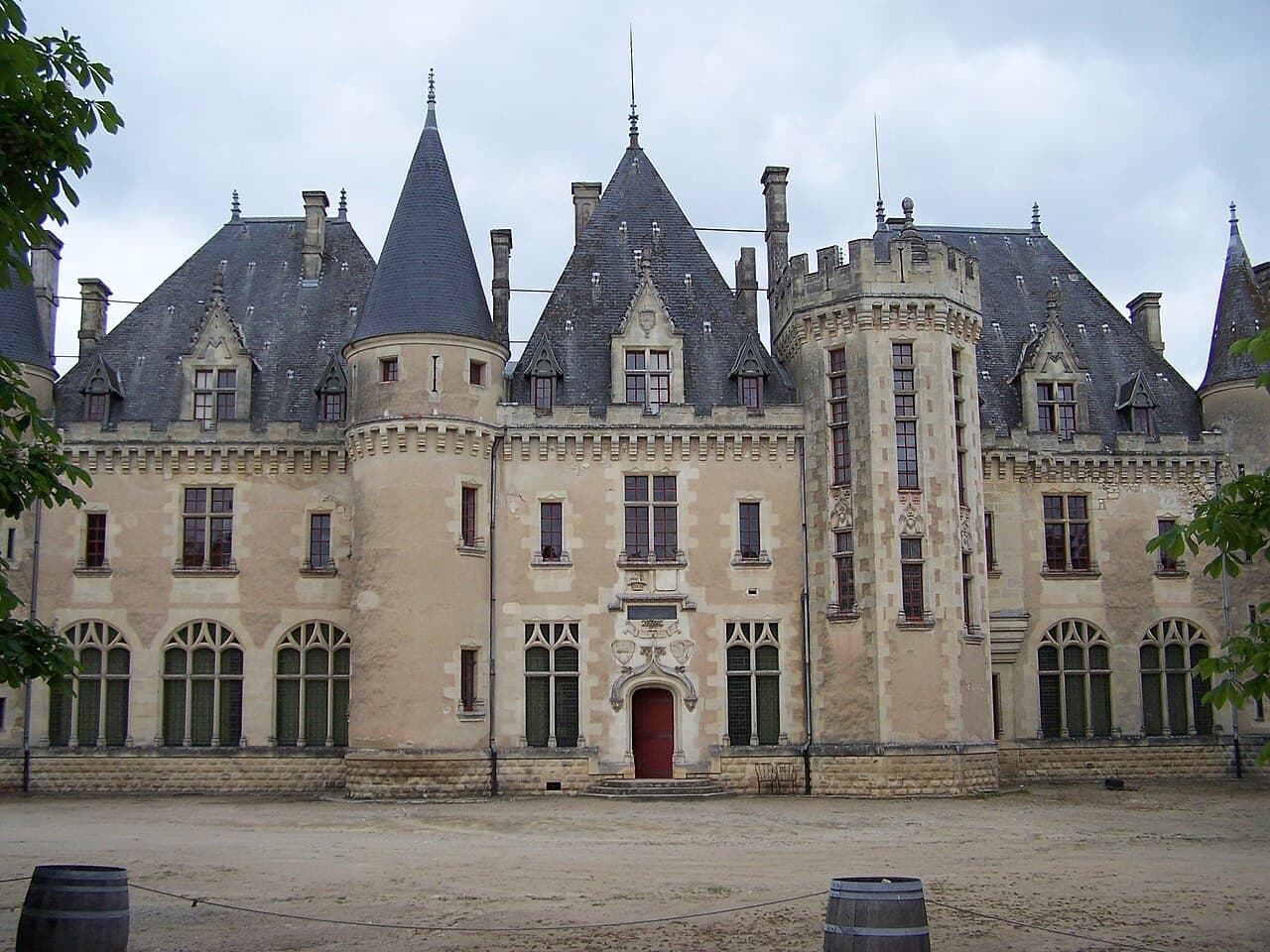
Château de Montaigne
The Château de Montaigne stands as a remarkable symbol of French Renaissance culture and intellectual history, located in Saint-Michel-de-Montaigne, within the Dordogne department of southwestern France. This castle, originally built in the 14th century, occupies a strategic position near the historical border between the Périgord and Bordelais regions. Its fortified structure reflects the medieval necessity for defense in a borderland fraught with conflict and political tension.
The castle’s historical significance is deeply intertwined with the life and works of Michel de Montaigne, the eminent Renaissance philosopher and essayist. From 1571 until his death in 1592, Montaigne lived at the château, where he composed his groundbreaking "Essais" in the castle’s iconic library tower, a space he personally called his "librairie." This tower remains a central architectural and cultural feature, embodying the intellectual spirit of the Renaissance.
Medieval origins and eyquem family ownership
The château was initially constructed as a hill castle in the 14th century, designed primarily for defense. Its location near the volatile border between Périgord and Bordelais made it a strategic stronghold during the medieval period. In 1477, the estate was acquired by Ramon Eyquem, a wealthy Bordeaux merchant who became the hereditary lord of Montaigne. This acquisition established the château within the Eyquem family lineage, which would maintain ownership for several generations.
During the mid-16th century, around 1554, Pierre Eyquem, Michel’s father and a vassal to the Archbishop of Bordeaux, undertook significant fortifications of the castle. These upgrades were motivated by the turbulent context of the French Wars of Religion, a period marked by sectarian conflict and regional instability. The fortifications enhanced the castle’s defensive capabilities, reflecting the need for security amid ongoing hostilities.
Renaissance architectural and cultural significance
The most distinguished architectural feature of the château is its Renaissance-era library tower, which remains intact despite the ravages of time and disaster. This tower is a large round structure topped with oak beams inscribed with 56 Latin maxims and proverbs, some original and others restored in the 20th century. The beams are arranged in an "S"-shaped reading path, a unique design that reflects Montaigne’s scholarly approach to knowledge.
The library itself is circular, approximately 12 meters in diameter, and is illuminated by three large windows offering expansive views of the surrounding landscape. Five tiers of bookshelves line the curved walls, allowing Montaigne to access his extensive collection efficiently from a small flat area where his desk and chair were situated. This innovative design maximized space and facilitated his methodical study and writing.
Interior features and artistic elements
The castle’s interior includes a chapel on the ground floor of the main tower, where Montaigne baptized his children. A concealed hatch allowed him to attend mass privately, highlighting the importance of religious practice and personal privacy. On the first floor, Montaigne’s bedroom adjoins a cabinet that preserves traces of original frescoes, including depictions of Roman charity and an image referencing the ancient painter Zeuxis. These artworks provide insight into the intellectual and cultural milieu of the château’s inhabitants.
Historical events and notable visitors
In 1584, the château served as a political venue when Montaigne hosted King Henry of Navarre, the future Henry IV of France, along with other nobles. This event underscores the château’s role not only as a private residence but also as a site of political and social significance during the late Renaissance.
After Montaigne’s death, his widow Françoise de La Chassaigne continued to reside at the estate. She welcomed Marie de Gournay, Montaigne’s close friend and literary executor, who played a crucial role in preserving and promoting Montaigne’s legacy. The château remained a family residence during this period, maintaining its cultural importance.
19th-century ownership and reconstruction
In the 19th century, the château entered a new phase of ownership when it was purchased in 1860 by Pierre Magne, a minister under Napoleon III. Magne retired to the château and died there in 1879, linking the site to the political history of the Second French Empire.
A catastrophic fire in January 1885 destroyed most of the château except for the library tower. The subsequent reconstruction was carried out in a neo-Renaissance style, contrasting with the preserved Renaissance-era tower. This rebuilding shaped the château’s current architectural appearance, blending historical preservation with 19th-century stylistic revival.
Modern preservation and digital reconstruction efforts
The library tower was officially recognized as a historic monument in 1952, followed by the designation of the remainder of the château and its grounds in 2009. These protections ensure the preservation of the site’s architectural and cultural heritage.
Since 2002, the château has been the focus of digital reconstruction projects, including a virtual recreation of the library completed in 2015 by the Archéovision laboratory of Bordeaux-Montaigne University. These efforts have enhanced public access and understanding of the château’s historical and intellectual significance.
Architectural layout and surviving structures
The surviving structures of the château center around the library tower complex, which includes a large round tower, a smaller round tower containing a spiral staircase, and a small square building known as a corps de logis. This ensemble was designated a historic monument in 1952.
The château is set within a square courtyard surrounded by ramparts, reflecting its medieval defensive origins. The surrounding park, whose layout was designed by Montaigne himself, adds to the site’s aesthetic and historical value.
Additional notable features include a personal chapel on the ground floor, the winter cabinet with fresco remnants, and a discreet hiding place Montaigne used to avoid unwanted visitors. These elements illustrate the multifunctional nature of the château and offer a glimpse into the private life of its most famous resident.
Frequently asked questions (FAQ)
- What is the historical significance of Château de Montaigne?
- Château de Montaigne is renowned as the birthplace of philosopher Michel de Montaigne, who developed the essay as a literary form. The castle itself dates back to the 16th century and reflects the Renaissance architectural style, making it an important landmark in French history.
- When was Château de Montaigne built?
- The construction of Château de Montaigne began in 1565 and was completed in 1588. This period coincided with the height of the Renaissance in France, which is evident in the castle's architectural features and design.
- What are the opening hours for Château de Montaigne?
- Château de Montaigne is open to visitors from March to November, typically from 10 AM to 6 PM. It's advisable to check the official website for specific hours as they may vary based on the season or special events.
- Can I take guided tours of Château de Montaigne?
- Yes, guided tours are available and highly recommended for a deeper understanding of the castle's history and architecture. Tours often include access to the gardens and the interior, providing an enriching experience for visitors.
- Is it possible to visit Château de Montaigne year-round?
- While the castle is primarily open from March to November, it is closed during the winter months. However, special events or private tours may be available upon request during the off-season.
- What are the ticket prices for visiting Château de Montaigne?
- Ticket prices for Château de Montaigne are generally around €8 for adults, with discounts available for students and children. Family tickets and group rates may also be offered, so it's best to check the official site for the latest pricing information.
- When is the best time to visit Château de Montaigne?
- The best time to visit is during the spring and early autumn months when the weather is pleasant, and the gardens are in full bloom. Visiting during weekdays can also help you avoid larger crowds, providing a more personal experience.
- What nearby attractions should I consider when visiting Château de Montaigne?
- Nearby attractions include the picturesque vineyards of the Bordeaux region and the historic town of Saint-Émilion, known for its wine heritage. These locations offer a great opportunity to explore additional cultural and culinary experiences after visiting the castle.
- How do I get to Château de Montaigne?
- Château de Montaigne is easily accessible by car, located approximately 50 km east of Bordeaux. Public transport options may be limited, so driving or taking a taxi is recommended for the most convenient visit.
Photo gallery

Information
Website
Visit websiteSources & official resources
Verify the information above using these authoritative references.
Loading map...
Visitor reviews
No reviews yet. Been here? Write the first review and help other travelers!
Write the first reviewVisited this castle? Share your experience
Your review helps other travelers and adds first-hand knowledge to our encyclopedia.



