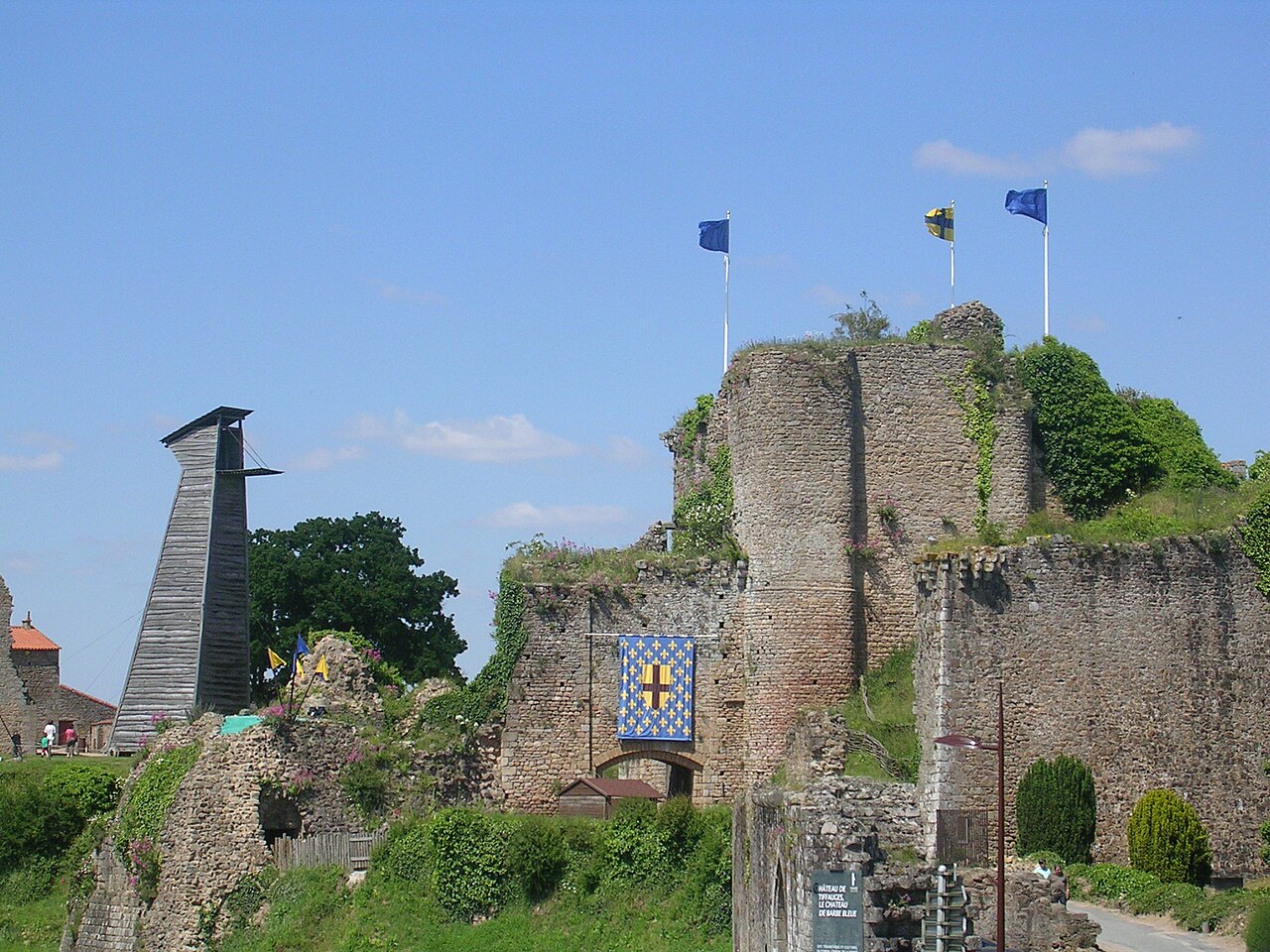
Château de l’Échasserie
The Château de l’Échasserie is a remarkable example of a medieval hill castle located in the Hauts-de-France region of France, specifically in the municipality of La Bruffière. Its origins date back to the 11th century, when it was initially constructed as a wooden donjon to defend the area against Norman raids along a vital Roman road connecting Tiffauges and Saint-Georges-de-Montaigu. This early fortification marked the castle's strategic importance in guarding the borders between the duchies and counties of Brittany, Anjou, and Poitou.
By the high medieval period, the wooden structure was replaced with a stone fortress, reflecting the evolution of military architecture and the need for more durable defenses. The castle’s ownership history is rich, passing through influential families such as the Sauvage family in the 13th century, who had ties to the Knights Templar chapter at La Madeleine in Clisson, and later the Charbonneau family, who maintained control for nearly five centuries.
Architectural features and layout
The castle’s irregular pentagonal plan is defined by five towers positioned at each corner, a design that maximizes defensive coverage. These towers include two square towers on the southwest corner and three round towers on the northwest, northeast, and southeast corners. Four of these towers remain largely intact today, including the distinctive northeast chandelier tower, the southeast large round watchtower, the southwest square tower, and a truncated northwest round tower.
The chandelier tower
The chandelier tower is notable for its rare and elaborate roof structure, restored in the early 1980s using a massive single timber frame weighing around 17 tons. Its roof features decorative elements such as four fleur-de-lys symbols and a weather vane depicting the Sun King, Louis XIV, highlighting an 18th-century royal association. This tower exemplifies the blend of military and symbolic architectural features that characterize the château.
The large round watchtower
The large round tower, also called the watchtower, is unique as it survived the devastating fire of 1793 unscathed. It is adjacent to an early 19th-century residential building and originally featured crenellations and machicolations, defensive elements typical of medieval fortifications. The tower contains a conical spiral staircase designed with narrowing diameter and increasing step height to hinder attackers during sieges, illustrating advanced defensive planning.
The southwest square tower and moat defenses
The southwest square tower dates from the 14th century and stands next to the site of the former chapel. It is separated from the main castle by a small postern gate leading to a broad water-filled moat. This tower includes a defensive firing slit aimed specifically at covering the moat area, underscoring its role in active defense. The moat itself varies in width from 10 to 20 meters, providing a significant barrier against attackers.
Other structural elements
The truncated northwest round tower remains only a few meters tall, marking a fragment of the original fortifications. The main residence was destroyed during the French Revolution, but remnants such as a ground-floor external chimney attached to the southwest square tower survive. The eastern entrance to the château is accessed via a stone bridge crossing the moat, featuring an iron gate adorned with fleur-de-lys finials sourced from a 19th-century Nantes townhouse, linking the site to French royal symbolism.
Historical evolution and ownership
The château’s history is marked by significant events and changes in ownership. After its initial construction, it became associated with the Knights Templar through the Sauvage family’s donation in 1235. The Charbonneau family held the castle from 1250 until 1738, after which it was acquired by the Servanteau de La Brunière family, known shipowners from Les Sables-d’Olonne.
The French Revolution brought destruction and tragedy to the château and its owners. Charles André Augustin Marie Servanteau de l’Échasserie, the then mayor and a former cavalry officer, was executed in 1793. That same year, a military expedition led by General Kléber set fire to the château and much of the surrounding village, sparing only one tower. This event marked the end of the castle’s original medieval form.
In the early 19th century, the estate was acquired by Louis Richard de la Vergne, whose son François Richard de La Vergne became the 131st Archbishop of Paris and cardinal. The château remained in the family lineage, eventually passing to the du Rosel de Saint-Germain family. Recognition of the château’s heritage value came in 1971 when its façades and roofs, particularly of the square tower, watchtower, and chandelier tower, were officially protected as historical monuments.
Post-revolutionary reconstruction and current state
The lordly residence visible today was constructed in the early 19th century using stones from the ruins of the original residence destroyed during the Revolution. This building reflects the post-revolutionary classical architectural style while maintaining continuity with the site’s medieval past.
The original chapel was destroyed during the Revolution, but a new chapel was built on the same site by the de la Vergne family in the 19th century, continuing the religious tradition of the estate. Additional 19th-century structures include stables to the west and a northern curtain wall, completing the expanded estate.
The château’s roofs are covered with slate, consistent with regional styles for prestigious buildings, while outbuildings feature tile roofing typical of agricultural structures. Two narrower stone bridges provide additional access to lands north and south of the château, integrating the fortress with its environment.
Outbuildings around the château have been repurposed as residences, with the southern cluster known locally as “le Chenil.” These buildings, together with the château, form a coherent ensemble reflecting centuries of architectural evolution, noble residence, and defensive needs.
Frequently asked questions (FAQ)
- How do I get to Château de l’Échasserie?
- Château de l’Échasserie is located in the beautiful countryside of France, easily accessible by car or public transport. The nearest train station is approximately 15 kilometers away, and local buses frequently service the area. For those driving, there is ample parking available on-site.
- What is the historical significance of Château de l’Échasserie?
- Château de l’Échasserie dates back to the 15th century and has played a pivotal role in the region’s history. Originally built as a defensive fortress, it later transformed into a luxurious residence for nobility. The castle is a testament to the architectural evolution of the period and remains a symbol of local heritage.
- When was Château de l’Échasserie built?
- Construction of Château de l’Échasserie began in the early 1400s and was completed by the end of the century. It reflects the architectural styles of the late Middle Ages, showcasing both Gothic and Renaissance influences. The castle has been preserved over the centuries, allowing visitors to appreciate its historical context.
- Can I take a guided tour of Château de l’Échasserie?
- Yes, guided tours of Château de l’Échasserie are available for visitors and provide in-depth insights into its history and architecture. Tours typically last about an hour and are led by knowledgeable guides who share fascinating stories about the castle and its past inhabitants. Reservations are recommended, especially during peak tourist seasons.
- Why is Château de l’Échasserie considered an architectural gem?
- Château de l’Échasserie is renowned for its stunning blend of Gothic and Renaissance architectural styles, characterized by intricate stonework and elegant towers. The castle's layout and design reflect the defensive needs of the time while also showcasing the opulence of noble life. Its preservation allows visitors to experience the grandeur of historical architecture firsthand.
- Is it possible to host events at Château de l’Échasserie?
- Yes, Château de l’Échasserie offers facilities for hosting special events such as weddings, corporate gatherings, and private parties. The scenic surroundings and historic ambiance provide a unique backdrop for any occasion. Interested parties are encouraged to contact the castle's management for details on availability and services.
- What are the opening hours for Château de l’Échasserie?
- Château de l’Échasserie is open to the public from Tuesday to Sunday, with varying hours depending on the season. Generally, the castle opens at 10 AM and closes at 6 PM, but it's advisable to check the official website for any seasonal changes. Closed days are typically observed on Mondays and certain holidays.
- What are the ticket prices for visiting Château de l’Échasserie?
- Ticket prices for Château de l’Échasserie vary depending on age and group size, with discounts available for students and seniors. Adult tickets are typically priced around €10, while children under 12 can enter for free. Group rates are also offered, making it an affordable option for families and school trips.
- When is the best time to visit Château de l’Échasserie?
- The best time to visit Château de l’Échasserie is during the spring and early autumn months when the weather is pleasant, and the gardens are in full bloom. Summer can be quite busy with tourists, while winter months may limit access to outdoor areas. Planning your visit during weekdays can also help avoid crowds.
- Are there any nearby attractions to visit along with Château de l’Échasserie?
- Yes, there are several nearby attractions that complement a visit to Château de l’Échasserie, including local vineyards offering tours and tastings. Additionally, the charming village of Échasserie features quaint shops and restaurants that provide a taste of local culture. Exploring the surrounding countryside can also reveal beautiful walking trails and scenic views.
Information
Loading map...
Visitor reviews
No reviews yet. Been here? Write the first review and help other travelers!
Write the first reviewVisited this castle? Share your experience
Your review helps other travelers and adds first-hand knowledge to our encyclopedia.