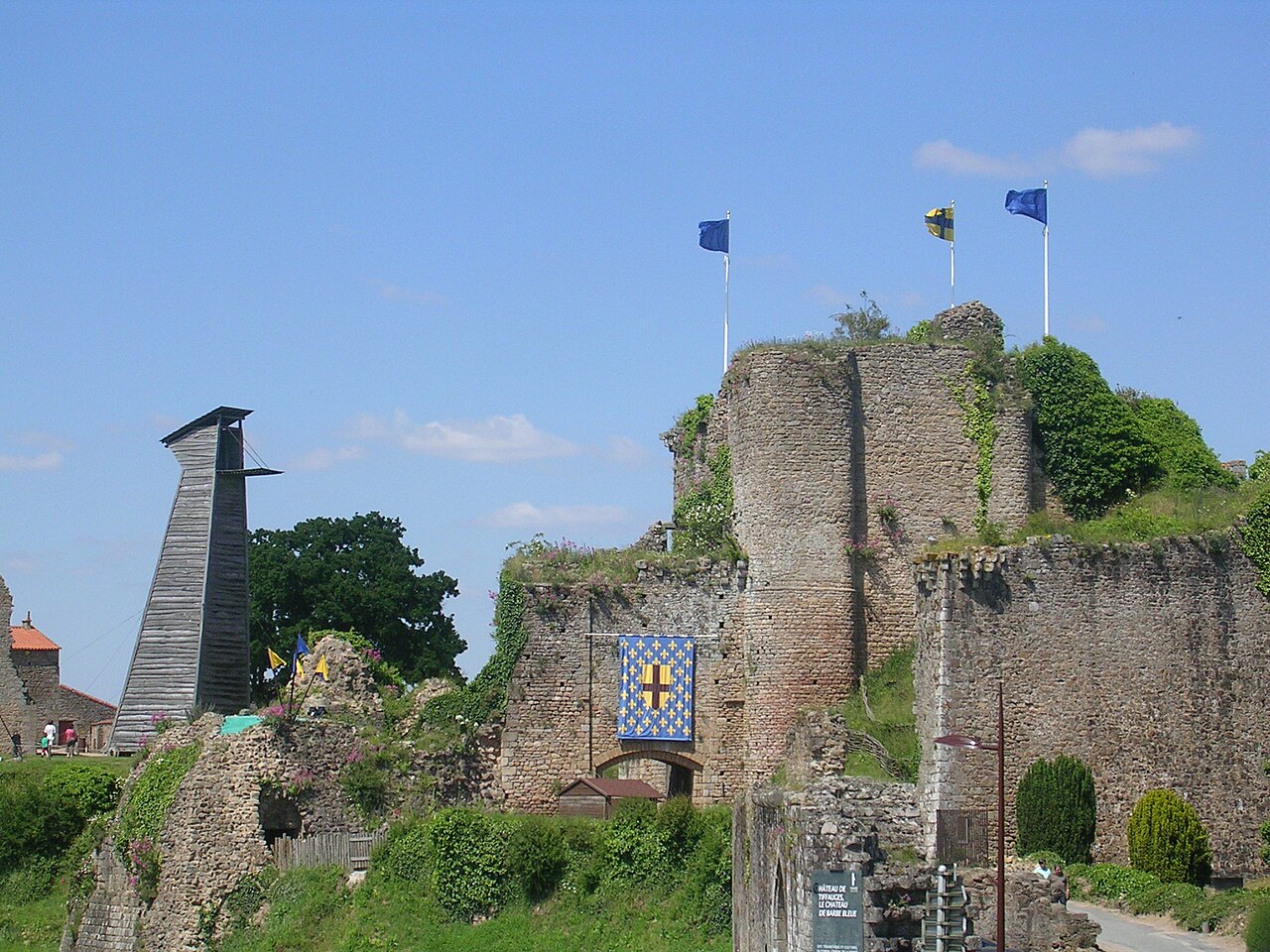
Château de Mortagne-sur-Sèvre
The Château de Mortagne-sur-Sèvre stands as a remarkable example of medieval military architecture in western France, located in the town of Mortagne-sur-Sèvre. Its strategic position on a granite promontory overlooking the left bank of the Sèvre Nantaise river allowed it to dominate the surrounding valley and control vital access routes, reflecting its historical importance as both a defensive stronghold and administrative center.
Constructed primarily during the 11th and 12th centuries, the castle originated as a baronial seat under the authority of the Viscounts of Thouars. Early lords such as Antier I and his grandson Guillaume I, nicknamed Chotard, established the fortress’s foundations. The lineage of the Chotard family ended with Sybille Chotard, whose marriage to Pierre III de Chemillé transferred ownership to the Chemillé family. Over subsequent centuries, the castle passed through the hands of several noble families, including the Thouars, de La Haye, Scépeaux, Gondy, and finally the Neuville de Villeroy family, who maintained possession until the upheavals of the French Revolution.
The castle's role in medieval conflicts
During the Hundred Years’ War (1337–1453), the Château de Mortagne-sur-Sèvre gained heightened military significance. Between 1346 and 1373, the fortress was captured and fortified by English forces as part of their campaign to control this strategic frontier region. The French, under commanders such as Olivier de Clisson and the celebrated Bertrand du Guesclin, made persistent efforts to reclaim the castle. In 1373, an exchange involving the English captain Jean d’Évreux resulted in the fortress returning to French control, marking a pivotal moment in the local conflict.
Architectural evolution and military enhancements
In response to evolving military technology and ongoing political tensions in the late 16th century, the castle underwent significant modifications. A prominent addition was the construction of a large artillery tower, locally known as the "tour des Anglais" (English Tower). This cylindrical tower, supported by robust buttresses, was specifically designed to mount heavy artillery, enhancing the fortress's defensive capabilities. Its unique structural design remains a rare example of artillery fortifications from this period in France.
The castle’s defensive system also included the "tour du Trésor" (Treasury Tower), which featured internal doorways connecting it to other parts of the complex. This suggests multifunctional use, likely combining secure storage with administrative functions.
Residence of Henry of Navarre and later adaptations
In September 1588, the castle hosted Henry of Navarre, the future King Henry IV of France, underscoring its continued strategic and political importance during the turbulent Wars of Religion. This event highlights the castle's role not only as a military bastion but also as a site of political significance.
By the early 20th century, the fortress saw a transformation in purpose with the construction of a manor house within the castle enclosure. Situated between the tall ramparts and the artillery tower, this residence blended the medieval defensive architecture with more modern domestic styles, reflecting a shift from military use to a more residential function.
Structural layout and surviving features
The castle’s layout takes advantage of the natural topography, with stone walls following the contours of the granite plateau’s southwest spur. The fortress was designed as an enclosed complex with multiple towers, enabling control over the surrounding valley and access routes.
The most striking surviving feature is the large cylindrical artillery tower or "tour des Anglais", which stands prominently as a symbol of the castle’s late 16th-century military upgrades. Its buttressed construction and size distinguish it from typical medieval towers, reflecting innovations in fortification to accommodate artillery.
The "tour du Trésor" remains another significant remnant, with evidence of internal connectivity, indicating its role beyond mere defense.
Fortifications of the surrounding town
Beyond the castle itself, the adjacent fortified town was protected by three rings of defensive walls. Although much of these fortifications have not survived intact, their approximate layout is documented on Napoleonic cadastral maps. These maps reveal the locations of several fortified gates, including the Nantaise, Rochelaise, Saint-Louis, Poitiers, Bourneau, Bourbouttault (Bourbetault), and Bourneuf gates. These gates correspond to modern streets such as rue des Étangs and rue Nationale.
The town developed under the castle’s protection on the plateau behind it, forming an integrated defensive and urban system. This combined military and civic arrangement illustrates the castle’s dual role in regional defense and community governance from the medieval period through early modern times.
Frequently asked questions (FAQ)
- What is the historical significance of Château de Mortagne-sur-Sèvre?
- Château de Mortagne-sur-Sèvre played a key role during the Hundred Years’ War and hosted important historical figures like Henry of Navarre, reflecting its military and political importance.
- Can visitors see the artillery tower at the castle?
- Yes, the large artillery tower known as the "tour des Anglais" is a prominent surviving feature and can be viewed by visitors exploring the castle grounds.
- When was the castle originally built?
- The castle's origins date back to the 11th and 12th centuries, constructed as a medieval fortress by local lords under the Viscounts of Thouars.
- Is the castle accessible to the public?
- Visiting information varies, but the castle grounds and some structures are accessible to the public. It's advisable to check local resources for current opening hours and access guidelines.
- What architectural styles are visible at Château de Mortagne-sur-Sèvre?
- The castle exhibits a mixed architectural style, combining medieval defensive structures with later additions like the 16th-century artillery tower and early 20th-century residential buildings.
Information
Website
Visit websiteSources & official resources
Verify the information above using these authoritative references.
Loading map...
Visitor reviews
No reviews yet. Been here? Write the first review and help other travelers!
Write the first reviewVisited this castle? Share your experience
Your review helps other travelers and adds first-hand knowledge to our encyclopedia.