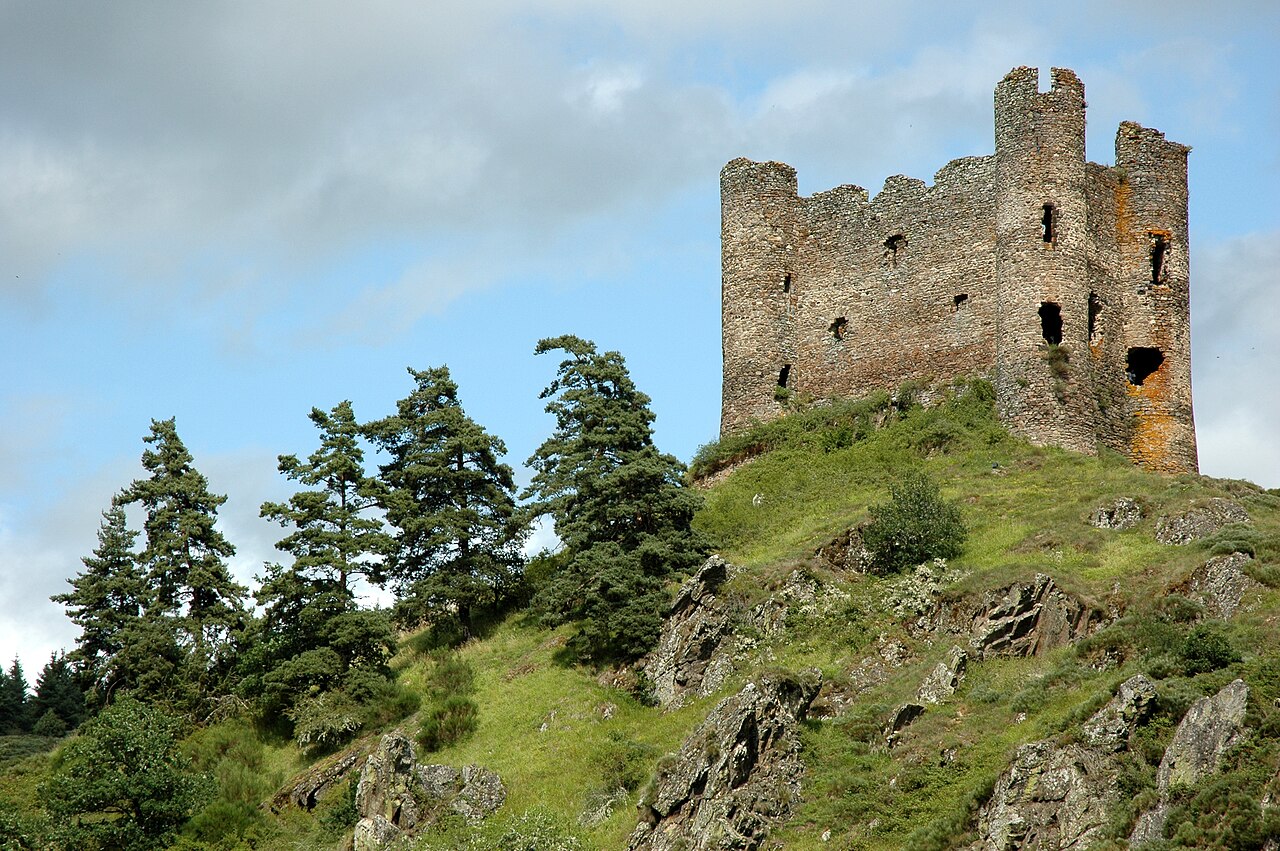
Château de Fournels
Château de Fournels stands as a remarkable example of a Renaissance fortified manor strategically positioned to dominate three valleys in the region of Hauts-de-France, France. Originally constructed by the influential Apcher barons in the medieval period, the château underwent significant rebuilding in 1573 under the direction of Jean d'Apcher, an illegitimate son legitimized in 1571. This reconstruction transformed the estate into a robust defensive residence with thick masonry walls and multiple towers, reflecting the turbulent era's need for security and military readiness.
The château's commanding location provided extensive oversight of the surrounding landscape, a critical factor in its defensive design. Its thick walls, pierced by narrow loopholes, allowed defenders to observe and repel attackers while remaining protected. The presence of several defensive towers reinforced its role as a stronghold rather than a purely residential estate. Throughout its history, Château de Fournels was not only a military bastion but also a noble residence adorned with period furniture, tapestries, and artwork, although these interior elements have since been removed.
Historical significance and noble lineage
The origins of Château de Fournels trace back to the medieval Apcher family, whose influence in the region dates to the mid-11th century. The Apchers maintained multiple strongholds, including nearby ruins around Albaret-Sainte-Marie and Arzenc-d’Apcher, underscoring their longstanding regional authority. Jean d'Apcher, who spearheaded the 1573 rebuilding, was the legitimized illegitimate son of François Martin, baron d’Apcher. His formal recognition to bear the Apcher coat of arms in 1571 marked a consolidation of family status and power.
Jean's marital alliances further strengthened the château's noble connections. His first marriage to Jeanne, the illegitimate daughter of Louis de Lastic, grand-prior of the Order of Saint John of Jerusalem in Auvergne, linked the Apchers to prominent military and religious orders. The Lastic family played a notable role in French history, including participation in the 1627 siege of La Rochelle, a pivotal event during the French Wars of Religion. Descendants such as Florimond de Lastic and Marie de Lastic d’Auteville, who was involved in the debut of Jean Racine’s play "Esther" at the Saint-Cyr school, highlight the family's cultural and historical prominence.
Connections to the Michel du Roc family and Napoleonic era
In the 18th century, the château passed into the hands of the Michel du Roc family through the marriage of Amélie de Lastic to Géraud Pierre de Michel du Roc, marquis de Brion. This family held extensive estates across Gevaudan, Quercy, and Languedoc, with their marquisate formally established in 1756. The Michel du Roc lineage maintained significant influence, including ties to Napoleonic circles such as the duke of Frioul and the abbé de Pradt. Dominique de Lastic de Fournels, born in 1742, served as the last bishop of Couserans, underscoring the family's continued religious and social importance.
Throughout the 19th and 20th centuries, the château remained in the possession of the Michel du Roc descendants, preserving its connection to regional nobility. Its historical and architectural value was officially recognized in 1961 when it was partially listed as a French historic monument.
Architectural features and defensive design
The château exemplifies the characteristics of a fortified manor house from the Renaissance period, primarily designed for defense rather than ornamental grandeur. Its thick masonry walls and defensive towers were constructed to withstand sieges and attacks, while the narrow loopholes allowed for effective surveillance and defense. The building's elevated position overlooking three valleys provided strategic advantages, enabling control over key routes and early warning of approaching threats.
Despite its military features, the château also functioned as a noble residence. It once housed period furniture, tapestries, and paintings that reflected the status and tastes of its occupants. However, these interior elements have been removed over time, and the château now stands empty and abandoned, preserving its authentic architectural form but lacking its former decorative richness.
Current condition and access
Today, Château de Fournels exists in a state of neglect but retains much of its original character and authenticity. It is accessible via the "Tour des monts d’Aubrac", a marked hiking trail that highlights the castle's integration within its natural landscape. The site offers visitors a unique opportunity to explore a Renaissance fortified manor in a picturesque setting, although no specific decorative features or archaeological artifacts have been documented on-site.
The château's preservation as a partially listed historic monument ensures its continued recognition as a significant cultural and architectural heritage site in the Hauts-de-France region. Its blend of military architecture and noble history makes it a valuable example of Renaissance fortifications adapted for residential use.
The château in regional context
Château de Fournels is part of a broader network of medieval and Renaissance strongholds in the region, illustrating the complex feudal and military history of the area. The Apcher family's multiple holdings, including the nearby Apcher tower and ruins at Albaret-Sainte-Marie, demonstrate the strategic importance of controlling high ground and key valleys during the Middle Ages and Renaissance.
The château's location in Hauts-de-France situates it within a historically contested zone that saw various conflicts and power struggles, including religious wars and regional disputes. Its defensive features reflect the need for security in such a volatile environment, while its noble associations highlight the intertwined nature of military and social status in French history.
Cultural heritage and tourism potential
While currently abandoned, Château de Fournels holds significant potential for cultural tourism due to its rich history and impressive architectural features. Its accessibility via hiking trails and proximity to other historic sites in the region make it an attractive destination for visitors interested in medieval and Renaissance history, military architecture, and French nobility.
Efforts to preserve and promote the château could enhance its role as a heritage site, contributing to local cultural identity and economic development through tourism. The château's story, spanning centuries of noble lineage and historical events, offers a compelling narrative for educational and interpretive programs.
Frequently asked questions (FAQ)
- How do I get to Château de Fournels?
- Château de Fournels is located in the charming village of Fournels in France. Visitors can reach the castle by car or public transport, with the nearest major city being Mende, which is about 30 kilometers away. There are also local buses that connect to surrounding areas.
- What is the historical significance of Château de Fournels?
- Château de Fournels dates back to the 12th century and has a rich history tied to the region's feudal past. It has served various roles over the centuries, including as a defensive stronghold and a noble residence. Today, it stands as a testament to medieval architecture and the historical narratives of the Auvergne region.
- When was Château de Fournels built?
- Construction of Château de Fournels began in the 12th century, making it one of the oldest castles in the area. It has undergone several renovations and restorations throughout its history, reflecting different architectural styles from various periods. Its enduring presence showcases the evolution of defensive architecture in France.
- Can I visit Château de Fournels?
- Yes, Château de Fournels is open to visitors throughout the year, allowing them to explore its historical grounds and learn about its significance. Guided tours are often available, providing deeper insights into the castle's history and architecture. Be sure to check the official website for any seasonal events or special openings.
- Why is the architecture of Château de Fournels unique?
- The architecture of Château de Fournels is notable for its medieval design, featuring thick stone walls and imposing towers that reflect its original defensive purpose. The mixture of Romanesque and Gothic elements showcases the evolution of architectural styles over the centuries. Visitors can admire both the functional aspects and the beauty of its design.
- Is it possible to access all areas of the castle?
- While many areas of Château de Fournels are accessible to visitors, some sections may be restricted due to preservation efforts. Guided tours typically include the main rooms and grounds, providing a comprehensive view of the castle's history. It’s advisable to check in advance if you have specific accessibility needs.
- What are the opening hours for Château de Fournels?
- Château de Fournels generally opens to the public from 10 AM to 6 PM, with extended hours during the summer months. However, hours may vary based on the season, so it’s recommended to check the official website before planning your visit. Special events may also affect opening hours.
- What are the ticket prices for Château de Fournels?
- Tickets for Château de Fournels are reasonably priced, with discounts available for students, seniors, and groups. Admission typically includes a guided tour of the castle and its grounds. Check the castle's official website for the most current pricing and any special promotions.
- When is the best time to visit Château de Fournels?
- The best time to visit Château de Fournels is during the spring and early autumn months when the weather is mild and pleasant. These seasons also offer fewer crowds, allowing for a more enjoyable experience while exploring the castle. Additionally, special events and festivals often occur during these times, enhancing your visit.
- Are there any nearby attractions to visit while at Château de Fournels?
- Yes, there are several nearby attractions that complement your visit to Château de Fournels. The stunning landscapes of the Cevennes National Park are just a short drive away, offering hiking and outdoor activities. Additionally, the historic town of Mende, with its rich heritage and charming streets, is also worth exploring.
Information
Loading map...
Visitor reviews
No reviews yet. Been here? Write the first review and help other travelers!
Write the first reviewVisited this castle? Share your experience
Your review helps other travelers and adds first-hand knowledge to our encyclopedia.