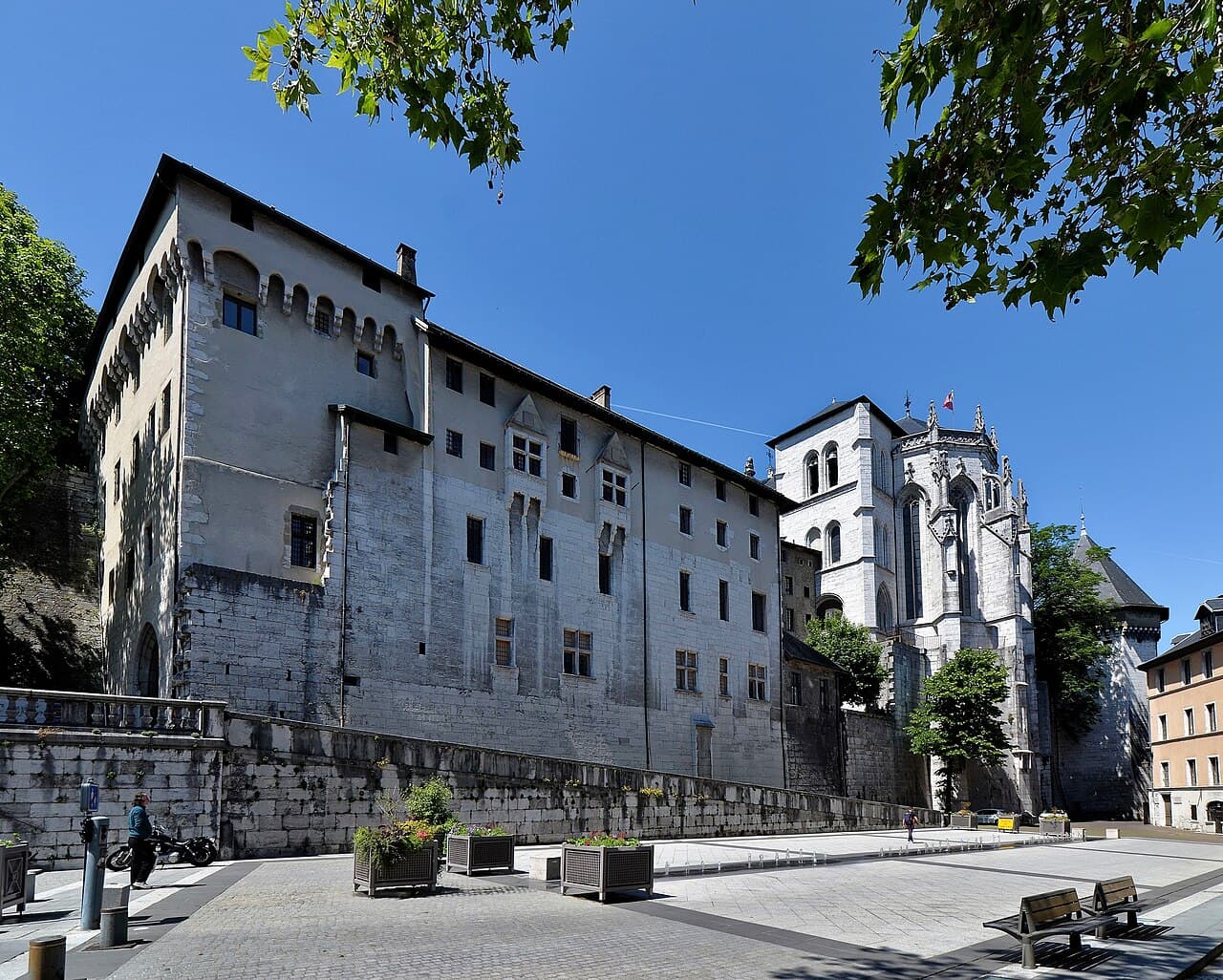
Château de Chambéry
The Château de Chambéry stands as a significant medieval fortress located in the city of Chambéry, within the Auvergne-Rhône-Alpes region of France. Originally constructed in the 11th century by the medieval lords of Chambéry near the ancient Roman settlement of Lemencum, this castle evolved into a central hub for political and administrative power in the region. Its strategic position on a raised earthwork known as a motte provided a defensive advantage, typical of early medieval fortifications.
Medieval origins and the house of savoie
The castle's prominence rose significantly in 1295 when Amédée V, Count of Savoie, acquired it, designating the château as the main residence and administrative center for the Counts of Savoie. This marked the beginning of extensive construction phases throughout the late 13th, 14th, and 15th centuries, transforming the castle into a fortified complex with multiple defensive towers and residential quarters. The castle's layout today reflects this layered history, featuring an irregular quadrilateral plan shaped by centuries of architectural evolution.
Fortifications and defensive architecture
The château's fortifications were enhanced with the addition of several towers, including the Tour demi-ronde (a semi-circular tower built in 1398), which served as a key defensive structure. This tower, restored in the early 19th century, provides access to the north wing currently housing the departmental council. Other notable towers include the Tour Trésorerie from the 14th to 15th centuries and the Tour du Carrefour (also known as the Tour des Archives), constructed in 1439. The Tour du Carrefour features vaulted chambers and machicolations, defensive openings that allowed defenders to repel attackers by dropping projectiles or shooting arrows. It also functioned as a prison and archive storage over time.
The main gate complex, originally on the west side and guarded by the Tour des Poudres and Tour aux Armes, included a drawbridge over a moat and a ramp leading to a terrace. This entrance was later relocated to the northeast side, featuring fortifications built between 1318 and 1330. The gate complex includes a rectangular tower from the late 15th century and the Porte de la Herse (gate of the portcullis) dating to 1302–1303. The portcullis was a heavy grated barrier operated by mechanisms in a chemin de ronde, with stone grooves still visible today.
The sainte-chapelle and religious significance
One of the château's most distinguished architectural features is the Sainte-Chapelle, a flamboyant Gothic chapel built between 1408 and 1430 by architect Nicolas Robert. The chapel features a single nave leading to a five-sided apse and includes two side galleries—one reserved for the duke and the other housing the organ. Inside, visitors find a marble altar from the 18th century adorned with gilded woodwork and stained glass windows from the 16th century, which underwent careful restoration in 2002. The chapel is historically notable for housing the Holy Shroud from 1502 to 1578, a revered religious relic attracting pilgrims and dignitaries alike.
In 1641, the chapel's façade was rebuilt in a classical style by Amadeo de Castellamonte, reflecting evolving architectural tastes. The château’s bell tower, known as the Tour Yolande, was constructed in 1470 under the direction of Blaise Neyrand, commissioned by Yolande de France. This tower houses a carillon of 70 bells created by the Paccard foundry in 1993, continuing a tradition dating back to a bell arrangement displayed at the 1937 Universal Exhibition. Concerts featuring this carillon are held regularly, adding a cultural dimension to the château's historic fabric.
Administrative role and historical events
After serving as the seat of the ruling House of Savoie until 1562, when the capital moved to Turin, the château retained its importance as an administrative center. It housed the Chambre des Comptes (financial court), various government offices, and the Intendance Générale, a regional administrative authority. The château's role extended beyond governance, hosting significant events such as the baptism of Amédée VIII in 1383 and the ducal celebration in 1416 marking Savoy’s elevation from a county to a duchy. It also witnessed royal marriages and political shifts, including surrender during the Franco-Savoyard War in 1600.
Damage and restoration efforts
The château endured several destructive events, including major fires in 1532, 1743 during a Spanish occupation, and a catastrophic blaze in 1798 that destroyed much of the complex and its archives. Restoration began in the early 19th century, notably under Napoleon I in 1805, who initiated reconstruction to revive the château’s structures and administrative functions.
Following the annexation of Savoie to France in 1860, the château was transferred to the local department of Savoie. Under Napoleon III, architects Dénarié and Duban expanded the château with a new wing and grand staircase. Later 19th-century renovations by architect Ernest Mélano restored royal apartments and central sections, preserving the château’s historical character while adapting it for modern use.
Architectural features and surviving elements
The château’s irregular quadrilateral layout incorporates elements from various periods, primarily the 14th and 15th centuries. The original 11th-century keep was destroyed in the 1798 fire, but lower rooms from this phase were rediscovered in 1935 and are accessible through a subterranean passage. The château also includes a relocated portal from the former Saint-Dominique monastery, moved in 1892.
Defensive towers such as the Tour demi-ronde, Tour Trésorerie, and Tour du Carrefour remain integral to the château’s silhouette. The ramparts and many medieval buildings have been lost to demolition or fire, with only two of the original four defensive towers surviving by the 18th century. The grounds now feature gardens established on the footprints of former structures.
Inside, a vaulted passageway with machicolations connects parts of the complex, and preserved government offices from the 14th century illustrate the château’s administrative continuity. The Prince’s apartment reflects the residential aspect of the fortress, offering insight into the lifestyle of its noble inhabitants.
Cultural heritage and current use
Today, the Château de Chambéry houses the Savoie Prefecture, the Savoie Departmental Council, and the Savoie Academy. It remains a focal point of regional governance and cultural identity. The château is classified as a historic monument since 1881, with the grand salon, featuring Louis XVI style decoration, separately listed since 1960.
Visitors can experience the château’s rich history through its preserved architectural features, the Sainte-Chapelle, and the regular carillon concerts held in the Tour Yolande. The château’s layered history, spanning from its medieval origins to its modern administrative role, makes it a unique example of a hill castle that has continuously adapted to changing political and cultural contexts.
Frequently asked questions (FAQ)
- What is the history of Château de Chambéry?
- Château de Chambéry has a rich history dating back to the 13th century. Originally a fortress, it became the residence of the Counts of Savoy and later served as an administrative center, reflecting the political significance of the region.
- When is Château de Chambéry open to visitors?
- Château de Chambéry is typically open to visitors from Tuesday to Sunday, with hours varying by season. It is advisable to check the official website for the most current opening times and any special holiday hours.
- Can I buy tickets in advance for Château de Chambéry?
- Yes, you can purchase tickets in advance through the official website or at the entrance. Buying tickets online can help you avoid long lines and ensure your entry on busy days.
- Is there accessibility for visitors with disabilities at Château de Chambéry?
- Château de Chambéry strives to provide accessibility for all visitors. However, due to the historical nature of the castle, some areas may be challenging to navigate; it's best to contact the castle administration for specific accessibility information.
- What are the nearby attractions to Château de Chambéry?
- Nearby attractions include the beautiful Lake Bourget and the stunning Parc de la Chênaie. Additionally, the historic town center of Chambéry offers charming streets, shops, and local cuisine to explore after your visit to the castle.
- When is the best time to visit Château de Chambéry?
- The best time to visit Château de Chambéry is during the spring and early fall when the weather is mild, and the gardens are in full bloom. These seasons also tend to attract fewer tourists, allowing for a more enjoyable experience.
- What architectural features can I expect to see at Château de Chambéry?
- Château de Chambéry showcases a blend of architectural styles, including medieval, Renaissance, and classical elements. Visitors can admire its imposing towers, intricate stonework, and beautifully preserved interiors reflecting its storied past.
- How much does it cost to visit Château de Chambéry?
- Ticket prices for Château de Chambéry vary depending on age and special exhibitions. Generally, adult tickets are reasonably priced, with discounts available for students, seniors, and children, making it accessible for a wide audience.
Photo gallery

Information
Website
Visit websiteSources & official resources
Verify the information above using these authoritative references.
Loading map...
Visitor reviews
No reviews yet. Been here? Write the first review and help other travelers!
Write the first reviewVisited this castle? Share your experience
Your review helps other travelers and adds first-hand knowledge to our encyclopedia.



