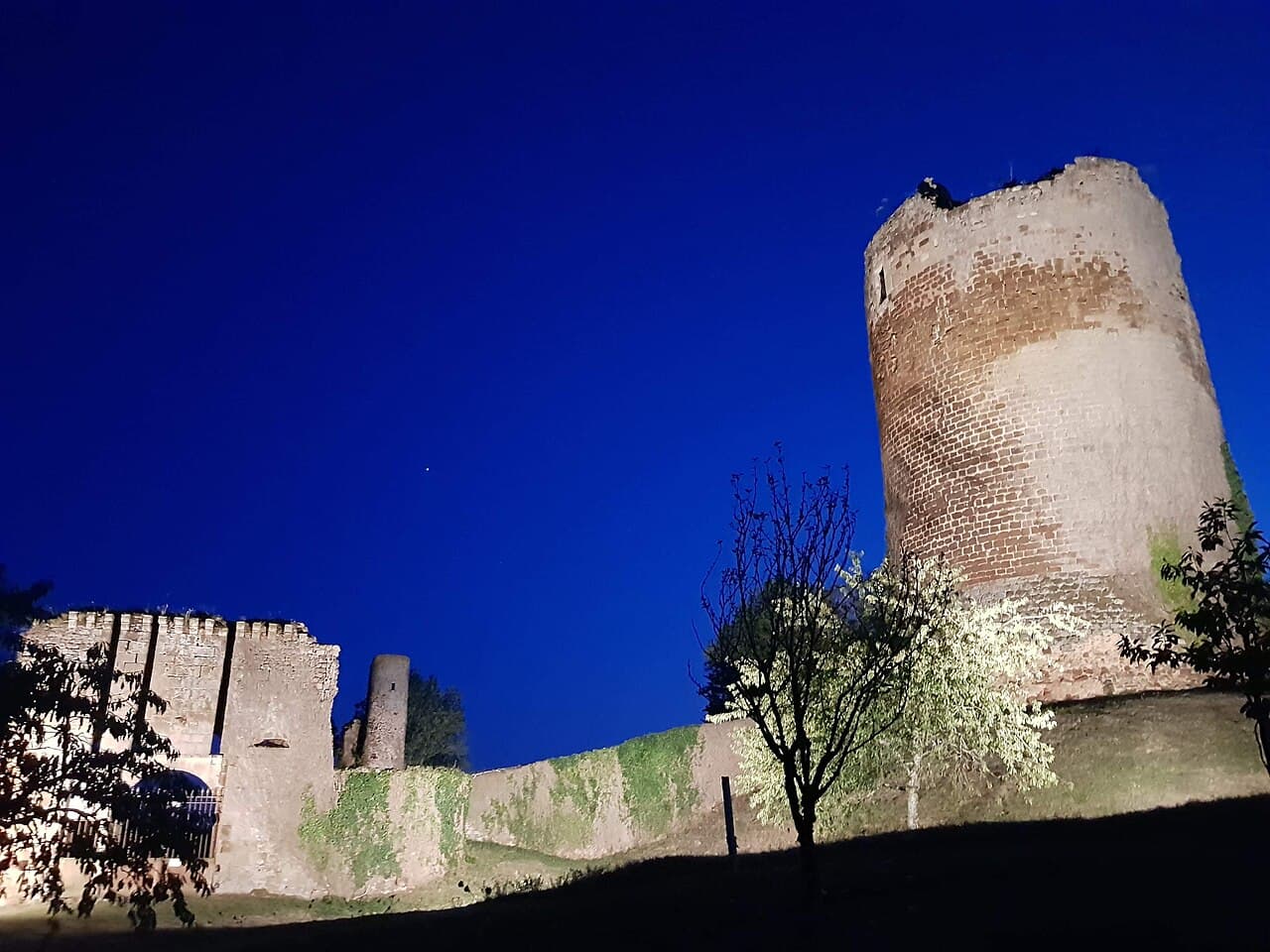
Château de Brosse
The Château de Brosse stands as a significant example of medieval military architecture in the heart of France, located in the hamlet of Brosse within the commune of Chaillac, near Saint-Benoît-du-Sault in the Indre département. This hill castle was originally established in the 10th century by a Frankish noble family, marking its importance as a fortified residence and administrative center during the early Middle Ages.
The castle's foundation is attributed to Gérald, Viscount of Limoges, following his marriage to Rothilde de Brosse. The earliest known written record dates to 974, when the chronicler Aimoin of Fleury referred to the site as "castrum quod Brucia dicitur", identifying it as a fortified place named Brosse. This early documentation underscores the castle's longstanding role in regional defense and governance.
Medieval origins and noble lineage
Throughout the Middle Ages, the Château de Brosse served as the seat of the seigneurs of Brosse, a noble family that expanded its influence over numerous surrounding communes by the early 14th century. The castle was not only a military stronghold but also a symbol of feudal authority and local governance. In 1322, the last heiress of the Brosse family, Jeanne de Brosse, married André de Chauvigny, baron of Châteauroux, transferring the estate and castle into the hands of the Chauvigny family. This marriage alliance reflects the common medieval practice of consolidating power and property through dynastic unions.
Conflict and decline during the hundred years' war
The 14th century brought significant turmoil to the Château de Brosse amid the protracted conflicts of the Hundred Years' War. Around 1369, English forces under Guillaume de Felynton, the seneschal of Poitiers, captured the fortress. The castle was deliberately set on fire, causing substantial damage. At this time, the castle was held by Guy I de Chauvigny, a loyalist to the French crown, making it a strategic target for the English military campaign.
Following this devastation, the castle's role as a permanent noble residence diminished during the 15th century. The damage and shifting political landscape likely contributed to its decline in strategic and residential importance.
Later history and preservation efforts
In the 18th century, specifically beginning in 1768, the property was acquired by Joseph de Fougières. Rather than restoring the castle, he initiated the dismantling of parts of the structure, repurposing the stones for other construction projects. This practice of quarrying castle ruins for building materials was common in the period and contributed to the gradual erosion of the fortress's physical integrity.
Recognizing the site's historical and cultural value, French authorities officially designated the Château de Brosse as a monument historique on March 11, 1935. This status has helped protect the remaining ruins and preserve them as an important testament to medieval fortification architecture and regional history.
Architectural features and surviving remains
The Château de Brosse is built on a motte, an elevated earthwork typical of early medieval fortifications. The surviving structures mainly date from the 13th century, reflecting a period of significant construction and fortification enhancement.
The circular keep and curtain walls
The most prominent feature is the circular stone keep (donjon) situated atop the motte, serving as the castle's primary defensive stronghold. This keep was surrounded by a curtain wall (enceinte), which formed the main defensive perimeter. The curtain walls, built toward the end of the 13th century, follow the natural contours of the rocky promontory, maximizing defensive advantage.
Towers and gatehouse
Flanking towers adjacent to the curtain wall underwent modifications in the 15th century, indicating attempts to update the fortress's defenses in response to evolving military technology and tactics. These towers would have provided vantage points for archers and lookouts.
Near the main entrance stands a gatehouse featuring a small wicket door, a narrow pedestrian access within the larger gate. Interestingly, this gatehouse lacks some typical defensive elements such as portcullises or machicolations, which may suggest a shift in the castle's function or reduced military emphasis during later periods.
Residential quarters and water supply
Opposite the entrance is a large polygonal tower, believed to be part of the corps de logis, or main living quarters. The substantial masonry indicates the tower's importance as a residence within the fortress complex.
In front of the gatehouse, a well with a stone curb (margelle) remains visible. This well would have been essential for supplying fresh water to the castle's inhabitants, particularly during sieges, highlighting the practical aspects of medieval castle design.
The surrounding hamlet and historical context
The nearby hamlet of Brosse retains a collection of well-preserved old houses that contribute to the site's historical atmosphere. The castle and hamlet together illustrate the integration of feudal power structures with local rural communities in medieval France.
The Château de Brosse exemplifies the evolution of medieval fortifications from early motte-and-bailey designs to more complex stone castles with integrated residential and defensive features. Its ruins offer valuable insight into the architectural and social history of the region during the early and high medieval periods.
Frequently asked questions (FAQ)
- How do I get to Château de Brosse?
- Château de Brosse is conveniently located in Chaillac, France, and can be reached by car or public transport. If driving, you can follow the D75 road which connects to major highways. For public transport, check local bus schedules to plan your visit.
- What is the historical significance of Château de Brosse?
- Château de Brosse dates back to the 15th century and is a remarkable example of medieval architecture in France. It has played a vital role in the region's history, serving as a defensive structure during various conflicts. Today, it stands as a testament to the rich heritage of French castles.
- When was Château de Brosse built?
- Construction of Château de Brosse began in the 15th century, with significant modifications made in subsequent years. The castle showcases architectural styles that reflect the evolution of design from the late Middle Ages to the Renaissance. Its enduring structure continues to attract visitors interested in historical architecture.
- Can I visit Château de Brosse year-round?
- Yes, Château de Brosse is open to visitors year-round, although the best time to visit is during the spring and summer months when the weather is pleasant. During these seasons, guided tours and special events are often available. Be sure to check the castle's official website for seasonal opening hours and special occasions.
- Why is Château de Brosse a popular tourist attraction?
- Château de Brosse is popular for its stunning architecture and rich history, providing a glimpse into France's medieval past. Visitors appreciate the beautiful surrounding landscape and the opportunity to explore the castle's well-preserved interiors. Its proximity to other local attractions also makes it a great stop for travelers.
- Is it possible to take guided tours of Château de Brosse?
- Yes, guided tours are available at Château de Brosse, providing visitors with in-depth knowledge of the castle's history and architecture. These tours are led by knowledgeable guides who can answer questions and share fascinating stories about the castle. It is advisable to book tours in advance, especially during peak tourist season.
- What are the opening hours for Château de Brosse?
- Château de Brosse typically opens its doors to visitors from 10 AM to 6 PM, with extended hours during the summer months. However, it's important to check the official website or contact the castle directly for the most current hours, as they may vary seasonally or due to special events.
- What are the ticket prices for visiting Château de Brosse?
- Ticket prices for Château de Brosse are generally affordable, with discounts available for children, students, and seniors. A typical adult ticket costs around €8, while family packages may also be offered. Always check the castle's official website for up-to-date pricing and any special promotions.
- Are there any nearby attractions to visit while at Château de Brosse?
- Yes, there are several attractions near Château de Brosse that visitors can enjoy. Nearby, you can find charming villages, scenic hiking trails, and other historical sites such as churches and museums. Exploring the surrounding area can enhance your visit and provide a fuller experience of the region's culture and history.
Photo gallery

Information
Website
Visit websiteSources & official resources
Verify the information above using these authoritative references.
Loading map...
Visitor reviews
No reviews yet. Been here? Write the first review and help other travelers!
Write the first reviewVisited this castle? Share your experience
Your review helps other travelers and adds first-hand knowledge to our encyclopedia.



