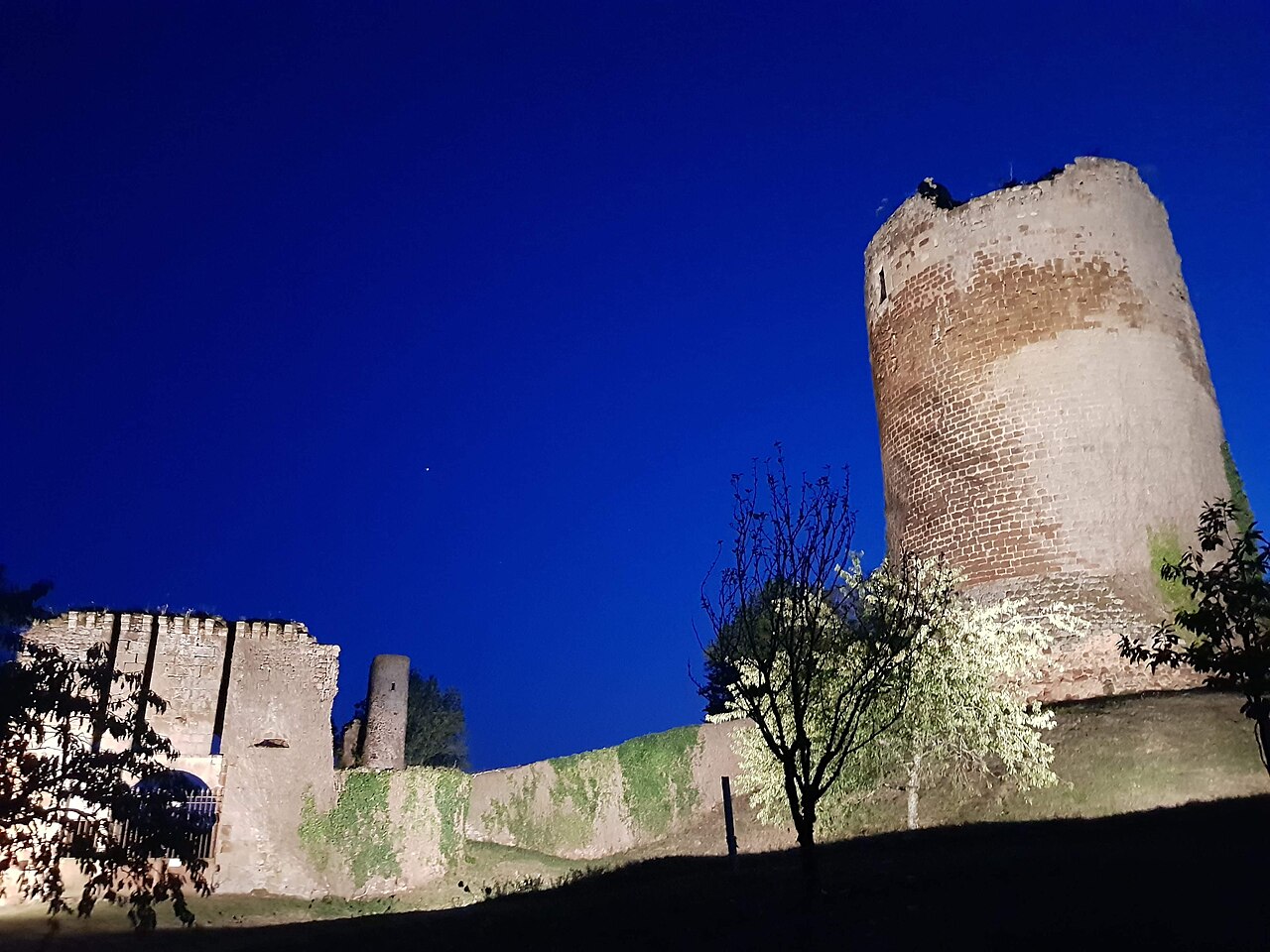
Château Guillaume de Lignac
Château Guillaume de Lignac stands as a remarkable example of medieval military architecture nestled in the Allemette river valley within the municipality of Lignac, France. This hill castle was originally constructed during the early medieval period, specifically between the late 11th and early 12th centuries, by the Aquitanian nobility. Its strategic location reflects the territorial ambitions of its founder, Guillaume IX of Aquitaine, a notable ruler celebrated for his patronage of the arts and the ideals of courtly love.
The castle’s architectural composition and historical significance are deeply intertwined with the lineage of the powerful Aquitaine family. The original fortress centered around a robust Romanesque donjon characterized by thick stone walls and a solid, imposing form designed primarily for defense and noble residence. This central keep formed the heart of the castle’s fortifications and was constructed using locally quarried stone, typical of the Romanesque style prevalent during this era.
Medieval origins and aquitanian influence
The initial phase of construction under Guillaume IX laid the foundation for a stronghold that would evolve over centuries. The castle was situated to control the Val d’Anglin region, a vital area for controlling trade routes and asserting noble dominance. The early medieval period saw the castle serving both as a defensive bastion and a symbol of feudal power.
Expansion under guillaume x and architectural adaptations
Ownership of the castle passed to Guillaume X of Aquitaine, son of Guillaume IX and father of the famed Eleanor of Aquitaine, in the 12th century. During his tenure, the castle underwent significant enlargement, particularly the expansion of the donjon in the 13th century. This expansion not only reinforced the castle’s defensive capabilities but also accommodated the needs of an expanding noble household. The stone construction was enhanced to improve durability and resistance against siege warfare.
Fourteenth-century fortifications and military innovations
The 14th century marked a pivotal era of fortification for Château Guillaume de Lignac. The original Romanesque donjon was augmented with the addition of four large cylindrical towers at its corners. These towers were strategically designed to provide flanking fire along the curtain walls, a defensive tactic that improved the castle’s ability to repel attackers.
One of the most notable architectural features introduced during this period was the installation of machicolations atop the ramparts. These stone projections with openings allowed defenders to directly threaten enemies attempting to scale the walls by dropping stones, boiling liquids, or other projectiles. This advancement represents a significant development in medieval military architecture, enhancing the castle’s defensive effectiveness.
Ownership transitions and noble lineage
From around 1200, the castle was held by the influential La Trémoille family for several generations, underscoring their regional power. The 16th century saw the estate pass to the Gouffier family, who initiated renovations that reflected a shift from purely military functions to more comfortable noble living. These renovations included roofing the donjon and the La Trémoille tower, as well as the creation of new residential apartments within the fortified structure.
In the early 17th century, ownership transferred to the Riffaut family, and later, through marriage alliances, to the La Faire family. During this period, the castle’s military importance declined, culminating in partial dismantling ordered by Cardinal Richelieu in the late 17th century. Richelieu’s policy aimed to reduce the fortifications of potentially rebellious nobles, reflecting the shifting political landscape of France under Louis XIII.
Architectural features and preservation
The core of Château Guillaume de Lignac is its Romanesque donjon, a testament to early medieval fortress design with its thick stone walls and formidable presence. The 13th-century enlargement and 14th-century additions of cylindrical towers and machicolations illustrate the castle’s evolution in response to changing military technologies and domestic needs.
The 16th-century renovations introduced wooden roofing frameworks and more habitable spaces within the castle, signaling a transition towards noble comfort while retaining defensive elements. Despite the partial dismantling in the 17th century, the castle’s remains have been preserved and restored, notably in the 19th century by a follower of Eugène Viollet-le-Duc, a pioneer in the restoration of medieval architecture.
Historical significance and cultural heritage
Château Guillaume de Lignac holds a significant place in French medieval history, not only for its architectural features but also for its association with prominent historical figures such as Guillaume IX and X of Aquitaine and the La Trémoille family. The castle’s designation as a historic monument in 1862 reflects its importance as a cultural and architectural heritage site.
The castle’s location in the Allemette river valley continues to underscore its strategic importance, offering insight into medieval territorial control and noble residence patterns. Today, the site attracts historians, architects, and visitors interested in the layered history of medieval fortifications and noble life in France.
Visiting château guillaume de lignac
While the castle remains partially preserved, visitors can explore the visible remnants of the Romanesque donjon, the cylindrical towers, and the machicolations that define its medieval military architecture. The surrounding landscape of the Allemette river valley adds to the atmospheric experience of this historic site.
Efforts to maintain and restore the château ensure that it remains a valuable educational and cultural resource. Visitors interested in medieval history, architecture, and French nobility will find Château Guillaume de Lignac a compelling destination that encapsulates centuries of historical evolution.
Frequently asked questions (FAQ)
- When was Château Guillaume de Lignac originally constructed?
- Château Guillaume de Lignac was originally constructed in the late 11th to early 12th century by the Aquitanian nobility.
- What architectural style characterizes Château Guillaume de Lignac?
- The castle is primarily Romanesque in style, featuring thick stone walls and a robust donjon typical of early medieval fortifications.
- Can visitors see the defensive features like machicolations and towers?
- Yes, visitors can observe the remains of the 14th-century cylindrical towers and machicolations which were added to enhance the castle's defenses.
- What families historically owned Château Guillaume de Lignac?
- The castle was owned by notable families including the Aquitanian rulers Guillaume IX and X, the La Trémoille family, the Gouffier family, the Riffaut family, and later the La Faire family.
- Is Château Guillaume de Lignac accessible to the public?
- The castle is partially restored and accessible for visitors interested in medieval history, although specific visiting hours and ticket information may vary.
Information
Website
Visit websiteSources & official resources
Verify the information above using these authoritative references.
Loading map...
Visitor reviews
No reviews yet. Been here? Write the first review and help other travelers!
Write the first reviewVisited this castle? Share your experience
Your review helps other travelers and adds first-hand knowledge to our encyclopedia.