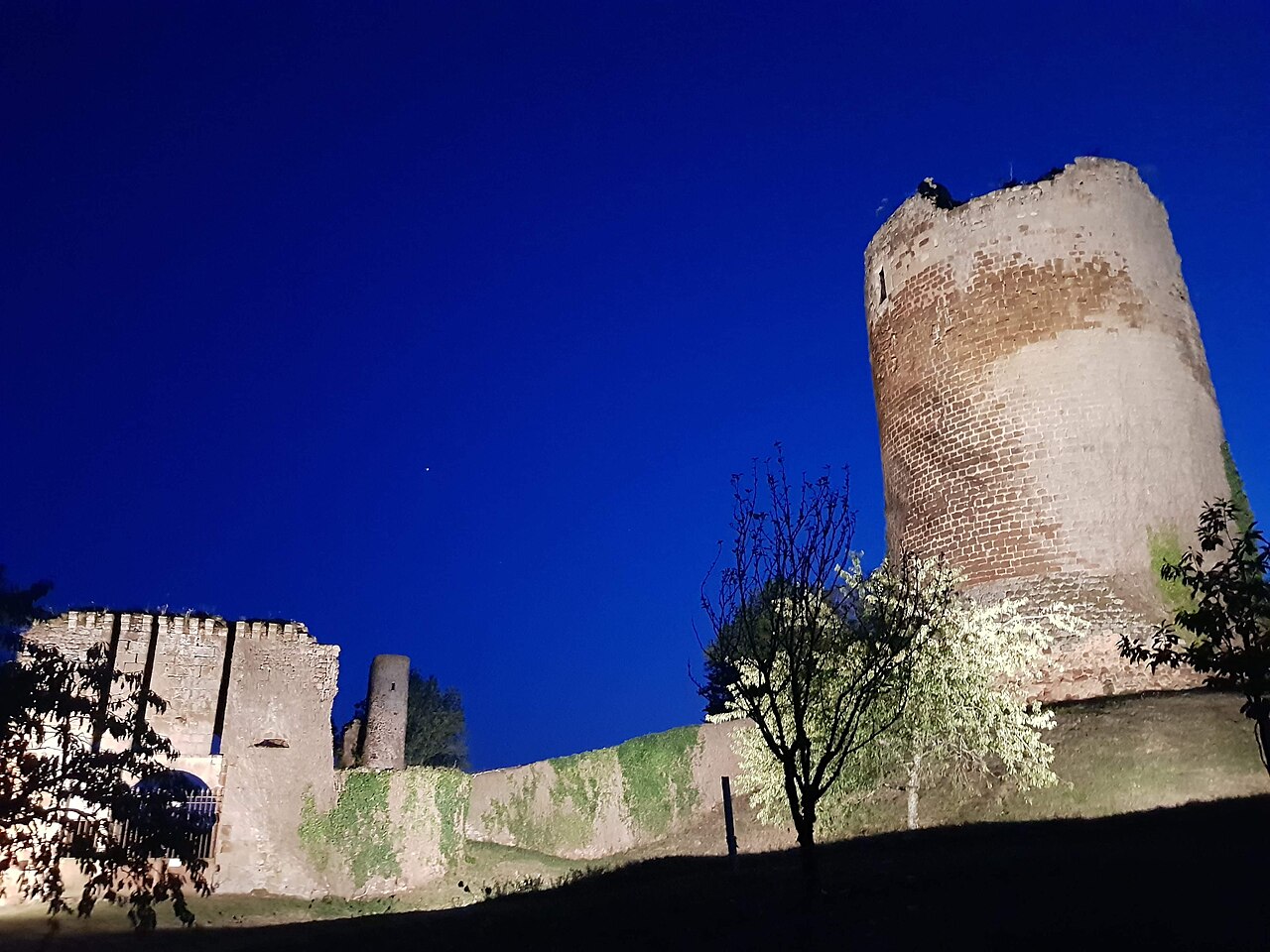
Château de la Prune-au-Pot
The Château de la Prune-au-Pot is a notable example of medieval military architecture located in the Hauts-de-France region of northern France. Constructed in the early 13th century, this hill castle was strategically positioned on a gently sloping plateau near the Creuse river, providing commanding views and natural defenses. Its origins trace back to the influential Pot family, who established the fortress as a rural stronghold and maintained control throughout much of the Middle Ages.
During its prime, the castle served both defensive and residential functions, reflecting the typical needs of medieval nobility. The fortress's design incorporates key military architectural features such as machicolated curtain walls, multiple towers including a square donjon and round towers, and a complex entrance system with drawbridges enhancing its defensive capabilities. The presence of a water reservoir fed by an integrated fountain within the donjon highlights the foresight in siege resilience, while the inclusion of latrines in a hexagonal chamber demonstrates attention to sanitation uncommon for the period.
Historical background and ownership
The castle's initial association with the Pot family is significant, as this lineage not only lent its name to the estate but also adopted the castle's name for one of its branches. Their stewardship lasted until the 15th century, when the family abandoned the fortress, initiating a gradual decline. By the 17th century, ownership had transferred to the Bourbon family, a prominent noble house in France. The château gained further historical importance when King Henri IV stayed there during military operations around the siege of Argenton, underscoring the site's strategic value during that era.
The upheavals of the French Revolution led to the confiscation of the château as part of the widespread redistribution of aristocratic properties. Following this period, the castle fell into disrepair, remaining largely abandoned for centuries. It was not until the late 20th century that preservation efforts began to stabilize the ruins. Between 1985 and 1996, volunteers from the association Chantiers Histoire et Architecture Médiévales undertook maintenance work to conserve the structure. In 2000, the castle was acquired by the Aguttes family, who initiated restoration projects aimed at preserving its medieval fabric.
Recognition of the château's cultural and historical significance culminated in its designation as a historic monument. The most recent official inscription, dated 16 October 2023, replaced an earlier listing from 1972, reflecting ongoing efforts to protect and promote the site.
Architectural features and layout
Fortifications and defensive structures
The Château de la Prune-au-Pot is characterized by a square-shaped courtyard enclosed by robust defensive walls constructed primarily in the 13th century. These walls are topped with machicolations, which are openings between corbels allowing defenders to drop objects or boiling substances on attackers below. The castle was originally surrounded by protective moats set within meadowland, enhancing its defensive perimeter.
Within the enclosure stand three towers: a prominent square donjon and two round towers. The donjon features a multi-level staircase and a unique water reservoir at its base, supplied by a built-in fountain, ensuring water availability during sieges. The first floor houses a hexagonal chamber with latrines, an advanced feature for medieval sanitary design.
The main entrance, known as the poterne, comprises two doorways: a large ogival (pointed arch) door and a smaller square door, each originally equipped with its own drawbridge. This dual-access system provided enhanced security and controlled entry into the courtyard.
Towers and specialized structures
The rectangular tour Colin is notable for containing a staircase housed within a semi-hexagonal turret, a design that facilitated vertical movement while reinforcing defense. Adjacent to tour Colin and the tower with the fountain is a tenant farmer’s residence built in more recent times, indicating continued habitation and use of the site beyond the medieval period.
Additional defensive elements include meurtrières, narrow vertical arrow slits designed for archers to fire while remaining protected. The presence of a cannon embrasure in the south wall reflects adaptations made to the castle's defenses during the advent of gunpowder weaponry.
Decorative and functional sculpted gargoyles adorn parts of the castle, serving as water spouts to direct rainwater away from the masonry. The remains of monumental chimneys and spiral staircases are visible, exemplifying the blend of utility and medieval architectural style.
Preservation and modern significance
Despite centuries of abandonment and gradual decay, the Château de la Prune-au-Pot remains partially preserved. Restoration and conservation efforts initiated in the late 20th century have been crucial in stabilizing the ruins and preventing further deterioration. Volunteer-led maintenance work and private ownership by the Aguttes family have contributed to preserving the castle's historical fabric.
The castle’s designation as a historic monument underscores its importance as a cultural heritage site. It provides valuable insight into medieval fortification techniques, residential architecture, and the evolution of defensive structures in central France. Visitors can explore the remains to appreciate the castle's architectural innovations and its role in regional history.
Visitor information and accessibility
While the Château de la Prune-au-Pot is not widely commercialized as a tourist destination, ongoing restoration has made parts of the site accessible for educational and cultural visits. Visitors interested in medieval architecture and French history will find the castle’s features and its preserved elements of particular interest.
Access to the castle involves traversing the surrounding landscape of meadowland and the plateau on which it stands. The site’s partial ruin status means that safety precautions are advised during visits. Information about opening hours and ticketing may be available through local heritage organizations or the current owners.
Frequently asked questions (FAQ)
- What is the historical significance of Château de la Prune-au-Pot?
- Château de la Prune-au-Pot is a remarkable example of French Renaissance architecture, built in the early 16th century. Its intricate design and historical artifacts reflect the rich cultural heritage of the region, making it a vital site for understanding France's past.
- When was Château de la Prune-au-Pot built?
- Construction of Château de la Prune-au-Pot began in 1520 and was completed in 1535. This timeframe places it firmly within the period of the French Renaissance, showcasing the artistic and architectural advancements of that era.
- What are the opening hours for visiting Château de la Prune-au-Pot?
- Château de la Prune-au-Pot is open to visitors from 10 AM to 6 PM daily, with extended hours during the summer months. It is advisable to check the official website for any seasonal changes or special events that may affect these hours.
- Can I take guided tours of Château de la Prune-au-Pot?
- Yes, guided tours are available and highly recommended for a deeper understanding of the castle's history and architecture. Tours typically last about an hour and provide insights that enhance the visitor experience.
- Is it possible to access Château de la Prune-au-Pot with limited mobility?
- Yes, Château de la Prune-au-Pot is committed to accessibility and offers facilities for visitors with limited mobility. However, it is advisable to contact the castle in advance to ensure that specific needs can be accommodated during your visit.
- What is the best time to visit Château de la Prune-au-Pot?
- The best time to visit Château de la Prune-au-Pot is during the spring and early autumn months when the weather is mild and the gardens are in full bloom. This period typically sees fewer crowds, allowing for a more enjoyable experience.
- How much do tickets cost for entry to Château de la Prune-au-Pot?
- Tickets for Château de la Prune-au-Pot are priced at €10 for adults, with discounts available for students and seniors. Children under 12 can enter for free, making it a great option for family outings.
- What nearby attractions are worth visiting when I go to Château de la Prune-au-Pot?
- Nearby attractions include the picturesque village of Saint-Rémy and the beautiful gardens of Parc des Jardins de la Prune. Both locations offer additional insights into the region's culture and history, making them perfect complements to your visit to the castle.
Information
Loading map...
Visitor reviews
No reviews yet. Been here? Write the first review and help other travelers!
Write the first reviewVisited this castle? Share your experience
Your review helps other travelers and adds first-hand knowledge to our encyclopedia.