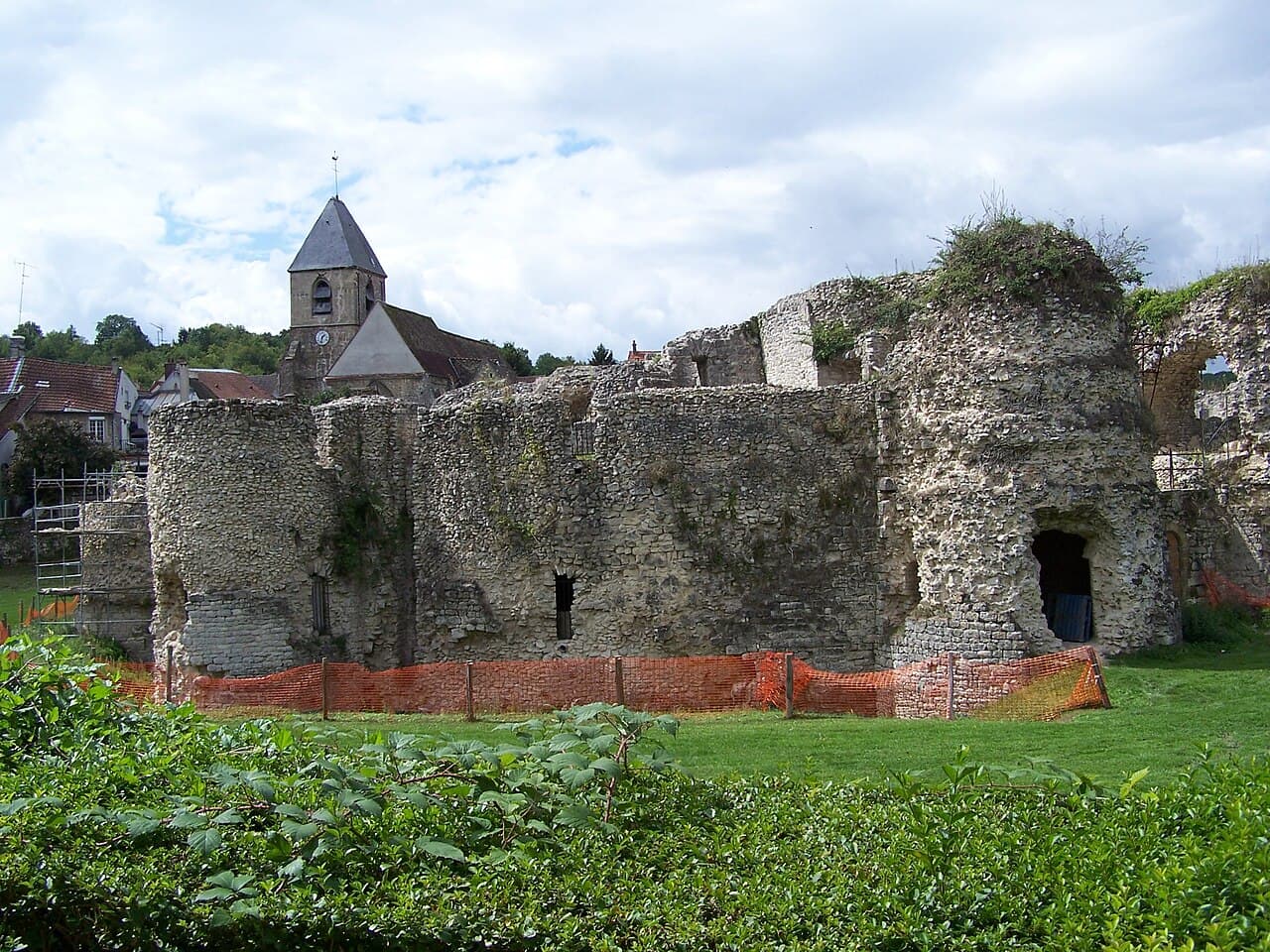
Château de Beynes
The Château de Beynes is a significant example of a high medieval hill castle situated in the municipality of Beynes, in the Hauts-de-France region of France. Originally constructed in the 11th century, this fortress played a crucial role in the royal defensive network guarding the western approaches of the French royal domain, particularly against threats from Normandy and other neighboring powers. The castle's strategic location on a rocky spur above the Mauldre River valley offered commanding views and natural defenses, making it a vital military and administrative center during the Middle Ages.
Early history and strategic importance
The earliest fortifications at the site date back to 1073, when a motte-and-bailey castle was established. This type of fortification, characterized by a raised earthwork (motte) topped by a wooden or stone keep and an enclosed courtyard (bailey), was typical of early medieval military architecture. The choice of location at the bottom of the Mauldre valley was deliberate, as it controlled a key crossing point and a north-south Roman road that was essential for trade and military movements.
The seigneurie of Beynes had been under the control of the Abbey of Saint-Germain-des-Prés since late Antiquity, highlighting the site's longstanding regional importance. Between 1087 and 1092, the Montfort family undertook significant fortification efforts. Their successful defense against the English king William Rufus in 1092 is a notable event, underscoring the castle's military significance early in its history. The first explicit written reference to a fortified site, described as a castrum, appears in 1176, supported by archaeological evidence of construction from the early 12th century. Earlier fortifications may have existed further south near the Roman road and the Mauldre River, but the current site became the primary stronghold.
Medieval military architecture and modifications
During the 13th century, the castle's role expanded as it controlled not only the Roman road but also a ford on the Mauldre River. The settlement it protected grew to an estimated 850 inhabitants, reflecting its importance as a fortified center of local governance and defense. The castle's architecture evolved over time, particularly during the Hundred Years’ War when it fell under English control. The English transformed it into a fortified royal garrison, adapting it for the era's changing military technologies.
Major enhancements included the reduction of the original central donjon, the construction of two-story residential buildings, and the strengthening of the outer walls by doubling the enceinte. Nine semi-circular towers were added along the curtain walls to provide overlapping fields of fire, a common defensive feature designed to eliminate blind spots. The moats surrounding the castle were broadened, and artillery galleries were incorporated to accommodate the use of gunpowder weapons, marking a transition from medieval to early modern fortification techniques.
Renaissance transformation and residential use
Following the expansion of the French royal domain in the 15th century, the castle underwent a significant transformation under Robert d’Estouteville, who converted it from a purely military fortress into a more comfortable residence. This included demolishing the keep and adapting the defensive walls to suit the needs of early artillery and residential comfort. The architectural improvements continued under the guidance of Philibert de l’Orme, a prominent Renaissance architect known for his innovative use of structure and materials.
In 1536, King Henri II granted the castle to Diane de Poitiers, his favored courtier, who commissioned new residential buildings. These constructions featured pioneering roofing techniques using laminated timber, an early example of this method that allowed for more complex and durable roof structures. The castle remained a venue for aristocratic gatherings well into the 17th century, hosting notable figures such as the mystic Madame Guyon and theologian Abbé de Fénelon in 1688.
Decline, ruin, and modern conservation
By the 18th century, the Château de Beynes had been abandoned and fell into ruin. The local population quarried its stones for building materials, accelerating the castle's decay. The municipality purchased the site in 1967, initiating archaeological excavations and consolidation efforts between 1995 and 1999. Recognized for its cultural and historical importance, the ruins were designated a Monument historique in 1959 and received further classification in 2014.
Recent conservation efforts have focused on stabilizing the ruins, particularly after flooding in 2016 caused partial wall collapses. Volunteer groups have played a significant role in these restoration projects, helping to preserve the site for future generations. The drawbridge and barbican have been restored to reflect their historic appearance, enhancing the visitor experience and educational value of the castle remains.
Architectural features and layout
The castle occupies an oval-shaped site reflecting the original 11th-century motte, perched approximately 90 meters above sea level on a rocky spur overlooking the Mauldre valley. This natural elevation provided a defensible position with extensive views of the surrounding landscape. Originally, the castle was surrounded by deep moats filled with water, accessed via a drawbridge leading to a fortified barbican, which served as an additional defensive gateway. This barbican has been restored in modern times to illustrate its historic function.
The defensive enceinte was doubled during the Hundred Years’ War, with nine semi-circular towers spaced along its length, allowing defenders to cover the curtain walls with overlapping fields of fire. Two fortified gatehouses or châtelets guarded the main entrances from the village and the river, controlling access and serving as strongpoints during sieges.
The donjon was originally an oval-shaped tower with walls approximately 2.20 meters thick at the base. Its entrance was strategically placed opposite the main gate to complicate any direct assault. In the 15th century, the donjon was deliberately reduced in size as part of the castle's transition to a residence. The central courtyard, paved and flanked by two principal residential buildings, reflects the 15th-century adaptations aimed at improving habitability while maintaining defensive capabilities, including provisions for early artillery use.
The castle and village walls were pierced by three named gates: de Paris, de Mantes, and du Château. To the west, the defensive system extended beyond the main enceinte, including five additional fortified sites such as mottes and fortified farms, which contributed to the overall protection of the territory.
Construction materials include rubble masonry known as moellons for the donjon base and key structural elements, with stone blocks used in wall sections. The 16th-century residential buildings incorporated advanced roofing techniques developed by Philibert de l’Orme using laminated timber, a notable innovation for the period.
Visitor information and cultural significance
Today, the Château de Beynes stands as partially preserved ruins, accessible to visitors interested in medieval military architecture and French history. The site offers insight into the evolution of castle design from early motte-and-bailey fortifications to Renaissance residences adapted for artillery. Its designation as a Monument historique underscores its cultural heritage value.
Ongoing conservation efforts and archaeological research continue to enhance understanding of the castle's history and architecture. The restored drawbridge and barbican provide a tangible connection to the castle's defensive past, while the ruins themselves evoke the layered history of the site from the 11th century through the early modern period.
Frequently asked questions (FAQ)
- How do I get to Château de Beynes?
- Château de Beynes is conveniently located in the Yvelines department of France, easily accessible by car or public transportation. If you are traveling by train, the nearest station is Beynes, from where you can take a short taxi ride or walk to the castle.
- What is the historical significance of Château de Beynes?
- Château de Beynes dates back to the 14th century and has played a crucial role in the region's history. It served as a strategic military stronghold and later became a residence for various noble families, reflecting the architectural evolution of French castles over the centuries.
- When was Château de Beynes built?
- The construction of Château de Beynes began in the 14th century, with significant modifications made in subsequent centuries. Its architecture showcases a blend of medieval and Renaissance styles, making it an interesting site for history enthusiasts.
- Can I take guided tours of Château de Beynes?
- Yes, guided tours are available at Château de Beynes, providing visitors with in-depth insights into its rich history and architectural features. It's advisable to check the official website for tour schedules and availability before your visit.
- Why is Château de Beynes a popular tourist attraction?
- Château de Beynes attracts visitors due to its historical significance, stunning architecture, and picturesque surroundings. The castle offers a glimpse into France's noble past and is often featured in cultural events and exhibitions, enhancing its appeal.
- Is it possible to access Château de Beynes for individuals with disabilities?
- Yes, efforts have been made to ensure accessibility for visitors with disabilities at Château de Beynes. However, it is recommended to contact the site in advance to confirm specific accommodations and accessibility features available during your visit.
- What are the opening hours of Château de Beynes?
- Château de Beynes typically opens to visitors from Tuesday to Sunday, with specific hours that may vary by season. It's best to check the castle's official website for the most current opening times and any holiday schedules.
- What are the ticket prices for Château de Beynes?
- Ticket prices for Château de Beynes vary depending on age and group size, with discounts often available for students and seniors. Visitors are encouraged to purchase tickets in advance online for convenience and to avoid long queues at the entrance.
- When is the best time to visit Château de Beynes?
- The best time to visit Château de Beynes is during the spring and early autumn months when the weather is pleasant, and the gardens are in full bloom. Additionally, these seasons often feature fewer crowds, allowing for a more enjoyable experience exploring the castle and its grounds.
- Are there any nearby attractions to explore after visiting Château de Beynes?
- Yes, there are several nearby attractions worth exploring, including the historic town of Versailles with its famous palace and gardens. Other local sites, such as the picturesque village of Montfort-l'Amaury, offer charming streets and additional historical landmarks to enhance your visit.
Photo gallery

Information
Loading map...
Visitor reviews
No reviews yet. Been here? Write the first review and help other travelers!
Write the first reviewVisited this castle? Share your experience
Your review helps other travelers and adds first-hand knowledge to our encyclopedia.



