Chan Chan
Chan Chan, located near Trujillo in northern Peru, was the capital city of the Chimor kingdom and stands as the largest pre-Columbian city in South America. Founded in the 9th century, it flourished until its conquest by the Inca Empire in the late 15th century. Today, Chan Chan is a vast archaeological site renowned for its monumental adobe architecture and complex urban planning.
Geographical setting and environmental adaptations
Situated at the mouth of the Moche Valley on the arid northern Peruvian coast, Chan Chan's location posed significant challenges due to minimal rainfall. The city's survival depended heavily on the rivers originating from the Andes Mountains, which provided vital surface runoff water. This runoff was ingeniously harnessed through an extensive network of irrigation canals and water control systems, enabling agriculture and sustaining a large urban population despite the harsh desert environment.
Urban layout and architectural features
Spanning approximately 20 square kilometers (7.7 square miles), Chan Chan's urban center covered about 6 square kilometers (2.3 square miles). The city was divided into several large compounds known as ciudadelas, which served as palatial complexes for the ruling elite. These ciudadelas contained plazas, storerooms, ceremonial platforms, and burial sites, reflecting the social hierarchy and the concentration of political and religious power.
Ciudadelas: royal compounds
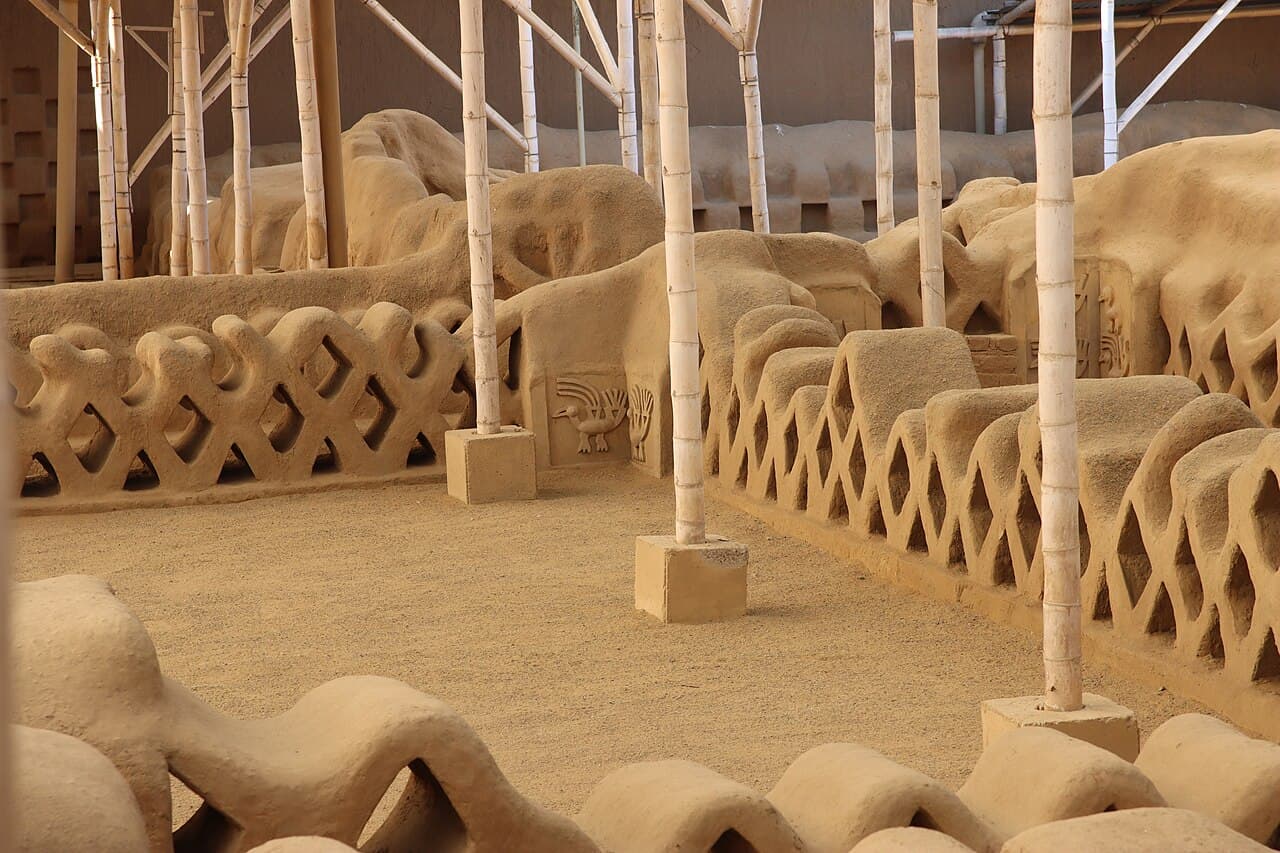
The ciudadelas were architectural masterpieces made primarily of adobe bricks, featuring high walls with intricate geometric and zoomorphic reliefs characteristic of the Chimú culture. These compounds were self-contained units with multiple courtyards and rooms, designed to house the royal family, administrative officials, and religious leaders. The elaborate decoration and scale of these structures emphasize the wealth and authority of the Chimor rulers.
Housing for artisans and commoners
Outside the ciudadelas, the majority of Chan Chan's inhabitants lived in smaller, more modest dwellings called small, irregular agglutinated rooms (SIARs). These clustered rooms often functioned as both living spaces and workshops, reflecting the city's role as a center for craft production. Artisans specialized in textiles, ceramics, metalwork, and other crafts essential to Chimor society.
Historical significance and cultural context
The Chimor kingdom emerged around the 9th century CE as a dominant power along the northern coast of Peru. Chan Chan served as the political and economic center of this empire until its defeat by the expanding Inca Empire around 1470 CE. The city's layout and monumental architecture illustrate the Chimú's complex social organization, advanced engineering skills, and artistic achievements.
Chimú culture and empire
The Chimú developed a sophisticated culture known for its distinctive art style, especially in pottery and metalwork. Their control over vast agricultural lands was supported by extensive irrigation systems, which allowed them to sustain a large population and generate surplus resources. Chan Chan's role as the capital was central to maintaining the empire's political cohesion and economic prosperity.
Conquest by the Incas
In the late 15th century, the Inca Empire expanded northward, eventually conquering the Chimor kingdom. Despite the political takeover, Chan Chan retained its importance as a regional center, and many aspects of Chimú culture influenced Inca administration and art. The city's decline began after the Spanish conquest, which disrupted indigenous societies across the region.
Architectural techniques and preservation challenges
Chan Chan's buildings were constructed primarily from adobe, a sun-dried mud brick that was shaped and fired in the dry climate. The city's walls and structures feature decorative friezes with motifs representing marine life, animals, and geometric patterns, symbolizing Chimú cosmology and beliefs.
However, the adobe construction makes the site vulnerable to erosion from wind and occasional heavy rains. Preservation efforts have focused on stabilizing the ruins and protecting the intricate reliefs from further deterioration. Despite these challenges, Chan Chan remains one of the most important archaeological sites for understanding pre-Columbian urbanism and culture in South America.
Visiting Chan Chan today
As an archaeological site, Chan Chan offers visitors a glimpse into the life of the Chimor kingdom through its monumental architecture and urban layout. The site is managed to allow public access while balancing conservation needs. Visitors can explore the remains of the ciudadelas and learn about the cultural and historical significance of this ancient city through onsite museums and guided tours.
Chan Chan's status as a UNESCO World Heritage Site highlights its global importance as a cultural and historical landmark. Its preservation provides valuable insights into the engineering, artistic, and social achievements of the Chimú civilization.
Frequently asked questions (FAQ)
- What is Chan Chan and why is it significant?
- Chan Chan is the largest adobe city in the world, built by the Chimu civilization around the 9th century. It is significant for its remarkable architecture, intricate designs, and its role as a political and cultural center in pre-Columbian Peru.
- When was Chan Chan declared a UNESCO World Heritage Site?
- Chan Chan was declared a UNESCO World Heritage Site in 1986. This designation recognizes its cultural importance and the need for preservation of its unique architectural and historical features.
- What are the opening hours for Chan Chan?
- Chan Chan is typically open to visitors from 9:00 AM to 5:00 PM daily. However, it is advisable to check for any seasonal changes or special closures before planning your visit.
- How do I get to Chan Chan from Trujillo?
- You can reach Chan Chan from Trujillo by taking a taxi or a local bus, which takes about 20 minutes. There are also guided tours available that include transportation for a more comprehensive experience.
- Can I take guided tours of Chan Chan?
- Yes, guided tours of Chan Chan are available and highly recommended. These tours provide insightful information about the history, architecture, and significance of the site, enhancing your visit.
- Is it possible to explore Chan Chan independently?
- While independent exploration of Chan Chan is allowed, it is advisable to hire a guide to fully appreciate the site's historical context and architectural details. Many visitors find that a guide enriches their experience significantly.
- What is the best time to visit Chan Chan?
- The best time to visit Chan Chan is during the dry season, from May to October, when the weather is pleasant and ideal for exploring outdoor sites. Early mornings or late afternoons are also great times to avoid the midday heat and crowds.
- What are the ticket prices for visiting Chan Chan?
- As of now, the ticket prices for Chan Chan are typically around 10 soles for adults, with discounts for students and children. It's a good idea to check the official site or local information for any updates on prices before your visit.
- Are there any nearby attractions to visit along with Chan Chan?
- Yes, nearby attractions include the Huacas del Sol y de la Luna, another archaeological site, and the city of Trujillo, known for its colonial architecture and vibrant culture. It’s worth spending a day exploring the rich history of the region.
Photo gallery

Information
Loading map...
Visitor reviews
No reviews yet. Been here? Write the first review and help other travelers!
Write the first reviewVisited this castle? Share your experience
Your review helps other travelers and adds first-hand knowledge to our encyclopedia.