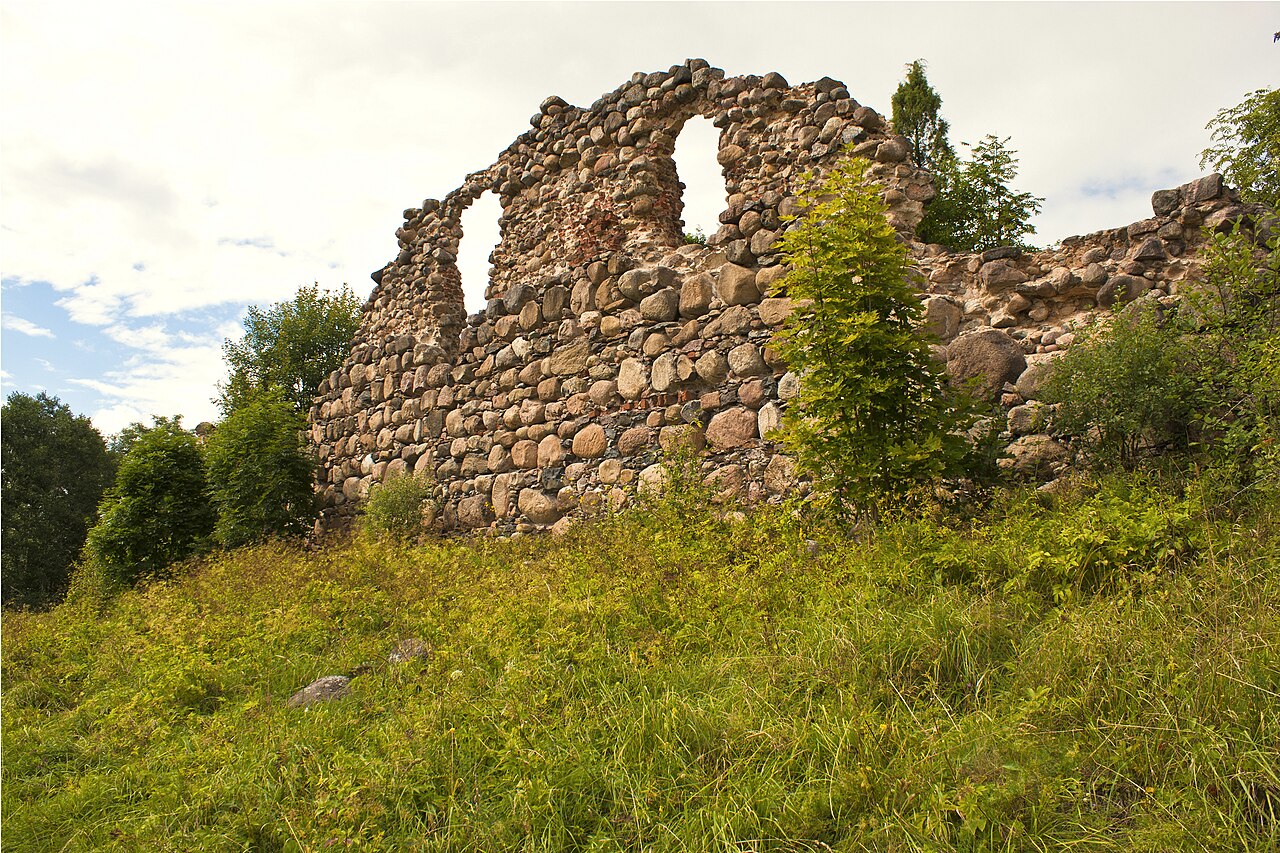
Cesvaine Castle
Cesvaine Castle stands as a significant medieval hill fortress located in the municipality of Cesvaine, Latvia. Its origins trace back to the early 13th century, with the earliest documented mention in 1209 when control shifted from the local Jersika principality to the Riga Archbishopric. This transition marked the beginning of the castle's importance as a fortified center under ecclesiastical authority.
The site initially hosted a wooden fortress constructed by the Latgalian people on the left bank of the Sula River. This early fortification served as a defensive stronghold and local power base. By the late 14th or early 15th century, this wooden structure was replaced by a more durable stone castle, reflecting the growing strategic and economic significance of the site. References to the stone fortress appear by 1410, and its construction aligns with the period's broader trend of fortifying key locations to control vital trade routes between Koknese and Alūksne.
Architectural features and layout
Cesvaine Castle was strategically situated on a naturally defended high plateau approximately 160 meters above sea level. The surrounding terrain provided formidable natural barriers: a deep valley carved by the Sula River to the west and north, steep banks and man-made fish ponds to the east, and a hand-dug moat guarding the southern approach. This combination of natural and artificial defenses made the castle a formidable fortress in its time.
The castle's layout consisted of a roughly square main enclosure measuring about 70 by 75 meters, with an adjacent outer bailey to the north, approximately 70 by 90 meters in size. The outer bailey served as an additional defensive courtyard and space for auxiliary functions.
The main entrance was located at the southwestern corner of the outer bailey, marked by a distinctive semicircular gate tower. This gate tower featured three successive gates controlling access first into the outer bailey and then through a northern central gate into the main castle enclosure. The castle walls, constructed of robust stone approximately 1.5 meters thick, encircled both the main castle and the outer bailey. These walls were punctuated by multiple gates and defensive towers, enhancing the fortress's defensive capabilities.
During the 16th century, the castle underwent modifications to adapt to evolving military technologies, including the addition of low semicircular bastion towers at the northern corners of the outer bailey to accommodate cannon defense. A notable architectural feature was a distinctive tower positioned above the main gate, a hallmark of castles owned by bishops. This element is consistent with similar episcopal castles such as Haapsalu Castle, indicating a building tradition distinct from that of the Livonian Order.
The internal arrangement of the castle, while not comprehensively documented, is believed to have included four wings surrounding a central courtyard within the main enclosure. Historical plans suggest the presence of a village church within the castle grounds, underscoring its dual role as both a military and ecclesiastical center.
Historical significance and turbulent past
Throughout the 15th and 16th centuries, Cesvaine Castle was a focal point of conflict in the region due to its strategic location and political importance. It frequently changed hands amid the power struggles involving the Livonian Order, the Riga Archbishopric, the Polish-Lithuanian Commonwealth, Sweden, and Russia.
In 1479, the castle endured one of several sieges linked to disputes between the Livonian Order and neighboring entities. The mid-16th century saw further military action; in 1559, a significant Russian army engaged the castle's defenders, though the fortress was not captured at that time. However, in 1577, during a subsequent Russian campaign, the castle fell to Russian forces. The conquest was marked by the execution of many defenders and partial destruction of the fortress structures.
Following the Livonian War, control of Cesvaine shifted to the Polish-Lithuanian Commonwealth in 1582. The castle's ownership continued to fluctuate during the Polish-Swedish conflicts and later the Russo-Swedish wars. These ongoing conflicts inflicted repeated damage on the castle, culminating in its thorough destruction by 1656 during the Second Northern War. After this devastation, Cesvaine Castle was abandoned and ceased to function as a military or administrative center.
Later developments and archaeological rediscovery
Centuries after its abandonment, the remnants of Cesvaine Castle were largely dismantled between 1894 and 1897 to provide building materials for a new manor house constructed on the site, known as the Cesvaine hunting castle. This manor incorporated stones from the medieval fortress, blending the site's historic fabric with newer architectural elements.
In the early 21st century, archaeological excavations conducted from 2001 to 2003 uncovered and studied surviving structures beneath and around the manor grounds. These investigations revealed valuable insights into the castle's original layout and construction techniques.
The manor itself suffered a significant fire in 2002, damaging the upper floors and roof. Restoration efforts were underway by 2013, focusing on rebuilding the roof and upper levels, although some central sections remained without roofing.
Present condition and visible remains
Today, only low ruins of Cesvaine Castle remain visible. Along the western wall of the outer bailey, approximately 50 meters long and 1.5 meters thick, remnants survive reaching heights of one to two meters. The semicircular gate tower at the southern end of the bailey is partly preserved, offering a glimpse into the castle's defensive architecture.
Most of the main castle's remains lie beneath the later manor house and its forecourt, though some original features such as two ponds on the eastern side and a surviving portion of the southern moat are still observable. The reuse of stones from the medieval fortress in the manor's construction underscores the site's layered history and the continuity of habitation and use over centuries.
Cesvaine Castle remains an important cultural and historical landmark in Latvia, embodying the region's medieval heritage and the complex political and military history of the Baltic area. Its ruins and the adjacent manor house continue to attract interest from historians, archaeologists, and visitors intrigued by the legacy of medieval fortifications and ecclesiastical power.
Frequently asked questions (FAQ)
- How do I get to Cesvaine Castle?
- Cesvaine Castle is located in the town of Cesvaine in the Vidzeme region of Latvia. It is accessible by car and local transport from major cities like Riga. Clear signage guides visitors to the site.
- What is the best time to visit Cesvaine Castle?
- The best time to visit Cesvaine Castle is during the late spring to early autumn months when the weather is mild and the surrounding landscape is lush. The castle grounds are open daily from 9:00 to 18:00.
- Is there an entrance fee to visit Cesvaine Castle?
- Visiting Cesvaine Castle is free of charge. Visitors can explore the ruins and surrounding areas without any ticket fees.
- Can I explore the entire castle ruins?
- While much of the main castle lies beneath the later manor house, visitors can explore the visible ruins of the outer bailey, including the semicircular gate tower and sections of the defensive walls. Some areas are restricted for preservation reasons.
- What architectural style characterizes Cesvaine Castle?
- Cesvaine Castle features <strong>Gothic architectural elements</strong> typical of high medieval ecclesiastical fortresses, including stone walls, gate towers, and bastions adapted for cannon defense.
- Are there guided tours available at Cesvaine Castle?
- Currently, guided tours are not regularly offered at Cesvaine Castle, but informational panels and brochures provide visitors with historical context and architectural details.
Information
Opening hours
9:00-18:00, daily
Ticket prices
Free
Current owner
Municipality
Website
Visit websiteSources & official resources
Verify the information above using these authoritative references.
Loading map...
Visitor reviews
No reviews yet. Been here? Write the first review and help other travelers!
Write the first reviewVisited this castle? Share your experience
Your review helps other travelers and adds first-hand knowledge to our encyclopedia.