Dzērbene Castle
Dzērbene Castle stands as a significant medieval fortress site near the village of Dzērbene in the municipality of Cēsis, Latvia. Founded in the mid-14th century, the castle played a crucial role within the Baltic region's complex political and military landscape, particularly under the influence of the Archbishopric of Riga. Its strategic location on a modest hill overlooking the surrounding terrain made it a vital stronghold and administrative center in the contested borderlands of the Livonian Confederation.
The castle's origins date back to around 1357, attributed to Archbishop Fromhold von Vyfhusen, although exact details of its founding remain partly uncertain. Designed as a hill castle with a strict square layout approximately 70 by 70 meters, Dzērbene exemplifies the lagerkastell style of military architecture. This style is characterized by a compact, fortified camp with a strong enclosed courtyard, surrounded by defensive walls and moats. The castle's corners were precisely aligned with the four cardinal points, emphasizing its geometric and strategic planning.
Medieval construction and strategic importance
Initially serving as a toll station and fortress on the southern edge of the Tālava region, Dzērbene was part of the Rauna castle district, close to the neighboring Autine district. The castle's defensive position was enhanced by moats on three sides, some of which remain visible today as half-preserved water-filled ditches integrated into the local parkland. The eastern corner featured a prominent round tower nearly eight meters in diameter, which was likely part of the original medieval construction. This tower underwent reinforcement or reconstruction in the 15th century to adapt to the emerging use of early firearms and cannon, reflecting the evolving military technology of the late medieval period.
Throughout the 14th and 15th centuries, Dzērbene Castle was a focal point of ecclesiastical and military power struggles. In 1361, Archbishop Fromhold pawned the castle to Barthold von Tiesenhausen, a vassal of the Riga archbishopric, evidencing its administrative role. By 1439, the presence of a church within the castle grounds highlights its religious significance. However, in 1479, the castle was captured without resistance by the Livonian Order under Master Bernhard von der Borch. The Order likely undertook fortification enhancements during their occupation, although the castle returned to archbishopric control by 1485, illustrating the shifting balance of power in Livonia.
Ownership changes and military conflicts in the 16th century
The 16th century saw Dzērbene Castle change hands multiple times amid the turbulent Livonian War. In 1530, it belonged to coadjutor Wilhelm von Brandenburg, and by 1555, chancellor Christoph Sturz held the estate. The castle was surrendered to the Livonian Order in 1556, only to be attacked and likely occupied by Russian forces in 1559 during their Livonian campaign. The fortress suffered significant damage and plunder during these conflicts. The decisive destruction occurred in 1577 when the army of Ivan the Terrible demolished the castle, marking the end of its military function.
Following its ruin, Dzērbene's lands passed to Polish control, with King Stephen Bathory granting the estate to the officer Johann Drobisch in 1580. The 1582 Treaty of Jam Zapolski referenced the castle as a citadel, indicating its lingering strategic relevance despite its damaged state. However, the fortress itself was abandoned, and the owners relocated to manor houses nearby, signaling a shift from medieval fortifications to residential estates.
Later history and manor development
In the 17th century, the estate was awarded by Swedish King Gustav II Adolf to nobleman Svante Banér. During this period, the castle ruins were partially dismantled, and stones were repurposed for manor construction. The estate was divided into "old" and "new" manors, with the latter incorporating parts of the medieval walls. By the late 18th century, the castle was described as no longer standing, and its ruins were reported destroyed by 1786. A small manor house featuring a square tower was erected on the site, continuing the site's occupation and use.
The manor experienced further challenges in the modern era, suffering fire damage during the 1905 revolution and again during World War I. Restoration efforts in 1929 and later in 1997, including an archaeological survey, helped document and preserve the site's historical remains. Further restoration in 2010 focused on the manor's facades and interiors, ensuring the continued use of the site as a local government facility, community center, music school, and café.
Architectural remains and archaeological significance
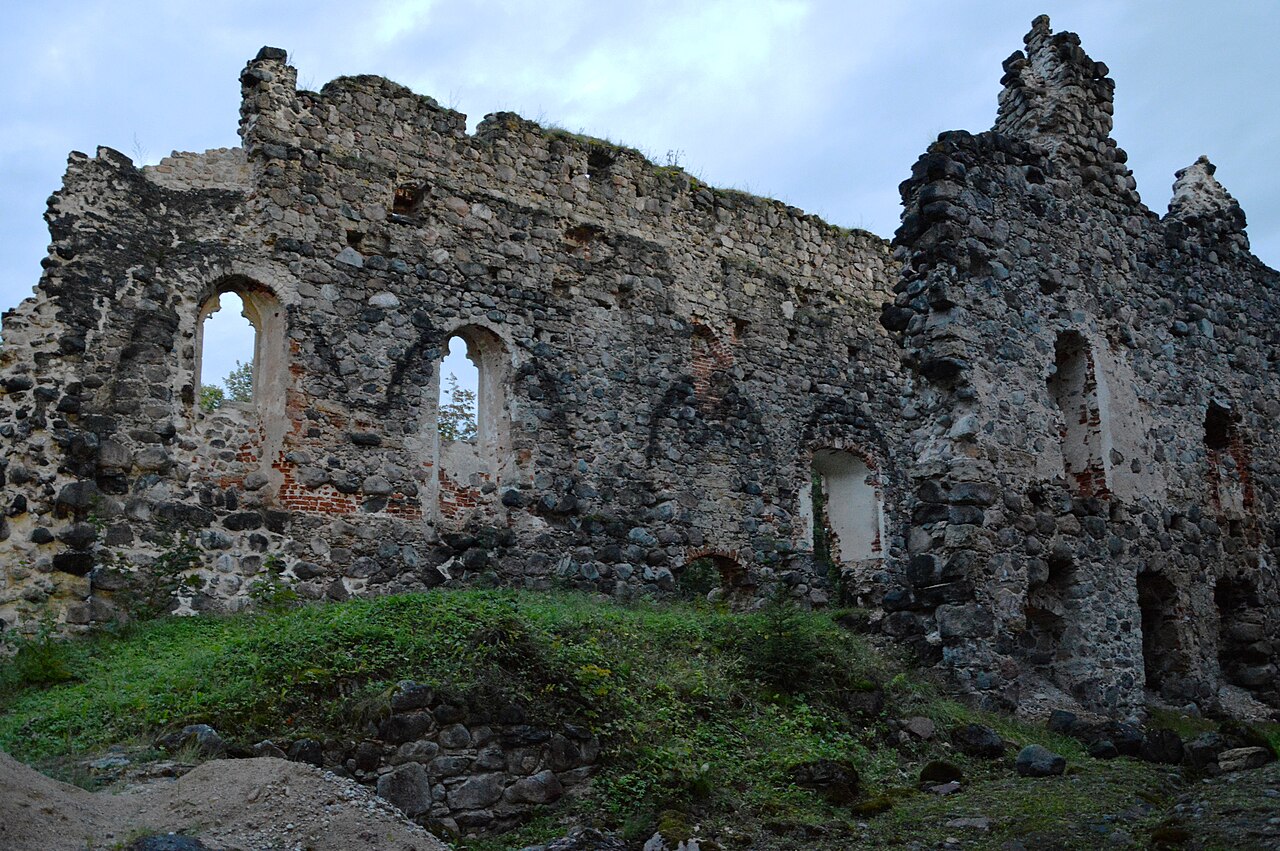
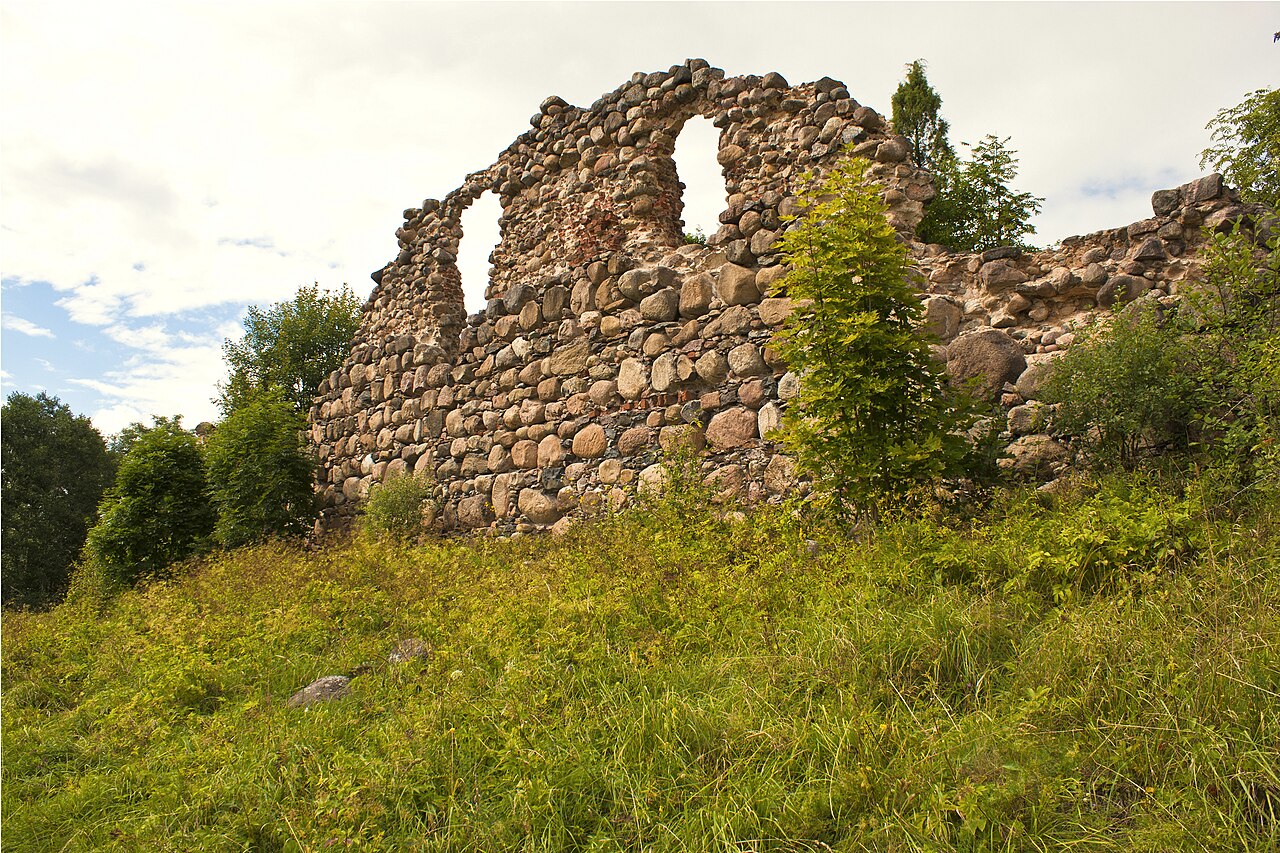
The surviving remains of Dzērbene Castle offer valuable insights into medieval military architecture in Latvia. The foundational structures of the eastern round tower remain visible near the manor's east side, illustrating the castle's original defensive features. Another round tower was integrated into the northeastern side of the present manor house, demonstrating the adaptive reuse of medieval fortifications in later estate architecture.
The castle's water-filled moats, still partially preserved, were critical to its defense and remain an important archaeological feature. The 1997 archaeological survey provided detailed mapping of the castle and manor grounds, contributing to heritage preservation and informing restoration work.
While no inscriptions or decorative elements have been recorded, and specific artifacts such as tools or ceramics have not been prominently documented, the site remains a key cultural landmark reflecting the historical shifts in control from the Archbishopric of Riga, the Livonian Order, Poland-Lithuania, Sweden, and Russia.
Dzērbene castle today
Today, Dzērbene Castle's legacy endures through the manor that occupies part of the former fortress grounds. The manor serves multiple community functions, including local government offices, a music school, and a café, making the historical site a vibrant center for local life. The preservation of the castle's foundational remains and moats within the landscape provides visitors with a tangible connection to Latvia's medieval past and the complex history of Livonia.
Frequently asked questions (FAQ)
- When was Dzērbene Castle built and by whom?
- Dzērbene Castle was founded around 1357, likely by Archbishop Fromhold von Vyfhusen of the Archbishopric of Riga, serving as a strategic fortress in the Livonian Confederation.
- What architectural style characterizes Dzērbene Castle?
- The castle is built in the lagerkastell style, a medieval military camp design featuring a square plan with strong defensive walls and water-filled moats.
- What remains of Dzērbene Castle can visitors see today?
- Visitors can see the foundational remains of the eastern round tower, parts of medieval walls integrated into the manor house, and the partially preserved defensive moats.
- How did the castle's ownership change over time?
- Dzērbene Castle passed through several hands including the Archbishopric of Riga, the Livonian Order, Polish and Swedish nobility, and eventually the Russian Empire before becoming a manor estate.
- Is Dzērbene Castle accessible to the public?
- The manor on the castle grounds functions as a community center and local government facility, allowing public access to some areas, though specific visiting hours may vary.
Information
Sources & official resources
Verify the information above using these authoritative references.
Loading map...
Visitor reviews
No reviews yet. Been here? Write the first review and help other travelers!
Write the first reviewVisited this castle? Share your experience
Your review helps other travelers and adds first-hand knowledge to our encyclopedia.