Celorico da Beira Castle
Celorico da Beira Castle, known locally as Castelo de Celorico da Beira, is a commanding medieval fortress perched on a granite outcrop in the village of Celorico da Beira, within the Beiras e Serra da Estrela region of Portugal. Situated approximately 550 meters above sea level on the northern slopes of the Serra da Estrela, the castle overlooks the expansive Mondego valley, offering strategic views that have defined its military importance for centuries.
The site’s history extends back to ancient times, with archaeological and epigraphic evidence suggesting fortifications dating to the Roman period, possibly under the reign of Emperor Augustus. Tradition also links the site to early Iberian tribes such as the Turduli and legendary figures like Brigo, said to be a king of Hispania. The castle’s origins as a defensive stronghold were solidified during the Christian Reconquista, when it was captured from Muslim control by forces loyal to King Afonso I of Portugal in the 12th century. The king entrusted the fortress’s reconstruction and defense to the Knights Templar, who enhanced its fortifications to secure the Beira frontier.
Medieval military significance and legendary sieges
Celorico da Beira Castle played a pivotal role in the defense of Portugal’s northeastern border throughout the Middle Ages. It was part of a network of fortified mountain towns including Guarda, Linhares da Beira, Trancoso, Marialva, and Longroiva. This chain of fortresses was crucial in repelling invasions and securing territorial claims.
Siege of 1189 and relief by linhares troops
In 1189, the castle endured a siege by Leonese troops. The defenders were aided by a daring night attack from the garrison of Linhares da Beira Castle, commanded by Rodrigo Mendes, brother of Celorico’s governor Gonçalo Mendes. The coordinated assault caught the besiegers between two forces, forcing their retreat and preserving the fortress.
The eagle and trout legend of the 13th century siege
During a later siege in the 13th century amid the conflict between King Sancho II and his brother Afonso III, the castle’s commander, Fernão Rodrigues Pacheco, famously refused to surrender despite dwindling provisions. According to legend, an eagle flying over the Mondego valley dropped a trout within the castle walls. Interpreting this as divine intervention, Pacheco cooked the fish with the last of their flour and sent it to Afonso III as a message of resilience. This act convinced the besiegers that the garrison remained well supplied, leading them to lift the siege. The town’s coat of arms still commemorates this event with the eagle and trout motif.
Architectural features and fortifications
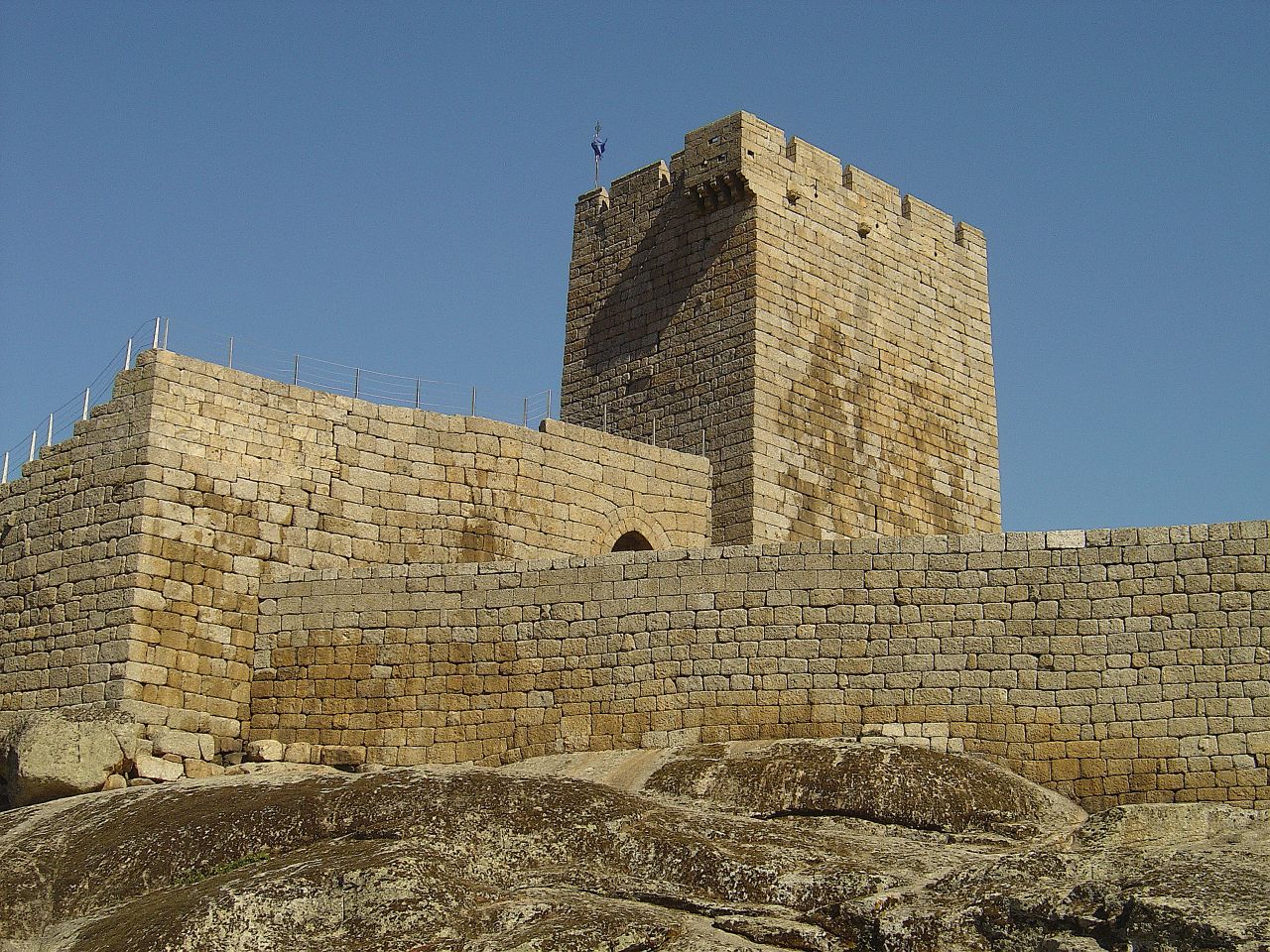
The castle’s surviving structure reflects a blend of Romanesque and Gothic architectural styles, shaped by centuries of modifications and restorations. The fortress occupies an irregular oval-shaped area atop the granite hill, enclosed by robust granite curtain walls that once protected the settlement within.
Walls, towers, and gates
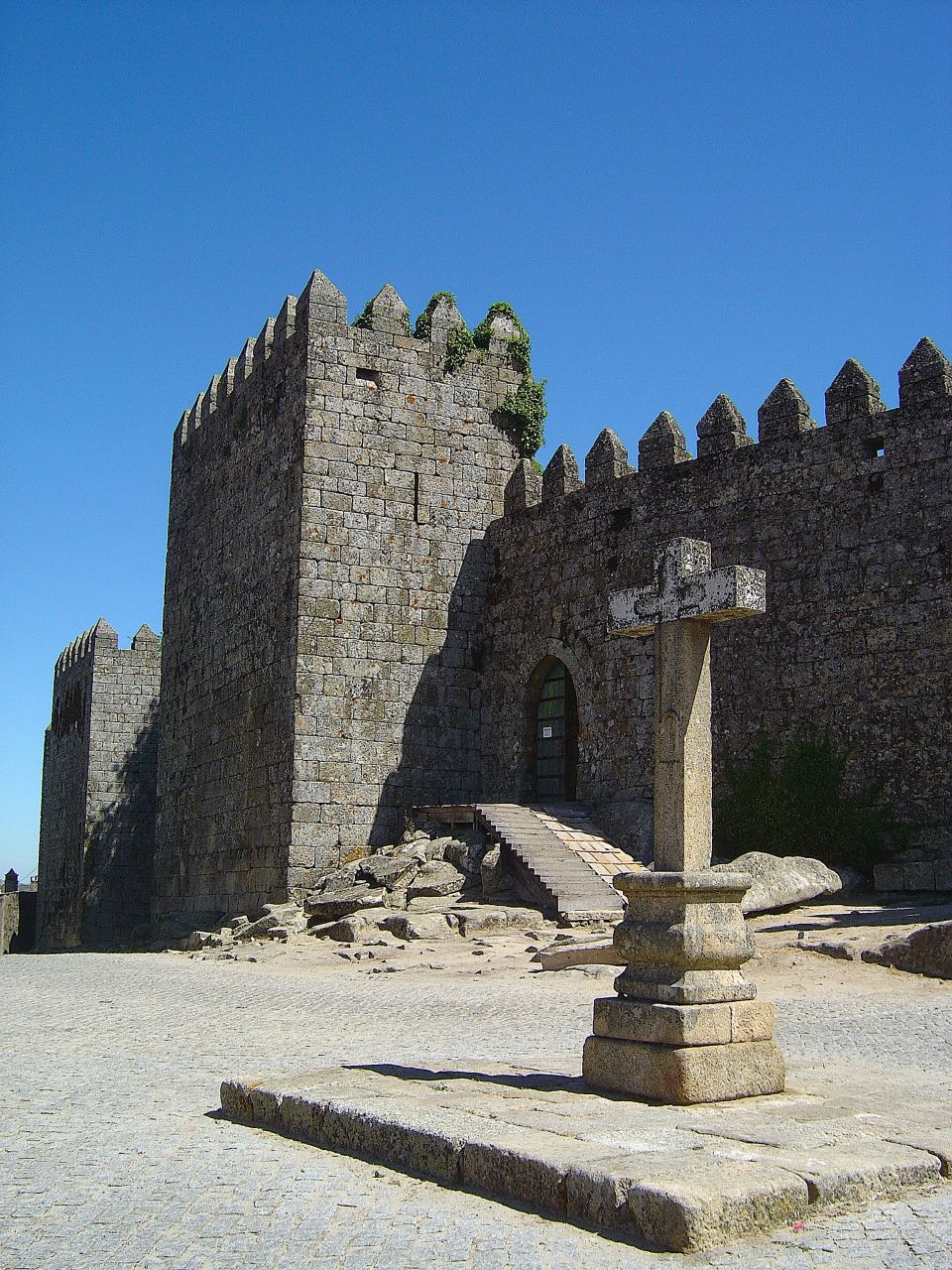
The enclosure features two main gates: the southern main entrance and the western Porta da Traição (Traitor’s Gate). Both gates are designed with characteristic pointed Gothic arches and covered by broken barrel vaults, retaining original stone hinges that link the castle interior with the historic town.
Two buttressed towers known as cubelos stand along the western wall, exhibiting irregular quadrangular and trapezoidal forms. These granite towers lack battlements but contribute to the fortress’s defense. Near the southeastern corner stands the prominent keep tower, a three-story square building crowned with crenellations and adorned with gargoyle carvings. The keep’s entrance is elevated on the second floor, accessible by an external stairway, and features a pointed relief arch.
Interior structures and water management
Within the courtyard lies a visible cistern that historically served as a vital water source during sieges. Evidence suggests the existence of a covered passage linking the castle to a nearby well known as the Poço d’El Rei (King’s Well), part of the castle’s sophisticated water management system. Although the original aqueduct is lost, these features highlight the strategic planning involved in sustaining the fortress’s inhabitants.
Historical conflicts and later use
Throughout its history, Celorico da Beira Castle witnessed numerous military engagements. It was involved in the 1383–1385 Portuguese succession crisis, where local garrisons united to repel Castilian invasions, notably contributing to victory at the Battle of Trancoso.
During the Seven Years’ War in 1762, Spanish forces captured the castle with minimal resistance. Later, in the Peninsular War (1810–1811), the fortress served as headquarters for French troops until expelled by the Anglo-Portuguese army under Sir Arthur Wellesley, the future Duke of Wellington. The nearby Church of Santa Maria was used as a field hospital during this period.
Decline, preservation, and modern access
By the 19th century, the castle had fallen into significant ruin. Urban expansion led to the demolition of much of the town’s defensive walls and parts of the castle, including the original keep tower and a notable passageway, whose stones were repurposed for paving. Despite considerations for demolition in 1835, the castle was declared a National Monument in 1923, sparking restoration efforts to preserve its remaining structures.
Subsequent conservation work in the mid-20th century stabilized the walls and preserved the castle’s essential features. Today, the fortress stands as a well-preserved example of medieval military architecture, freely accessible to visitors year-round. Walking the ramparts offers panoramic views of the Mondego valley, the Serra da Estrela mountains, and neighboring historic fortresses such as Linhares da Beira, Guarda, and Trancoso.
Although some areas feel somewhat neglected, with overgrown walkways and removed information panels, Celorico da Beira Castle remains a significant cultural and historical landmark, embodying the layered history of Portugal’s border defenses and medieval heritage.
Frequently asked questions (FAQ)
- How do I visit Celorico da Beira Castle?
- Celorico da Beira Castle is freely accessible year-round with open access. Visitors can explore the ramparts and enjoy panoramic views without an entrance fee.
- What is the historical significance of Celorico da Beira Castle?
- The castle was a key medieval fortress in Portugal’s Beira region, playing a vital role in border defense during the Middle Ages and involved in major conflicts like the Reconquista and the Peninsular War.
- When was Celorico da Beira Castle built?
- The castle’s origins trace back to the 12th century, with earlier fortifications on the site dating to Roman times and possibly earlier Iberian settlements.
- Can I see the castle’s architectural features?
- Yes, visitors can observe the castle’s mixed Romanesque and Gothic architectural styles, including granite curtain walls, towers, pointed arches, and a crenellated keep tower.
- Is the castle suitable for families and children?
- The castle is family-friendly with open outdoor areas and easy access to the ramparts. However, some pathways may be uneven or overgrown, so caution is advised for young children.
- What are the best times to visit Celorico da Beira Castle?
- The castle is open year-round and can be visited any time. Spring and autumn offer pleasant weather and clearer views of the surrounding valleys and mountains.
Information
Opening hours
Year-round, open access
Ticket prices
Free
Current owner
Municipality
Website
Visit websiteAddress
Escadas do Castelo, Celorico da Beira, Portugal
Sources & official resources
Verify the information above using these authoritative references.
Loading map...
Visitor reviews
No reviews yet. Been here? Write the first review and help other travelers!
Write the first reviewVisited this castle? Share your experience
Your review helps other travelers and adds first-hand knowledge to our encyclopedia.