Trancoso Castle
Trancoso Castle, locally known as Castelo de Trancoso, is a commanding medieval fortress perched on a granite hill overlooking the Beira plateau in the Beiras e Serra da Estrela region of Portugal. Its strategic position along the historic route connecting the Douro and Mondego valleys made it a vital stronghold on Portugal’s medieval frontier. The castle's origins date back to the 10th century, with the earliest fortification likely a Mozarabic watchtower constructed during a period of contested control between Christian and Muslim forces. The first documentary mention of the castle appears in 960, highlighting its long-standing significance in the region.
Medieval origins and early history
The initial fortifications at Trancoso were established during the turbulent early medieval period, when the Iberian Peninsula was a mosaic of Christian and Muslim territories. The castle's foundation is linked to Rodrigo Tedoniz, who took control of the area in the early 900s and initiated repopulation efforts with Christian settlers. The testament of his daughter, Chamôa Rodrigues, dated 960, includes the first written record of the castle, indicating its early importance.
Throughout the 10th and 11th centuries, Trancoso experienced frequent shifts in control due to ongoing conflicts. Around 1057–1058, King Fernando I of León secured a lasting Christian reconquest, after which the castle became part of the dowry of Countess Teresa during the formation of the County of Portugal. However, in 1140, Muslim forces led by Esmar besieged and sacked the town, underscoring its strategic value.
Following the foundation of Portugal in 1143, King Afonso Henriques reinforced Trancoso as a key border defense against the Kingdom of León. The castle was formally established in 1159, with earlier charters granted in 1155 and 1173, and its domains entrusted to the Knights Templar. This military order transformed the original Mozarabic structure into a more robust Romanesque keep surrounded by defensive walls.
Architectural evolution and fortifications
During the 12th and 13th centuries, Trancoso Castle underwent significant reconstruction and expansion. King Sancho I reaffirmed the town’s charter in 1207, and King Afonso II strengthened the town walls. The most substantial enhancements occurred under King Denis (1279–1325), who rebuilt the castle in stone and completed the surrounding walled town with its characteristic eleven gates and square towers. The polygonal curtain walls, constructed from local granite, feature six flanking towers and a central courtyard, forming a formidable defensive complex.
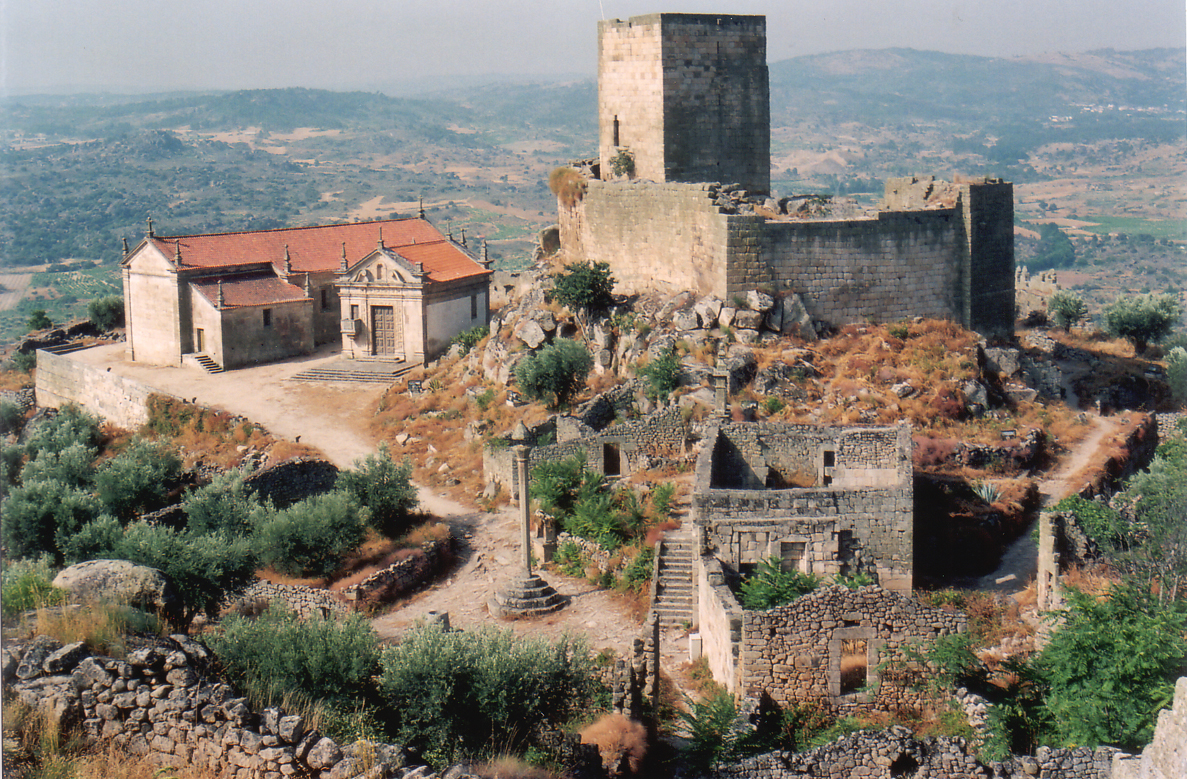
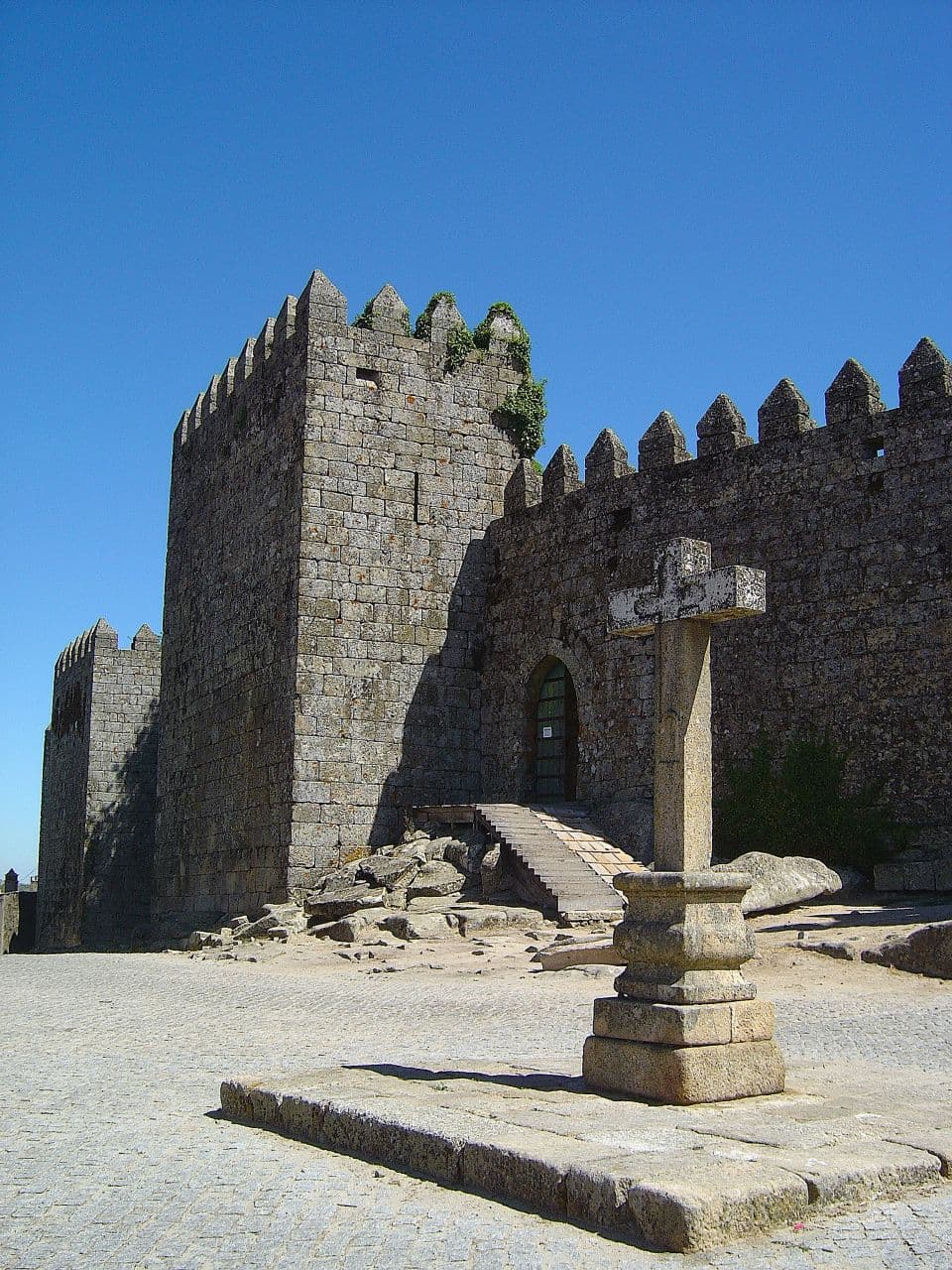
The castle’s keep, slightly offset within the enclosure, bears the coat of arms of King Denis and serves as a dominant architectural feature. The main gate, flanked by two towers, faces east toward the town square, while a postern gate on the west side provides access to the hillside. The curtain walls still reach nearly their original height, demonstrating the quality of medieval masonry. Inside the enclosure, foundations of earlier domestic buildings and a cistern that supplied the garrison remain visible.
The fortifications include a defensive wall reinforced by five square-shaped towers topped with crenellations and pyramid-like battlements. These towers are connected by a chemin de ronde, or wall walk, allowing defenders to patrol the ramparts. Originally, the settlement was enclosed by a ring of fortified walls about one kilometer in circumference, fortified by fifteen towers spaced at intervals. Four main gates, each protected by towers, controlled access to the town, complemented by three smaller postern gates for discreet entry and exit.
Historical significance and military role
Trancoso Castle was a key player in the defense of Portugal’s eastern frontier throughout the Middle Ages. It formed part of a chain of fortified mountain towns, including Guarda, Celorico da Beira, Linhares da Beira, Marialva, and Longroiva, each strategically positioned on granite ridges commanding views over surrounding valleys. This network was crucial in securing the Beira frontier against Castilian incursions.
During the 14th century, Trancoso saw significant military action, notably in the Battle of Trancoso in 1385. Under the command of Gonçalo Vasques Coutinho, the castle’s garrison successfully repelled a larger Castilian force during the Portuguese succession crisis, a pivotal moment that helped secure the throne for John I of Portugal. The castle remained a royal fortress and was garrisoned until the 16th century, after which its military importance waned, and domestic buildings expanded along its outer walls.
In the early 19th century, the castle was again used militarily when British troops under General William Carr Beresford were stationed there during the Peninsular War in 1809. By the mid-1800s, the Chapel of Santa Bárbara inside the castle, then in ruins, was repurposed as a powder magazine, though it was never used for this function. Parts of the castle walls were dismantled during this period to provide stone for public works, resulting in the loss of some gates and towers.
Restoration and current status
Recognizing its cultural and historical value, Trancoso Castle and its walls were declared a National Monument in 1921. Restoration efforts in the 1930s focused on rebuilding damaged sections of the walls and battlements to preserve the medieval character of the site. These works aimed to replicate the original defensive features, including the crenellated towers and curtain walls.
Today, the castle is well preserved and freely accessible during daytime hours. Visitors can explore the imposing curtain walls, towers, and the central courtyard, although the interior of the keep has undergone renovations and may not always be open. The castle’s elevated position offers panoramic views of the surrounding landscape, making it a popular destination for history enthusiasts and tourists alike.
Trancoso Castle stands as a remarkable example of early medieval military architecture that evolved through the Romanesque and Gothic periods. Its combination of strategic location, robust fortifications, and rich history reflects the complex medieval history of Portugal’s borderlands. The castle not only served as a military bastion but also shaped the urban development of Trancoso, embodying centuries of cultural heritage.
Frequently asked questions (FAQ)
- How do I get to Trancoso Castle?
- Trancoso Castle is located in the town of Trancoso, Beiras e Serra da Estrela region, Portugal. It is accessible by car and local transport, with parking available near the castle area.
- What is the best time to visit Trancoso Castle?
- The best time to visit Trancoso Castle is during the spring and autumn months when the weather is mild and the landscape is particularly scenic. The castle is open during daytime hours daily.
- Is there an entrance fee to visit Trancoso Castle?
- No, visiting Trancoso Castle is free of charge. Visitors can explore the castle grounds and walls without any ticket fees.
- Can I enter the keep of Trancoso Castle?
- The keep of Trancoso Castle may be closed at times due to ongoing renovations. Visitors should check current access conditions before planning their visit.
- What architectural styles are represented in Trancoso Castle?
- Trancoso Castle features a mix of Romanesque and Gothic architectural elements, reflecting its construction and modifications from the 10th to 14th centuries.
- Are there guided tours available at Trancoso Castle?
- Guided tours may be available through the local municipality or tourism office. Visitors are encouraged to inquire locally for scheduled tours and educational programs.
Photo gallery

Information
Opening hours
Daytime hours, daily
Ticket prices
Free
Current owner
Municipality
Website
Visit websiteAddress
R. do Castelo, Portugal
Sources & official resources
Verify the information above using these authoritative references.
Loading map...
Visitor reviews
No reviews yet. Been here? Write the first review and help other travelers!
Write the first reviewVisited this castle? Share your experience
Your review helps other travelers and adds first-hand knowledge to our encyclopedia.