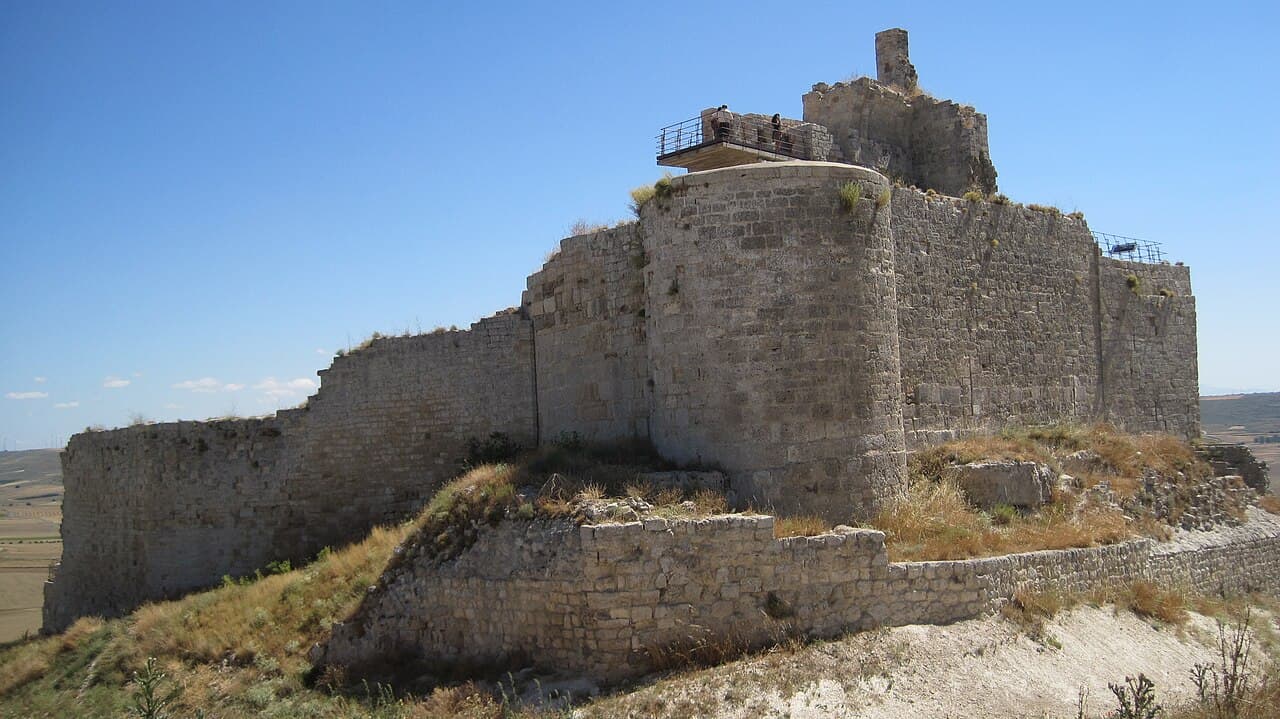
Castrojeriz Castle
Castrojeriz Castle stands as a remarkable hilltop fortress in the historic town of Castrojeriz, Spain, commanding a strategic position along the famed Camino de Santiago pilgrimage route. Its origins trace back to antiquity, with archaeological and historical evidence suggesting a complex layering of Roman, Visigothic, and medieval construction phases. While some traditions attribute its foundation to Julius Caesar during the Roman era, the earliest documented references to the castle date from the 9th century amid the volatile Christian-Muslim conflicts of the early medieval period.
The castle's location on a prominent hillside allowed it to serve as a vital defensive stronghold overseeing the surrounding plains and the pilgrimage path. The fortress evolved through centuries of warfare, political shifts, and architectural adaptations, reflecting the turbulent history of northern Spain from the Early Middle Ages through the Late Medieval period. Its enduring presence offers insight into the military, social, and religious dynamics that shaped the region.
Historical development and military significance
Castrojeriz Castle originated as a fortified site with probable Roman roots, evidenced by a surviving square tower attributed to Roman construction techniques. The subsequent Visigothic expansion introduced masonry work distinct from the Roman foundation, extending the fortress's defensive perimeter. The castle first appears in historical records during the 9th century, a time marked by frequent skirmishes between Christian kingdoms and Muslim forces in the Iberian Peninsula.
Following destruction by Arab troops, the fortress was substantially rebuilt in 882 AD under the leadership of Captain Munio Núñez, a prominent figure among the Foramontanos, who played a key role in repopulating and defending the northern frontier of the Christian kingdoms. This reconstruction reinforced the castle's fortifications, enabling it to withstand further attacks.
Throughout the Middle Ages, the castle remained a critical military asset within the County of Castile, officially incorporated in 1131. It served as a bulwark against incursions by various groups including Visigoths, Celts, Arabs, and rival Christian factions. The fortress also functioned as a political prison; notably, Queen Doña Leonor of Aragón was imprisoned and executed there in 1358, underscoring its role in regional power struggles.
The castle endured damage from natural disasters such as the 1755 Lisbon earthquake, which contributed to its gradual decline and partial ruin. Historically, the castle's environs encompassed a wide area with numerous religious and social institutions, including churches, convents, hospitals, and inns, highlighting its importance as a community center as well as a military fortress.
Architectural features and layout
The castle is primarily constructed of ashlar stone, carefully shaped blocks bonded with lime and clay mortar to ensure durability against environmental challenges such as earthquakes and heavy rainfall. Its defensive walls are notably robust, measuring approximately three meters thick and rising to about seven meters in height. These ramparts feature loopholes, narrow vertical slits designed to allow archers to defend the fortress while remaining protected.
The fortress is divided into three distinct sections reflecting its layered history: the Roman section with the nearly hidden square tower; the Visigothic extension characterized by different masonry styles; and the medieval additions that expanded and reinforced the complex.
Two prominent watchtowers stand at opposite ends of the hill, providing extensive views for surveillance and early warning of approaching enemies. The castle's core included a central courtyard or patio de armas, which served as a training ground for soldiers and a space for military drills.
The most fortified area was the keep or torre del homenaje, the stronghold within the fortress, offering the last line of defense. On the western side, a large tower adjoined the main structure, reinforced by a corner bastion known as a cubo, enhancing the castle's defensive capabilities.
The entire complex was enclosed by a curtain wall nearly three meters thick, contributing to the overall strength of the fortress. Although the castle is now in ruins with roofing collapsed, architectural elements such as the springing points of vaults remain visible, indicating the original sophistication of its design.
Restoration and preservation efforts
In recent years, restoration efforts have focused on consolidating the deteriorated stonework to preserve the castle's remains for future generations. These projects aim to stabilize the structure, prevent further decay, and facilitate public access for educational and cultural purposes.
Despite its ruined condition, Castrojeriz Castle remains a significant cultural landmark in northern Spain, attracting visitors interested in medieval military architecture, Spanish history, and the heritage of the Camino de Santiago. The castle's layered construction offers a tangible narrative of the region's complex past, from Roman times through the medieval era.
Cultural and historical importance
The castle's historical role as a military fortress, political prison, and community center underscores its multifaceted significance. Its strategic location along the Camino de Santiago pilgrimage route made it a key point of defense and control, influencing the flow of people and goods through northern Spain.
Moreover, the castle's association with notable historical figures like Captain Munio Núñez and Queen Doña Leonor of Aragón adds layers of political and social intrigue to its story. The fortress embodies the enduring legacy of the Early Medieval and Late Medieval periods in Spanish history, reflecting broader themes of conflict, power, and cultural exchange.
Today, Castrojeriz Castle stands as a testament to the resilience and complexity of medieval fortifications, offering scholars and visitors alike a profound connection to Spain's rich historical tapestry.
Frequently asked questions (FAQ)
- When was Castrojeriz Castle originally built?
- Castrojeriz Castle dates back to the 9th century, with earlier Roman and Visigothic origins evident in the structure.
- What architectural styles are present in Castrojeriz Castle?
- The castle features a blend of Roman, Visigothic, and medieval architectural elements, reflecting its long history and multiple phases of construction.
- Is Castrojeriz Castle open to the public for visits?
- Yes, the castle ruins are accessible to visitors, offering a glimpse into its historical significance and architectural features.
- What is the historical significance of Castrojeriz Castle in the Camino de Santiago?
- The castle served as a key defensive stronghold protecting the Camino de Santiago pilgrimage route, controlling movement and providing security during medieval times.
- How has the castle been preserved despite its ruined condition?
- Restoration efforts have focused on stabilizing the stonework and preventing further deterioration to maintain the castle as a cultural landmark.
Photo gallery

Information
Website
Visit websiteSources & official resources
Verify the information above using these authoritative references.
Loading map...
Visitor reviews
No reviews yet. Been here? Write the first review and help other travelers!
Write the first reviewVisited this castle? Share your experience
Your review helps other travelers and adds first-hand knowledge to our encyclopedia.



