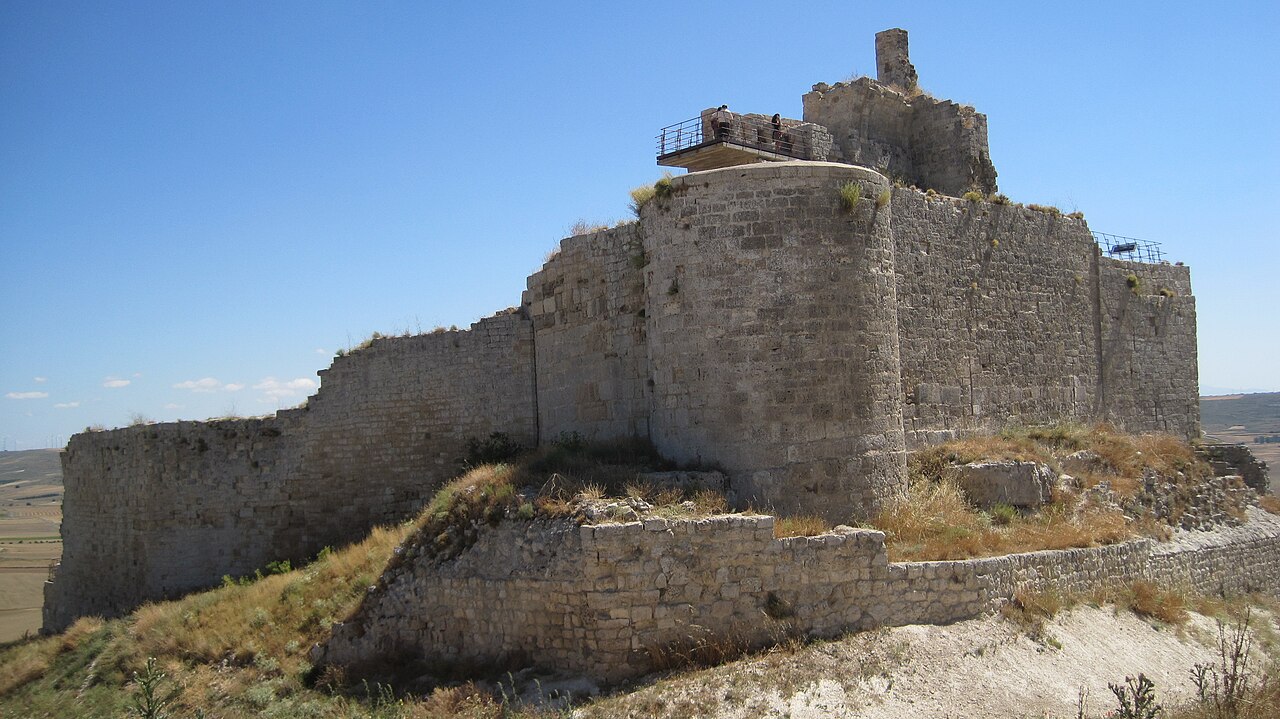
Castle of Palenzuela
The Castle of Palenzuela is a significant medieval fortress located in the municipality of Palenzuela, Spain. Its origins trace back to at least the mid-9th century, with the earliest documentation dating to the year 850. This places the castle’s establishment during the early stages of the Reconquista, a period marked by the Christian kingdoms’ efforts to reclaim territory from Muslim rule in the Iberian Peninsula. The castle’s strategic location on a prominent terrace overlooking the Arlanza valley near the confluence of the Arlanza and Arlanzón rivers provided a commanding view of the surrounding landscape, underscoring its military importance.
Throughout the 10th century, Palenzuela was situated in a contested frontier zone and endured two raids by Arab forces in 919. During this period, the town and castle were governed by the Counts of Castile, a noble family pivotal in the Christian reconquest of northern Spain. By the late 10th century, the town was granted legal charters, known as fueros, by Count Sancho García, a grandson of the notable Count Fernán González. These charters were subsequently confirmed and expanded by several medieval monarchs, reflecting Palenzuela’s growing regional significance.
Medieval ownership and political struggles
The castle’s ownership shifted frequently over the centuries, reflecting the turbulent political landscape of medieval Spain. In the reign of Fernando III during the early 13th century, it was held by Álvaro Núñez de Lara, a powerful nobleman who lost the lordship following his defeat, returning the castle to royal control. Nearly a century later, in 1295, Juan Núñez de Lara led a rebellion against Queen Regent María de Molina. Palenzuela endured a siege lasting nearly six months before surrendering and rejoining the crown’s domain.
Mid-14th century conflicts further shaped the castle’s fate. Pedro I of Castile, known as "the Cruel," granted the lordship to his half-brother Enrique de Trastámara. In 1356, Enrique besieged the town during a rebellion, securing its surrender and subsequently bestowing the lordship upon his wife, María de Padilla. By the early 15th century, the castle was under the possession of Queen Catalina, wife of King Enrique III.
Significant events and royal influence
Palenzuela reached a peak of political importance in 1425 when King Juan II convened the Cortes (parliament) at a nearby Franciscan convent. The castle later witnessed conflict between the king and Juan of Navarre in 1444. In 1451, the fortress joined several nearby strongholds in rebellion against Juan II and his favorite, Álvaro de Luna. Royal forces responded with a siege employing artillery, leading to the fortress’ surrender in early 1452. The king awarded the town to his son Enrique, though by 1454 ownership had returned to the Admirals of Castile.
Role during the peninsular war and later use
In the early 19th century, during the Peninsular War (1808–1814) between Spain and Napoleonic France, Palenzuela experienced multiple occupations by French troops. Commanding officers were headquartered in nearby Quintana del Puente, and in 1813, Marshal Soult took over the Jalón palace in Palenzuela, where Joseph Bonaparte, Napoleon’s brother and installed king of Spain, took refuge before fleeing the country.
Historically, the castle also served as a prison reserved for serious or political offenders. From the mid-15th century onward, a rule forbade the imprisonment of local inhabitants within the castle walls, emphasizing its role as a detention site for notable prisoners.
Architectural features and current state
The Castle of Palenzuela stands on a hill castle site with surviving masonry constructed from stone, typical of medieval military fortifications. The remains reveal robust walls and defensive structures, though the precise layout, measurements, and orientation remain unspecified. No decorative elements or inscriptions have been documented, and internal arrangements such as chambers or halls are not clearly recorded.
The castle’s elevated position overlooking the Arlanza valley provided strategic defense advantages, controlling access routes along the rivers. While detailed archaeological finds are scarce, the partial ruins allow for an understanding of its military function and historical significance.
Nearby historical sites
Near Palenzuela, the abandoned site of El Moral once hosted a second castle near the confluence of the Arlanza and Arlanzón rivers. This fortification had disappeared by the early 13th century, highlighting Palenzuela’s enduring prominence as the main stronghold in the region.
Frequently asked questions (FAQ)
- When was the Castle of Palenzuela originally built?
- The Castle of Palenzuela dates back to at least the mid-9th century, with the first documentation in the year 850.
- What is the architectural style of the Castle of Palenzuela?
- The castle features typical medieval stone masonry fortifications but does not have a clearly defined architectural style due to its age and partial preservation.
- Can visitors see the Castle of Palenzuela today?
- The castle is partially preserved as ruins, allowing visitors to view the remaining stone walls and understand its strategic hilltop location.
- What historical events took place at the Castle of Palenzuela?
- The castle was involved in significant medieval conflicts including sieges during noble rebellions, royal disputes, and the Peninsular War occupations by French troops.
- Was the Castle of Palenzuela used as a prison?
- Yes, from the mid-15th century onward, the castle served as a prison for serious or political offenders, with local inhabitants forbidden from being imprisoned there.
Information
Loading map...
Visitor reviews
No reviews yet. Been here? Write the first review and help other travelers!
Write the first reviewVisited this castle? Share your experience
Your review helps other travelers and adds first-hand knowledge to our encyclopedia.