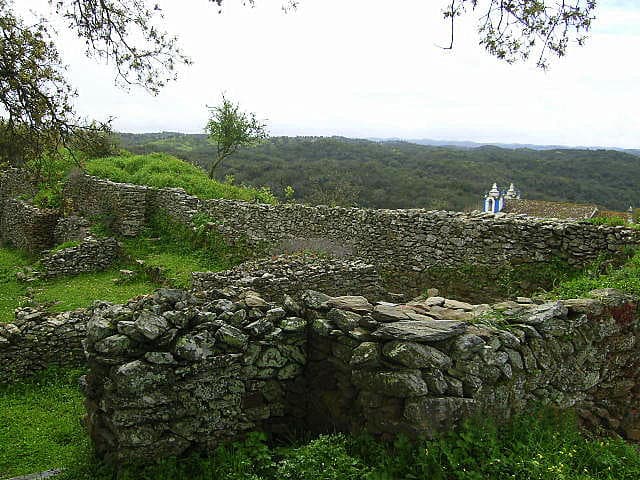
Castro da Cola
Castro da Cola is a significant fortified settlement located in the municipality of Ourique, in the Alentejo region of Portugal. This site uniquely illustrates a long continuum of human occupation, beginning in the late Neolithic or early Chalcolithic period and extending through the Bronze Age, Iron Age, Roman times, and into the Medieval Islamic period. Its strategic position on a large schist hill overlooking the surrounding landscape provided natural defenses that were enhanced by successive cultural groups over millennia.
The settlement's earliest phase saw small communities establishing a castro—a type of fortified village typical of the Iberian Peninsula during prehistoric times. Archaeological finds from this era include concave grinding stones and a rounded pestle, indicating early subsistence activities. The site flourished particularly during the Iron Age, evidenced by distinctive artifacts such as a short bronze sword with antenna-shaped hilts, ceramic urns, and glass and gold beads with possible Phoenician or Punic connections. These finds suggest that Castro da Cola was part of wider Mediterranean trade and cultural networks.
Roman and post-Roman occupation
During the Roman era, the site continued to be occupied, though evidence of full Romanization is limited. Archaeological remains include fragments of limestone columns, dressed stones, roof tiles (imbrices), and decorated ceramic fragments. These indicate some degree of Roman architectural influence but suggest that the settlement retained much of its indigenous character. Following the decline of Roman authority, the site underwent Christianization, reflecting broader religious and cultural shifts in the region.
Islamic transformation and medieval significance
From the 8th century onwards, Castro da Cola assumed a new identity under Islamic rule. Known in Muslim sources as Marjiq and later as Marachique after the Christian reconquest, it was transformed into a hisn—a small fortress integral to the defensive network securing the southern frontiers of the Iberian Peninsula. The name "Cola" likely derives from the Arabic "Qal'a", meaning fortress, underscoring its military function during this period.
The fortress was strategically positioned at a border zone between the Taifa kingdoms of Seville and Silves in the 11th century, highlighting its importance in regional power struggles. The Islamic town was organized into two main sectors: a military area with a courtyard surrounded by warehouses and stables, and a larger urban quarter featuring streets lined with houses arranged around central patios. Archaeological evidence reveals shops, workshops, ovens, wells, and a large cistern, illustrating a vibrant community engaged in pastoralism, agriculture, and textile production, as shown by weaving tools such as spindle needles and lead weights.
Architectural features of the fortress
The fortification encloses an irregular polygonal area approximately 330 meters in perimeter. Its walls, built primarily from locally quarried schist stones set with earth mortar, reach thicknesses of about 2.7 meters. The walls are reinforced by several square towers and display construction techniques including opus spicatum (herringbone masonry) in some segments. The fortress is further protected by two outer defensive lines, possibly serving as detached structures similar to ravelins or half-moons.
The main gate, located on the eastern wall, features a bent entrance—a defensive design that impedes direct access by forcing attackers to turn sharply. This architectural element is typical of fortifications in the region from the 11th century onward. Although only the gate's foundations and remains of an adjacent tower survive, they provide valuable insight into the fortress's defensive strategies.
Decline and later history
Despite its earlier prominence, Castro da Cola began to decline in the 14th century. By the 15th century, it was abandoned as a municipal center, with administrative functions moving to nearby Ourique. However, the fortress retained military relevance and underwent modifications, including maintenance of the bent entrance gate. Historical records from the 16th century, such as those by André de Resende, mention the ruins, and the site attracted scholarly attention over subsequent centuries.
Systematic archaeological investigations began in the mid-20th century, notably by Abel Viana between 1958 and 1964, who revealed key aspects of the Islamic occupation. Further excavations and conservation efforts took place from 1988 to 2005, including restoration work and detailed topographic surveys. These projects have helped preserve the site and deepen understanding of its complex history.
Religious and cultural significance
Adjacent to the ruins lies the Sanctuary of Nossa Senhora da Cola, an important Marian pilgrimage site in the Alentejo region. Local legends speak of a miraculous image of the Virgin Mary and a bell that rang during the Moorish period, adding a mystical dimension to the site's history. The sanctuary is believed to occupy the site of the former Islamic necropolis, linking the area's religious heritage across different cultures and eras.
Nearby earthworks and smaller forts, collectively known as the Castelinhos d’além da Terra do Azinhal, may represent secondary defensive structures associated with the main fortress, illustrating the broader defensive landscape of the region.
Archaeological remains and legacy
The archaeological record at Castro da Cola provides a layered narrative of human occupation spanning thousands of years. Prehistoric tools, Iron Age weapons, Roman architectural fragments, and Islamic artifacts coexist within the site, offering a rare glimpse into the evolving defensive, domestic, and economic functions of a fortified settlement in southern Portugal.
Restoration efforts have stabilized the ruins, although some interventions have altered original structures. A vaulted chamber with plastered and painted walls, once described by José Leite de Vasconcelos, preserves fragments now housed in the Ethnological Museum, underscoring the site's architectural complexity.
Today, Castro da Cola stands as a National Monument and a key archaeological park, attracting visitors interested in prehistoric, Roman, and Islamic heritage. Managed by the municipality of Ourique, it offers insights into the cultural transformations that shaped the Alentejo region over millennia.
Frequently asked questions (FAQ)
- How do I get to Castro da Cola?
- Castro da Cola is located near the town of Ourique in the Alentejo region of Portugal. Visitors can reach the site by car via local roads; parking is available nearby. It is recommended to check local tourist information for the best routes and accessibility.
- What is the historical significance of Castro da Cola?
- Castro da Cola is significant for its long history of occupation from prehistoric times through the Islamic period. It illustrates cultural transitions from Neolithic settlements to an Islamic fortress, reflecting the strategic importance of the site in regional defense and administration.
- Can I visit the Sanctuary of Nossa Senhora da Cola when visiting the ruins?
- Yes, the Sanctuary of Nossa Senhora da Cola is adjacent to the archaeological site and is an important Marian pilgrimage destination. Visitors can explore the sanctuary alongside the ruins to experience both the religious and historical heritage of the area.
- What architectural features are notable at Castro da Cola?
- Notable features include the polygonal fortified walls built of schist stone, reinforced square towers, and the distinctive bent entrance gate typical of 11th-century Islamic military architecture in the region.
- Is the site accessible for visitors with limited mobility?
- Due to the site's hilltop location and uneven terrain, access may be challenging for visitors with limited mobility. It is advisable to contact the local municipality or visitor center for specific accessibility information before planning a visit.
Photo gallery

Information
Current owner
Municipality of Ourique
Loading map...
Visitor reviews
No reviews yet. Been here? Write the first review and help other travelers!
Write the first reviewVisited this castle? Share your experience
Your review helps other travelers and adds first-hand knowledge to our encyclopedia.



