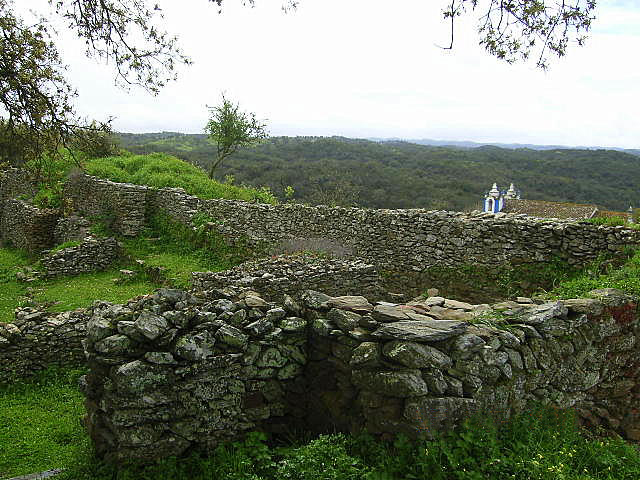
The Castle of Ourique stands as a significant historic site in the municipality of Ourique, located in southern Portugal. Perched atop a hill approximately 245 meters high, this hill castle occupies a strategic position that has been valued since ancient times. The site reflects a layered history of occupation, beginning with a castro (a pre-Roman fortified settlement), followed by Romanized settlement phases, and eventually the construction of the castle during the Islamic period in the 9th century.
Known in Arabic sources from the 10th century as Al-Riqa, the castle's precise identification with the current Ourique location remains debated among historians. Nevertheless, it played a crucial role during the Christian Reconquista in the 12th and 13th centuries. The castle was part of a defensive network north of the Algarve mountains, safeguarding an important military and trade route connecting the Algarve region with the Sado River valley. This strategic position meant the castle was frequently contested, changing hands multiple times during the intense conflicts of the Reconquista.
Historical significance and the battle of ourique
The Battle of Ourique in 1139 is one of the most legendary episodes associated with the castle. This battle marked a turning point in Portuguese history, as it led to the rise of Afonso Henriques as the first king of Portugal. Although the exact location of the battle is subject to scholarly debate, the castle and its surrounding area are traditionally linked to this seminal event. The victory helped consolidate Portuguese independence and fostered the establishment of the Portuguese kingdom.
Medieval reconstruction and ownership
Following the Christian conquest of the castle in the 13th century, the site came under the control of the Order of Santiago, a military and religious order instrumental in the Reconquista efforts. Under the reign of King Dinis of Portugal, the castle underwent significant reconstruction between the late 13th and early 14th centuries. This period coincided with the issuance of a formal foral (charter) to the nearby settlement of Vila Nova de Ourique in 1290, which helped establish local governance and economic stability.
During this era, the castle functioned primarily as a local defensive stronghold. Its design likely featured typical Gothic military architectural elements, including an oval-shaped citadel with a keep tower integrated into the surrounding curtain walls. The castle's position on a hilltop provided natural defensive advantages and visibility over the surrounding landscape.
Architectural features and archaeological remains
The original castle complex comprised two main components: the fortified wall enclosing the settlement and the citadel atop the hill near the parish church. The citadel's oval layout was consistent with Gothic military architecture of the period, designed to maximize defense and control access points. The keep tower was a central feature, serving as the last line of defense and a symbol of lordly power.
Today, no medieval structures remain intact. The hilltop site now hosts the Miradouro de Ourique (viewpoint), also known as Parque Frederico Ulrich or Miradouro Ramiro Sobral. This modern viewpoint includes a quadrangular water tower built roughly where the medieval keep once stood. Visitors enter through a 20th-century pointed arch gate designed to evoke medieval architectural forms, though the supporting walls of the platform are more likely modern constructions.
Recent archaeological excavations since 2018 have uncovered a rammed earth retaining wall approximately three meters high on the northern slope of the hill. This wall, constructed using compressed earth layers, is associated with ceramic fragments dating from the 15th century and later, indicating continued use or occupation of the site beyond the medieval period. Within the historic village, about 2.5 kilometers from the castle hill, archaeologists have identified approximately 21 medieval silos. Some of these storage pits may date back to the Islamic period, underscoring the long history of habitation and agricultural activity in the area.
Decline and modern developments
By the late medieval period, the castle's military importance diminished due to its inland location and changing defensive priorities favoring coastal and border fortifications. The castle gradually lost its strategic value and by the 20th century, it no longer served any defensive function. In the 1960s, the remaining medieval structures were demolished to make way for modern infrastructure, including the water tower and viewpoint.
Although the site was proposed for protection as a Property of Public Interest in 1973, this designation was withdrawn in 2012 after it was determined that no substantial original remains survived. Nonetheless, the site holds cultural significance, commemorated by a statue of King Afonso Henriques that honors the legendary battle traditionally associated with Ourique.
Visiting the castle of ourique today
Visitors to the Castle of Ourique today can enjoy panoramic views from the Miradouro de Ourique, which offers sweeping vistas of the surrounding landscape. While the original medieval structures are no longer visible, the site provides a tangible connection to Portugal's formative history and the Reconquista era. The archaeological findings enrich the understanding of the site's long occupation and its role in regional defense and settlement patterns.
The castle hill is accessible to visitors interested in exploring the historical significance of the location and appreciating the natural beauty of the Alentejo region. Interpretive signage and the commemorative statue of King Afonso Henriques help contextualize the site's importance within Portuguese national heritage.
Frequently asked questions (FAQ)
- When was the Castle of Ourique originally constructed?
- The Castle of Ourique was originally constructed during the Islamic period, likely in the 9th century, on a site with earlier pre-Roman and Romanized occupation.
- What is the historical significance of the Battle of Ourique?
- The Battle of Ourique in 1139 is a pivotal event linked to the castle, marking the rise of Afonso Henriques as the first king of Portugal and the foundation of Portuguese independence.
- Are there any original medieval structures still visible at the castle site?
- No original medieval structures survive today. The hilltop features a modern viewpoint and water tower, with archaeological remains uncovered nearby.
- Can visitors access the Castle of Ourique year-round?
- Yes, the site is open daily from sunrise to sunset, allowing visitors to explore the hilltop and enjoy panoramic views throughout the year.
- Is there an entrance fee to visit the Castle of Ourique?
- Visiting the Castle of Ourique is free of charge, making it accessible to all interested in its history and scenic location.
Information
Opening hours
Open daily, sunrise to sunset
Ticket prices
Free
Current owner
Municipality
Loading map...
Visitor reviews
No reviews yet. Been here? Write the first review and help other travelers!
Write the first reviewVisited this castle? Share your experience
Your review helps other travelers and adds first-hand knowledge to our encyclopedia.