Castle of Salir
The Castle of Salir stands as a significant medieval hill fortress located in the municipality of Loulé in the Algarve region of southern Portugal. Originally constructed in the 12th century by the Almohad Muslim rulers during their control of the Algarve, it formed part of a strategic defensive network designed to protect local settlements from advancing Christian forces during the Reconquista.
Archaeological evidence indicates that the site was occupied as early as the late 11th century, with a nearby Muslim settlement confirmed by finds such as a funerary stele dated to 1016. The castle's location atop a limestone hill approximately 250 meters above sea level allowed it to oversee important inland routes and valleys, making it a key rural stronghold throughout the Almohad period in the 12th and early 13th centuries. This positioning enabled the fortress to serve as a refuge for the local population during periods of Christian military incursions.
Historical context and military significance
Between 1248 and 1250, the castle was seized by Christian forces, notably the Order of Santiago, shortly after their conquest of nearby Tavira. Following its capture, the fortress was deliberately set on fire but was rebuilt twice under Christian rule, reflecting its ongoing military importance during the Algarve campaign. Prominent figures such as D. Paio Peres Correia and King D. Afonso III were associated with the castle during this period.
Despite its initial strategic value, by the 14th century military focus shifted towards coastal fortifications, leading to the gradual decline and abandonment of the Castle of Salir. The fortress suffered further damage during the devastating 1755 earthquake that affected much of Portugal, accelerating its deterioration. Subsequent reuse of its stones for local construction contributed to the loss of much of its original fabric.
Architectural features and layout
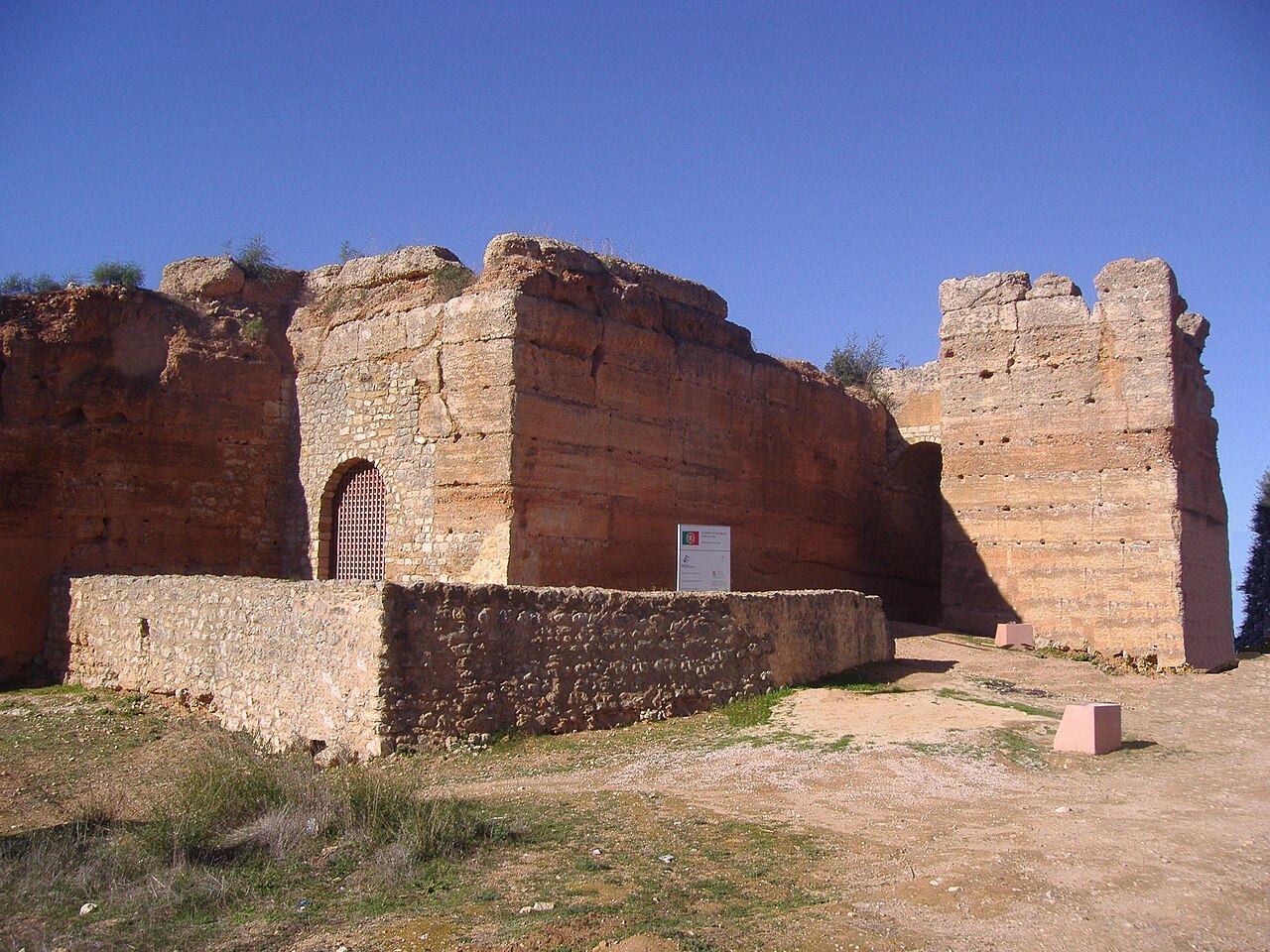
The castle occupies an irregular polygonal enclosure covering approximately 4,200 square meters. Its walls, constructed primarily using rammed earth techniques with limestone foundations, stand about 1.8 meters high and 2 meters thick. The defensive circuit includes four quadrangular towers positioned on various slopes of the hill, each in different states of preservation. Notably, the "Muro Maior" tower on the northwest slope is accompanied by remains of 12th and 13th-century buildings.
The main entrance is believed to have been on the southern side where the terrain is gentler, although no definitive gate structures survive. The castle's walls vary in thickness from one to nearly five meters, with some sections reaching heights of up to four meters, highlighting the fortress's robust defensive design.
Urban core and domestic structures
Excavations have revealed an organized urban core within the castle walls, laid out in a grid pattern. Six small rectangular houses surround a central courtyard paved with stone slabs. These dwellings feature rammed earth walls atop stone bases and contain kitchens with hearths, indicating their domestic use during the Islamic period.
Additional findings include a narrow street approximately 1.8 meters wide that ended at a defensive wall, suggesting a peripheral neighborhood adjacent to the northwest defenses. The presence of ten silos for storage and an ancient drainage system with water outlets through small wall holes demonstrate the inhabitants' attention to resource management and sanitation.
Archaeological discoveries and artifacts
Archaeological excavations beginning in the 1980s uncovered a wealth of artifacts that illuminate daily life at the castle. These include glazed and unglazed ceramics dating from the 12th to 15th centuries, metal objects such as scissors, knives, a decorated belt plate, and weapons. Bone fragments believed to be weaving tools and botanical remains like wheat and acorn seeds provide insight into the agricultural practices and crafts of the castle's inhabitants.
Preservation and visitor experience
Today, the Castle of Salir remains a partially preserved ruin, with significant sections of its walls and towers still visible. Some wall segments have been integrated into later constructions, while others stand in varying states of ruin. East of the "Muro Maior" tower, excavations revealed remains of Moorish kitchens and living quarters, now complemented by landscaping featuring traditional Portuguese pavement stones and benches.
A simple rectangular building within the excavated area functions as an interpretative center, providing museum facilities and visitor information. This center enhances understanding of the archaeological findings and the castle's historical significance.
The castle's location on a limestone hill offers commanding views of the surrounding valleys, adding to its appeal as a heritage site. Efforts to protect and promote the Castle of Salir have increased in recent years, recognizing its important role in the medieval history of the Algarve and its value as a cultural landmark.
Frequently asked questions (FAQ)
- When was the Castle of Salir originally built?
- The Castle of Salir was originally constructed in the 12th century by the Almohad Muslim rulers during their control of the Algarve region.
- What is the architectural style of the Castle of Salir?
- The castle primarily features construction techniques typical of the High Medieval period, including rammed earth walls with limestone foundations, but it does not conform to a single defined architectural style.
- Can visitors access the Castle of Salir today?
- Yes, visitors can explore the partially preserved ruins of the Castle of Salir, including its towers, walls, and an interpretative center that provides historical context and archaeological information.
- What artifacts have been found at the Castle of Salir?
- Excavations have uncovered a variety of artifacts, including glazed and unglazed ceramics from the 12th to 15th centuries, metal tools and weapons, bone fragments likely used for weaving, and botanical remains such as wheat and acorn seeds.
- Why did the Castle of Salir lose its military importance?
- By the 14th century, military focus shifted towards coastal fortifications in the Algarve, leading to the gradual abandonment and decline of the Castle of Salir.
Information
Website
Visit websiteSources & official resources
Verify the information above using these authoritative references.
Loading map...
Visitor reviews
No reviews yet. Been here? Write the first review and help other travelers!
Write the first reviewVisited this castle? Share your experience
Your review helps other travelers and adds first-hand knowledge to our encyclopedia.