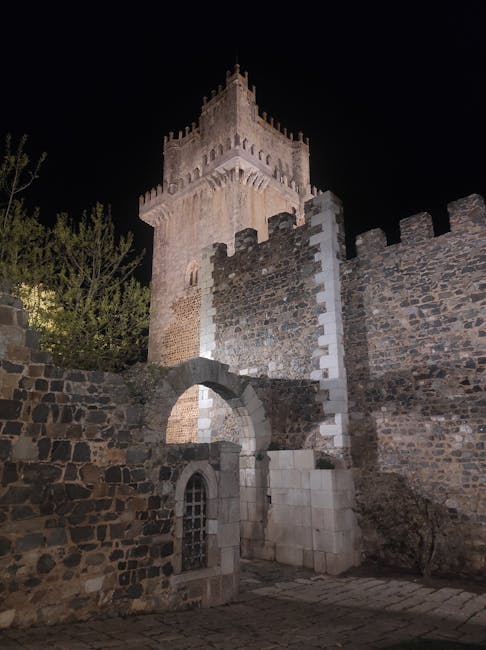
Castle of Aljustrel
The Castle of Aljustrel stands as a remarkable testament to the layered history of human occupation and military architecture in southern Portugal. Located in the municipality of Aljustrel, this hill castle occupies a strategic elevated position at 247 meters above sea level, commanding expansive views over the surrounding landscape. Its origins lie in the Islamic period of the Iberian Peninsula, with construction likely initiated in the 11th or late 12th century under Almohad influence during the era of Al-Andalus. However, the site’s significance predates the medieval fortress by millennia, with evidence of human activity from the Paleolithic and Chalcolithic periods.
Archaeological excavations have uncovered a rich array of artefacts including flint tools, ceramics, and traces of early copper mining, indicating that the hilltop was a center for prehistoric settlement and resource exploitation. By the Roman period, the area—possibly known as Vipasca—had developed into an important mining settlement. Although there appears to have been intermittent occupation during the Iron Age and Roman era, the site’s prominence resurged with the construction of the fortress during the Muslim rule.
Medieval military significance and christian reconquest
The castle’s military importance became particularly pronounced during the Christian Reconquista. In 1234, knights from the Order of Santiago, serving under King Sancho II, successfully captured the fortress. The following year, the king granted the castle and its surrounding lands to the Order, a donation later reaffirmed by King Afonso III in 1255. This transfer marked the castle’s integration into the Christian military-religious network that played a crucial role in consolidating Portuguese control over the region.
Following the conquest of the Algarve region, the strategic importance of the Castle of Aljustrel diminished, leading to its decline into a minor commandery of the Order of Santiago. Nevertheless, the site remained occupied into the late medieval period, likely until the 15th century, before falling into gradual ruin. During this phase, the Order constructed a small keep tower within the castle grounds, serving as both residence and administrative center. This tower shares architectural affinities with the nearby Messejana Castle, reflecting regional fortification styles of the time.
Architectural features and construction techniques
The castle occupies an oval-shaped hilltop approximately 100 meters long and 30 meters wide, enclosed by defensive walls primarily constructed using taipa—a traditional rammed earth technique incorporating lime and large stones to create dense, durable walls. These walls, located mainly on the northwest, northeast, and southeast slopes, demonstrate a building method consistent with Roman open construction practices, notably lacking visible foundations or wooden frameworks.
Within the enclosure, archaeological remains reveal the foundations of two quadrangular towers. Some of the original Islamic walls were later heightened with stone masonry layers during the Christian period. Unlike many medieval castles, these walls did not feature battlements or adarves (defensive walkways); instead, wooden paths likely provided access along the ramparts. Residential structures adjacent to the western walls include taipa walls supported by stone foundations, containing functional elements such as a circular hearth with charcoal and stones, and a bread oven, highlighting the domestic life within the fortress.
The castle also features single-room compartments built against natural jasper rock formations, with carefully defined door thresholds and herringbone-patterned masonry, showcasing advanced construction techniques. Excavations uncovered two intersecting paved streets surfaced with medium-sized stone slabs. One street curves and crosses near the walls, incorporating a central drainage channel with a slight slope directing water to an external channel, evidencing sophisticated urban planning and hygiene considerations.
Religious significance and sanctuary of nossa senhora do castelo
Over the castle ruins stands the Sanctuary of Nossa Senhora do Castelo, a Baroque church built in the 14th century and modified over subsequent centuries. This sanctuary commemorates a local tradition of a Marian apparition and has long served as a spiritual focal point for the community. The church features a single nave, chancel, sacristy, and a former pilgrims’ house. Its main façade is adorned with pilasters, volutes, and topped by a gable and cross, typical of Baroque ecclesiastical architecture.
The interior boasts 17th-century polychrome azulejos with maize motifs, a barrel-vaulted former galilee, and a ribbed cross vault that survived the devastating 1755 earthquake. The chancel contains a barrel vault and a richly carved Baroque altar in white and gold, with Rococo niches housing a wooden image of the sanctuary’s patron saint. A large embedded rock near the chancel floor is linked to Marian legends, blending religious belief with the castle’s historical fabric.
The sanctuary complex also includes a Baroque calvary with a square base and three levels supporting a Latin cross, as well as a bell arch with volutes atop the stairway leading to the church, underscoring its devotional and communal functions.
Modern history, archaeological research, and preservation
In the 19th and 20th centuries, mining activities, particularly manganese extraction, caused damage to parts of the medieval walls. However, from 1989 to 2010, extensive archaeological investigations under the Vipasca project revealed multiple layers of occupation from prehistoric times through the Islamic and Christian medieval eras. These studies have been crucial in documenting the site’s complex history and guiding preservation efforts.
Today, the Castle of Aljustrel remains partially preserved, with many structures in various states of decay due to centuries of neglect, earthquake damage, and mining impacts. Nonetheless, ongoing archaeological work has helped stabilize the ruins and enhance public understanding of this historically rich site. Access to the hilltop is facilitated by a multi-level stairway beginning on Rua de Nossa Senhora do Castelo, featuring an arch with a bell historically used for religious and community alerts. A geodetic marker known as a gurita, installed in 1802, also remains on site, reflecting the castle’s continued significance in regional mapping and surveying.
The castle and sanctuary ensemble was officially designated a Property of Public Interest in 1992, ensuring legal protection and recognition of its cultural and historical value. Visitors today can explore the evocative ruins and the sanctuary, gaining insight into the site’s multifaceted past that spans prehistoric settlement, Islamic fortification, Christian military history, and enduring religious devotion.
Frequently asked questions (FAQ)
- How do I get to the Castle of Aljustrel?
- The Castle of Aljustrel is located on a hilltop in the municipality of Aljustrel, Alentejo region, Portugal. Visitors can reach the site via a multi-level stairway starting from Rua de Nossa Senhora do Castelo, offering an accessible path to the fortress and sanctuary.
- What is the historical significance of the Castle of Aljustrel?
- The castle has a rich history dating back to the Islamic period in the 11th or 12th century and played a key role during the Christian Reconquista. It later became a commandery of the Order of Santiago, reflecting its military and religious importance in medieval Portugal.
- Can I visit the Sanctuary of Nossa Senhora do Castelo at the site?
- Yes, the Sanctuary of Nossa Senhora do Castelo is located atop the castle ruins. It is a Baroque church with 17th-century azulejos and architectural features that survived the 1755 earthquake, making it a significant religious and cultural attraction.
- Is the castle well preserved?
- The Castle of Aljustrel is partially preserved, with many structures in a state of decay due to centuries of neglect, mining damage, and earthquake impact. Archaeological efforts have helped stabilize and document the ruins for visitors.
- When was the castle built?
- The castle was likely constructed in the 11th or late 12th century during the Muslim presence in the Iberian Peninsula, under Almohad influence in the region of Al-Andalus.
Information
Loading map...
Visitor reviews
No reviews yet. Been here? Write the first review and help other travelers!
Write the first reviewVisited this castle? Share your experience
Your review helps other travelers and adds first-hand knowledge to our encyclopedia.