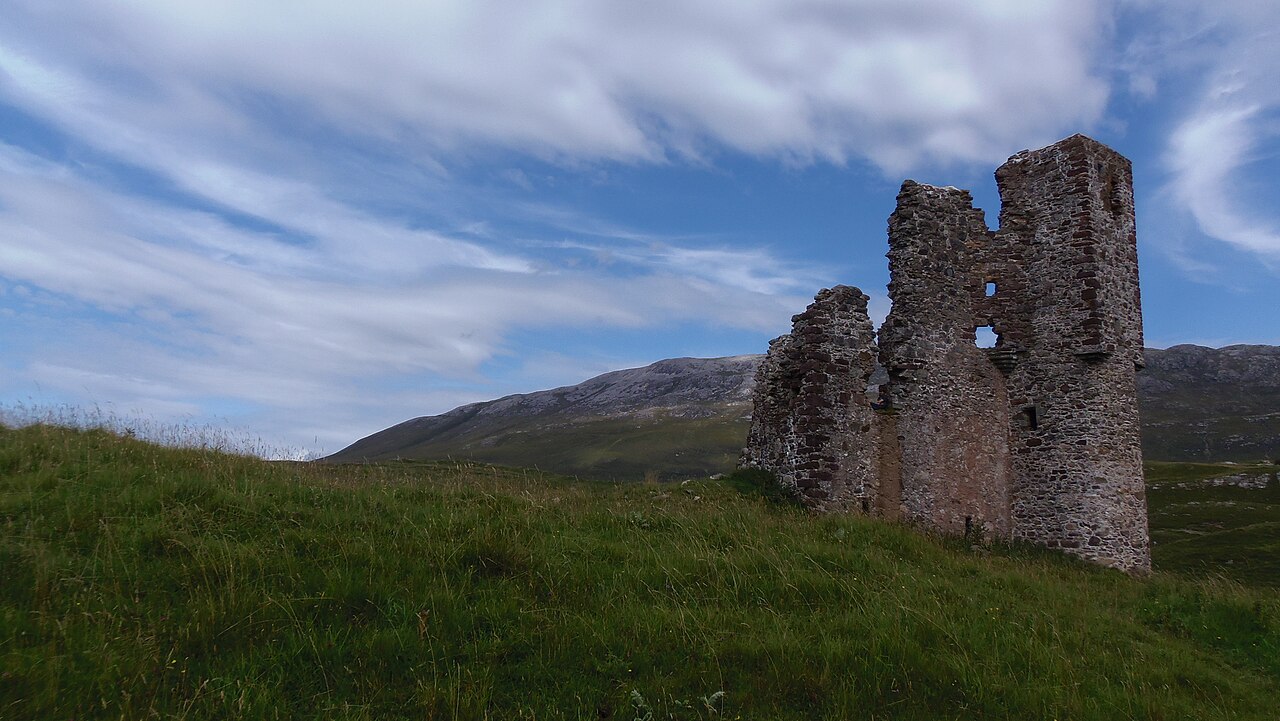
Castle Varrich Ruins
Castle Varrich stands as a remarkable example of a 14th-century hill castle situated near the village of Tongue in the Scottish Highlands. Its precise origins remain somewhat obscure, but the site is believed to be over a thousand years old, incorporating earlier fortifications possibly dating back to Norse occupation. The castle served as the ancestral seat of the chief of Clan Mackay, a significant Highland clan, and reflects the complex history of Scottish and Norse interactions in the region.
Historical significance and origins
The earliest known use of the site predates the existing stone structure, with evidence suggesting that the Mackay clan originally inhabited caves beneath the rocky outcrop. These caves likely provided shelter before the construction of any formal fortifications. The castle itself is thought to have been constructed in the 14th century atop an older Norse fortification, a common practice in the Highlands where new powers often built upon previous defensive sites.
This layering of history is significant, as it illustrates the transition from Norse to Scottish control in the area. The Clan Mackay rose to prominence during the medieval period, and Castle Varrich became their stronghold and symbol of authority. The castle's location on a natural rocky outcrop allowed it to command extensive views over the surrounding landscape, including the Kyle of Tongue and the imposing mountains of Ben Loyal and Ben Hope.
Architectural features and construction
The castle’s walls are constructed from roughly squared blocks of metamorphosed sandstone, laid in irregular horizontal courses without the use of mortar. This dry-stone construction technique has contributed to the walls’ resilience against the harsh Highland weather over many centuries. The walls are notably thick, measuring approximately 1.4 meters or more, and the stonework is consistent throughout the wall thickness rather than having a rubble core, which is unusual for castles of this period.
Originally, Castle Varrich had two floors plus an attic. The ground floor was likely used as stables or for livestock, accessible through a surviving doorway on the north side. The absence of internal staircases connecting the floors suggests that access to the upper living quarters was via an external ladder or removable stairs, a defensive feature allowing the upper floor to be isolated in times of attack.
The upper floor contained living spaces, including a window on the east wall and a fireplace on the west wall, although these features have collapsed and are no longer clearly visible. The attic space likely served as additional storage or accommodation.
Modern additions and preservation
In 2017, a galvanized steel spiral staircase and viewing platform were installed within the ruins to facilitate visitor access and enhance the experience of the castle’s panoramic views. These modern interventions are sensitively designed to preserve the integrity of the ancient stonework while allowing visitors to appreciate the strategic vantage point that made Castle Varrich a formidable stronghold.
Today, the castle ruins are protected as a Scheduled Monument, reflecting their importance as a cultural and historical landmark. The site’s preservation allows insight into medieval construction techniques and the social history of the Highlands.
Strategic location and natural defenses
Castle Varrich’s position on a rocky promontory provided natural defenses that were enhanced by the thick stone walls. The elevation offered clear sightlines over the surrounding terrain, crucial for early warning against potential invaders. The castle overlooks the Kyle of Tongue, a sea loch that would have been an important route for travel and trade, as well as a possible avenue for hostile forces.
The surrounding landscape, including the rugged peaks of Ben Loyal and Ben Hope, adds to the dramatic setting and emphasizes the castle’s role in controlling the region. The natural caves beneath the castle further highlight the strategic use of the terrain by the Clan Mackay.
Historical transitions and clan heritage
While Castle Varrich was the traditional seat of the Clan Mackay chiefs for centuries, the clan eventually relocated their seat of power to Tongue House in the nearby village. This shift marked the decline of the castle as a residential and administrative center but did not diminish its symbolic importance.
The castle remains a potent emblem of the clan’s heritage and the turbulent history of the Scottish Highlands. It stands as a testament to the enduring legacy of medieval Scottish clans and their adaptation to changing political and military landscapes.
Visiting castle varrich
Located about an hour’s walk from the village of Tongue, Castle Varrich is accessible via clearly marked paths. Visitors can explore the ruins and enjoy spectacular views of the surrounding mountains and coastline. The site offers a unique opportunity to connect with Scotland’s medieval past and the story of Clan Mackay.
Frequently asked questions (FAQ)
- How do I get to Castle Varrich from Tongue village?
- Castle Varrich is approximately a one-hour walk from Tongue village, accessible via well-marked walking paths. The route offers scenic views and is suitable for visitors with moderate fitness.
- What is the historical significance of Castle Varrich?
- Castle Varrich was the ancestral seat of the Clan Mackay chiefs and possibly built atop an earlier Norse fort. It illustrates the medieval history and clan heritage of the Scottish Highlands.
- Can I climb inside the ruins of Castle Varrich?
- Yes, a galvanized steel spiral staircase and viewing platform were installed in 2017 to allow safe access to upper levels of the ruins, offering panoramic views of the surrounding landscape.
- When is the best time to visit Castle Varrich?
- The best time to visit Castle Varrich is during late spring to early autumn when weather conditions are milder, enhancing the hiking experience and visibility of the scenic views.
- Is there an entry fee to visit Castle Varrich?
- There is no entry fee to visit Castle Varrich as it is an open historic site managed as a Scheduled Monument.
Information
Current owner
Scheduled Monument
Loading map...
Visitor reviews
No reviews yet. Been here? Write the first review and help other travelers!
Write the first reviewVisited this castle? Share your experience
Your review helps other travelers and adds first-hand knowledge to our encyclopedia.