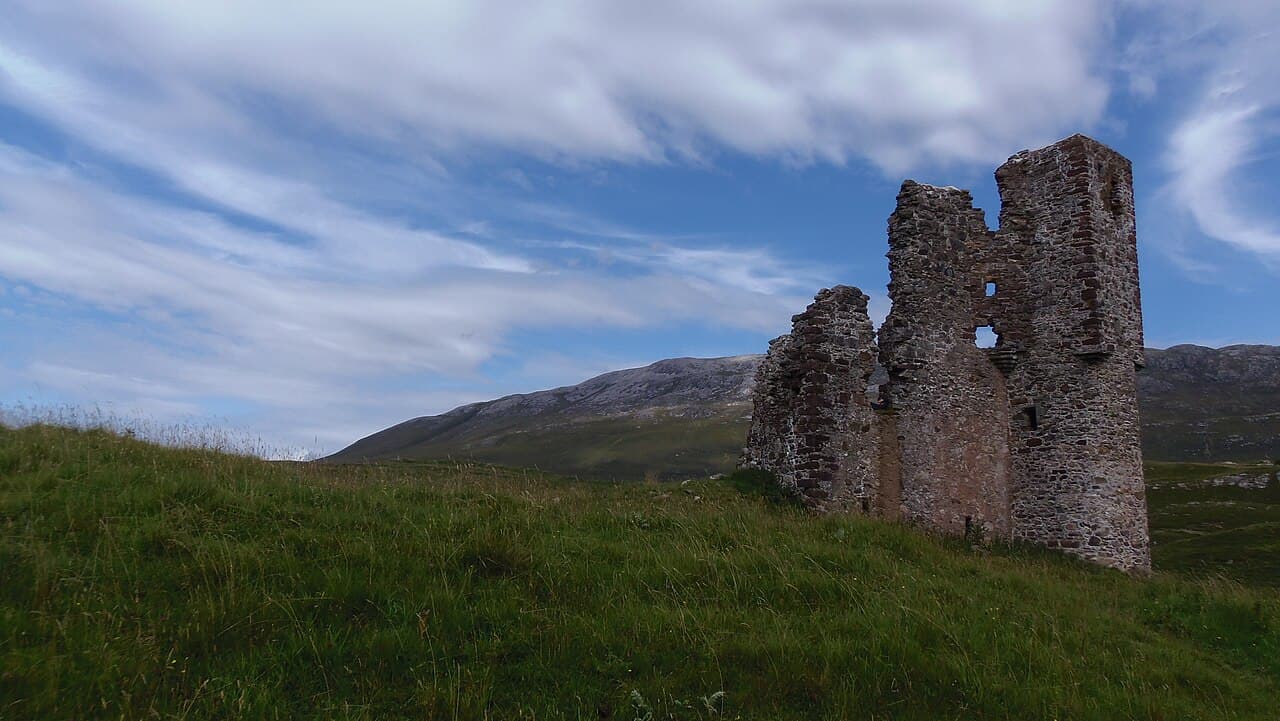
Ardvreck Castle
Ardvreck Castle stands as a poignant ruin on a small peninsula on the north bank of Loch Assynt in the Scottish Highlands. Constructed around 1590 by the MacLeods of Assynt, a branch of the wider Clan MacLeod, it served as a strategic stronghold and clan seat for centuries. The castle's location, which can become an island depending on the water level, offered natural defensive advantages typical of a hill castle in the rugged Highland landscape. Its history is intertwined with the turbulent political and clan conflicts of Scotland from the late 16th century through the 18th century.
Architectural features and layout
The original structure of Ardvreck Castle was a rectangular tower house comprising three stories, built in the late 16th century. This tower house formed the defensive core of the castle, characteristic of Scottish tower houses of the period. The ground floor contained vaulted chambers with stone arches, providing robust protection and storage space. Gunloops pierced the vaulted basement walls, allowing defenders to fire upon attackers while remaining protected.
A distinctive feature added around 1590 was a round stair turret corbelled out from the tower to support a square caphouse, providing access to the upper floors. Surrounding the tower was a curtain wall enclosing a courtyard and likely a walled garden, evidence of which remains in the form of foundation walls and defensive earthworks. The castle's footprint extended beyond the tower to include domestic quarters and service buildings, as indicated by the foundations of a rectangular building with a fireplace found nearby.
The castle's defensive structures included curtain walls and traces of a moat, enhancing its protection against siege. The walls, though now largely ruined, once formed a formidable barrier. The south wall of the tower house and parts of the stair tower survive, while other walls remain only as fragments or foundations. The castle's elevated position and natural water defenses made it a stronghold well-suited to the clan warfare and political unrest of its era.
Historical significance and clan conflicts
The MacLeods had controlled the Assynt region since the early 14th century, and Ardvreck Castle was their principal seat from the late 16th century. The castle witnessed significant events during the Wars of the Three Kingdoms in the mid-17th century. In 1650, James Graham, 1st Marquess of Montrose, a royalist commander loyal to King Charles I and later Charles II, sought refuge at Ardvreck Castle after his defeat at the Battle of Carbisdale. Montrose was captured there by Neil MacLeod of Assynt and his wife Christine, who betrayed him to the Covenanters. Montrose was imprisoned briefly in the castle's vaulted cellar before being handed over and subsequently executed in Edinburgh. This event marked a tragic turning point in Scottish history and imbued Ardvreck Castle with a lasting historical legacy.
Following the restoration of the monarchy, Neil MacLeod was declared a rebel, and in 1672 the rival Clan Mackenzie besieged Ardvreck Castle for two weeks, ultimately capturing it. The Mackenzies took control of the Assynt lands and held the castle for several decades. In 1726, they built the nearby Calda House, a more modern mansion intended to replace the aging and uncomfortable Ardvreck Castle. However, Calda House was destroyed by fire under mysterious circumstances in 1737, possibly set deliberately to prevent its acquisition by rival families.
Ardvreck Castle itself fell into ruin after a lightning strike in 1795, with its walls partially dismantled to provide stone for Calda House and other local buildings. The castle and its surroundings later passed into the hands of the Earl of Sutherland, who retained ownership into the 20th century.
Cultural heritage and legends
Ardvreck Castle is steeped in local legend and folklore. It is reputed to be haunted by two ghosts: a tall man dressed in grey, believed to be connected to the betrayal of Montrose, possibly even Montrose himself, and a young girl who, according to legend, was promised to the devil (known in Scots as "Clootie") as part of a pact made by the MacLeods to build the castle. In despair, the girl is said to have thrown herself from one of the towers, adding a tragic and supernatural dimension to the castle's history.
Conservation and present condition
Today, Ardvreck Castle remains a ruin, classified as partially preserved. The surviving south wall of the tower house and stair turret stand as evocative reminders of its former grandeur. The castle's ruins were stabilized and conserved between 2003 and 2004 by the Historic Assynt Trust, which worked to secure the site and prevent further decay. These efforts have made Ardvreck Castle accessible to visitors interested in Scottish history, clan heritage, and castle architecture.
The castle is a significant cultural landmark within the Scottish Highlands, offering insight into the defensive architecture of the late Renaissance period in Scotland and the complex clan dynamics of the region. Its dramatic setting on Loch Assynt and its evocative ruins continue to attract historians, tourists, and those fascinated by Scotland's rich past.
Visitor information and accessibility
Ardvreck Castle is located near the village of Lairg in the Highland council area of Scotland. The site is accessible by road and is a popular destination for those exploring the scenic landscapes of the Highlands. Visitors can explore the ruins and surrounding grounds, which provide a tangible connection to Scotland's clan history and architectural heritage.
While the castle is in ruins, the site offers a compelling glimpse into 16th-century Scottish defensive architecture and the turbulent history of the Highlands. Visitors are advised to wear appropriate footwear due to uneven terrain and to respect the fragile ruins. The castle and the nearby remains of Calda House are important heritage sites preserved for public education and enjoyment.
Frequently asked questions (FAQ)
- When was Ardvreck Castle built and by whom?
- Ardvreck Castle was built around 1590 by the MacLeods of Assynt, a branch of the Clan MacLeod, who controlled the area since the early 14th century.
- What role did Ardvreck Castle play in the Wars of the Three Kingdoms?
- In 1650, James Graham, 1st Marquess of Montrose, sought refuge at Ardvreck Castle but was betrayed and captured there before being executed in Edinburgh.
- Who captured Ardvreck Castle in 1672 and what happened afterward?
- Clan Mackenzie besieged and captured Ardvreck Castle in 1672, taking control of the Assynt lands and later building Calda House nearby.
- What remains of Ardvreck Castle today?
- Today, the ruins include parts of the south wall of the tower house, the stair turret, foundation walls, and traces of curtain walls and a moat.
- Is Ardvreck Castle accessible to visitors?
- Yes, Ardvreck Castle is accessible to visitors and is managed by the Historic Assynt Trust, though the terrain can be uneven and visitors should take care around the ruins.
Photo gallery

Information
Sources & official resources
Verify the information above using these authoritative references.
Loading map...
Visitor reviews
No reviews yet. Been here? Write the first review and help other travelers!
Write the first reviewVisited this castle? Share your experience
Your review helps other travelers and adds first-hand knowledge to our encyclopedia.


