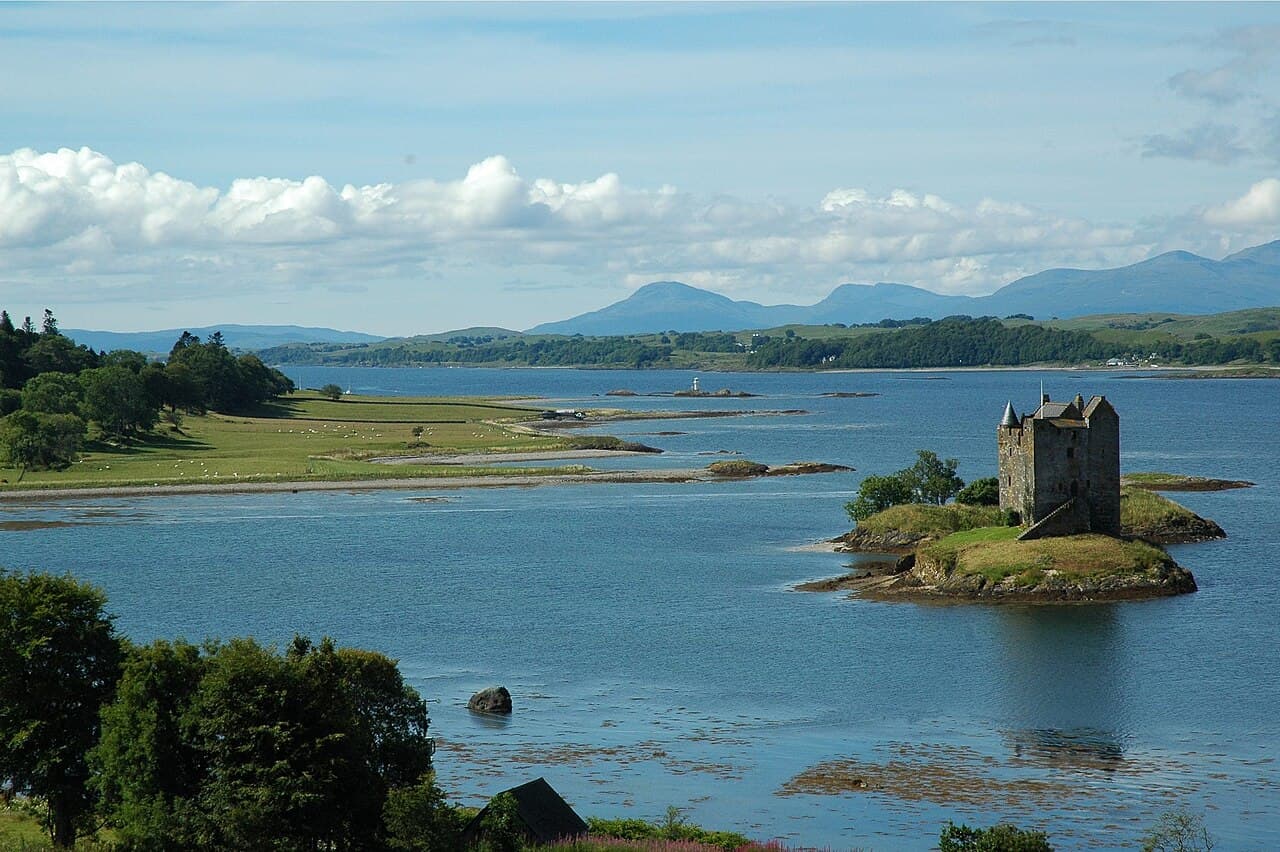
Castle Stalker
Castle Stalker is a striking four-story medieval tower house or keep, uniquely situated on a small tidal islet in Loch Laich, an inlet off Loch Linnhe in western Scotland. This picturesque location, surrounded by water and framed by dramatic mountain scenery, has made Castle Stalker an iconic symbol of Scottish Highland heritage and a favored subject for postcards and calendars. Its name derives from the Gaelic word Stalcaire, meaning 'hunter' or 'falconer', reflecting the castle's historical ties to hunting and the natural landscape.
The castle is among the best-preserved examples of a late medieval tower house in western Scotland, retaining much of its original stone structure and defensive features. Its origins trace back to around 1320, when the Clan MacDougall, then Lords of Lorn, established a small fort on the islet. This initial fortification served as a strategic stronghold controlling access to the surrounding lands and waterways.
Historical development and ownership
In 1388, the lordship of Lorn, including the castle, passed to the Stewart clan. The Stewarts are believed to have constructed the castle in its present form in the 1440s, under the leadership of John Stewart. John Stewart's tenure was marked by familial and political intrigue, including his marriage to the mother of his illegitimate son Dugald, who later became chief of Appin and avenged his father's murder.
King James IV of Scotland, a relative of the Stewarts of Appin, is known to have visited Castle Stalker, using it as a hunting base. His visits likely influenced expansions to the castle, including the addition of a top floor and roof, which enhanced both its defensive capabilities and residential comfort.
A notable episode in the castle's history occurred around 1620, when Duncan Stewart reportedly lost the castle to the Campbell clan in a drunken wager. The Stewarts briefly regained possession in 1689 but lost it again after their defeat at the Battle of Dunkeld. The Campbells then besieged the castle until the Stewarts surrendered in 1690.
During the Jacobite rising of 1745, Castle Stalker was garrisoned by government troops under Campbell command. The castle withstood a siege by a much larger force of Stewart supporters, demonstrating its strong defensive design and strategic importance.
The Campbells maintained control until about 1800, after which the castle was used as a storehouse. By around 1840, the castle was abandoned, its roof removed or collapsed, leading to significant deterioration.
In 1908, Charles Stewart of Achara purchased Castle Stalker and undertook basic conservation efforts. Later, in 1965, Lieutenant Colonel D. R. Stewart Allward acquired the castle and spent a decade restoring it to a habitable state. The castle remains privately owned and is open to the public during selected summer periods.
Architectural features and layout
Castle Stalker is built on a rectangular plan measuring approximately 15.2 by 12.1 meters, with a height ranging from 11.8 to 14.8 meters. Its four stories include a ground floor with three cellars and a prison cell accessible only through a trapdoor from the first floor, emphasizing security and defense.
The main entrance is located on the first floor of the southwest wall, reached by stone stairs and protected by double doors and machicolations—openings in the floor designed to drop missiles on attackers below. Above the entrance, a sandstone coat of arms of the Stewart clan is prominently displayed.
The first floor contains a large hall with windows on three sides and a fireplace featuring a decorative lintel on the west wall. Originally, the first and second floors had large halls with slightly sloped floors to facilitate drainage during storms, a practical architectural feature.
A distinctive bartizan, or small overhanging turret, is positioned at the southeast corner. This turret includes several arrow slits for defense and retains a carved human head, believed to represent the master mason who built the castle, adding a personal historical touch.
Remnants of defensive walls surround the tower, including foundation fragments and parts of a wall in the northern corner that may have originally stood about 3.9 meters high. These fortifications underscore the castle's role as a fortified residence during turbulent periods.
Cultural significance and popular culture
Castle Stalker's dramatic setting and authentic medieval architecture have made it a cultural icon of the Scottish Highlands. Its appearance in the film Monty Python and the Holy Grail (1975) as "The Castle of Aaaaarrrrrrggghhh" brought international recognition, despite most filming occurring elsewhere. It also appeared briefly in Highlander: Endgame, further cementing its place in popular culture.
Today, Castle Stalker is a cherished heritage site, attracting visitors drawn by its history, architecture, and stunning natural surroundings. The castle's private ownership ensures careful preservation, allowing public access during summer months to experience its unique atmosphere and historical significance.
Visiting castle stalker
Access to Castle Stalker is limited due to its location on a tidal islet. Visitors typically reach the castle by boat, as no permanent causeway exists. The site is open to the public at selected times during the summer, providing opportunities to explore the castle's interior and learn about its rich history.
Due to the castle's preservation status and access challenges, visitors are advised to plan their trips carefully, considering tide schedules and booking guided tours where available. The surrounding landscape offers additional attractions, including scenic views of Loch Linnhe and the rugged Scottish Highlands.
Frequently asked questions (FAQ)
- How do I get to Castle Stalker?
- Castle Stalker is located in Argyll county, easily accessible by car. The castle is situated on a tidal island, so be sure to check the tide times for the best views and access. There is a small parking area available for visitors.
- What is the historical significance of Castle Stalker?
- Castle Stalker dates back to the 15th century and served as a stronghold for the Stewarts of Appin. Its strategic location allowed it to control the sea routes and trade in the region. Today, it is celebrated for its picturesque beauty and historical importance in Scottish heritage.
- When was Castle Stalker built?
- Castle Stalker was constructed in 1320 and has undergone various renovations over the centuries. It was originally built as a fortified tower house and has a rich history tied to the local clans. The castle's architecture reflects the medieval style prevalent during its construction.
- Can I enter Castle Stalker?
- Castle Stalker is not regularly open to the public for interior tours, but it can be viewed from the shore or during guided boat trips. Special events may allow access, so it's best to check the official website for updates. Experiencing the castle from the outside is still a captivating sight.
- Why is Castle Stalker known as the "Castle of the Rock"?
- Castle Stalker is often referred to as the "Castle of the Rock" due to its dramatic position on a rocky islet. This unique setting enhances its charm and has made it a popular subject for photographers and artists. The breathtaking backdrop of the surrounding landscapes adds to its allure.
- Is it possible to take photographs at Castle Stalker?
- Yes, visitors are encouraged to take photographs of Castle Stalker from the surrounding areas. The castle offers stunning views from various angles, especially during sunrise and sunset. However, please respect the private property and avoid any restricted areas.
- What are the opening hours for Castle Stalker?
- Castle Stalker does not have regular opening hours for public access, as it is primarily a private property. It is best to check their official website or contact the management for any special open days or events. Planning your visit around these opportunities will enhance your experience.
- What are some nearby attractions to visit?
- While visiting Castle Stalker, you can explore nearby attractions such as the picturesque town of Oban and the stunning landscapes of the Argyll and Bute region. Other historical sites, such as Inveraray Castle and the scenic Loch Awe, are also within a short drive. These locations offer additional cultural experiences and natural beauty.
- What are the ticket prices for visiting Castle Stalker?
- As Castle Stalker is primarily a private property, there is no set ticket price for general visits. However, for special events or guided tours, prices may vary, so it's advisable to check their official website for the most current information and any available opportunities to visit.
Photo gallery

Photo by No machine-readable author provided. Gerpsych~commonswiki assumed (based on copyright claims).•CC BY-SA 3.0
Information
Website
Visit websiteFeatured in
Articles on the Castlopedia blog that feature Castle Stalker.
Sources & official resources
Verify the information above using these authoritative references.
Loading map...
Visitor reviews
No reviews yet. Been here? Write the first review and help other travelers!
Write the first reviewVisited this castle? Share your experience
Your review helps other travelers and adds first-hand knowledge to our encyclopedia.



