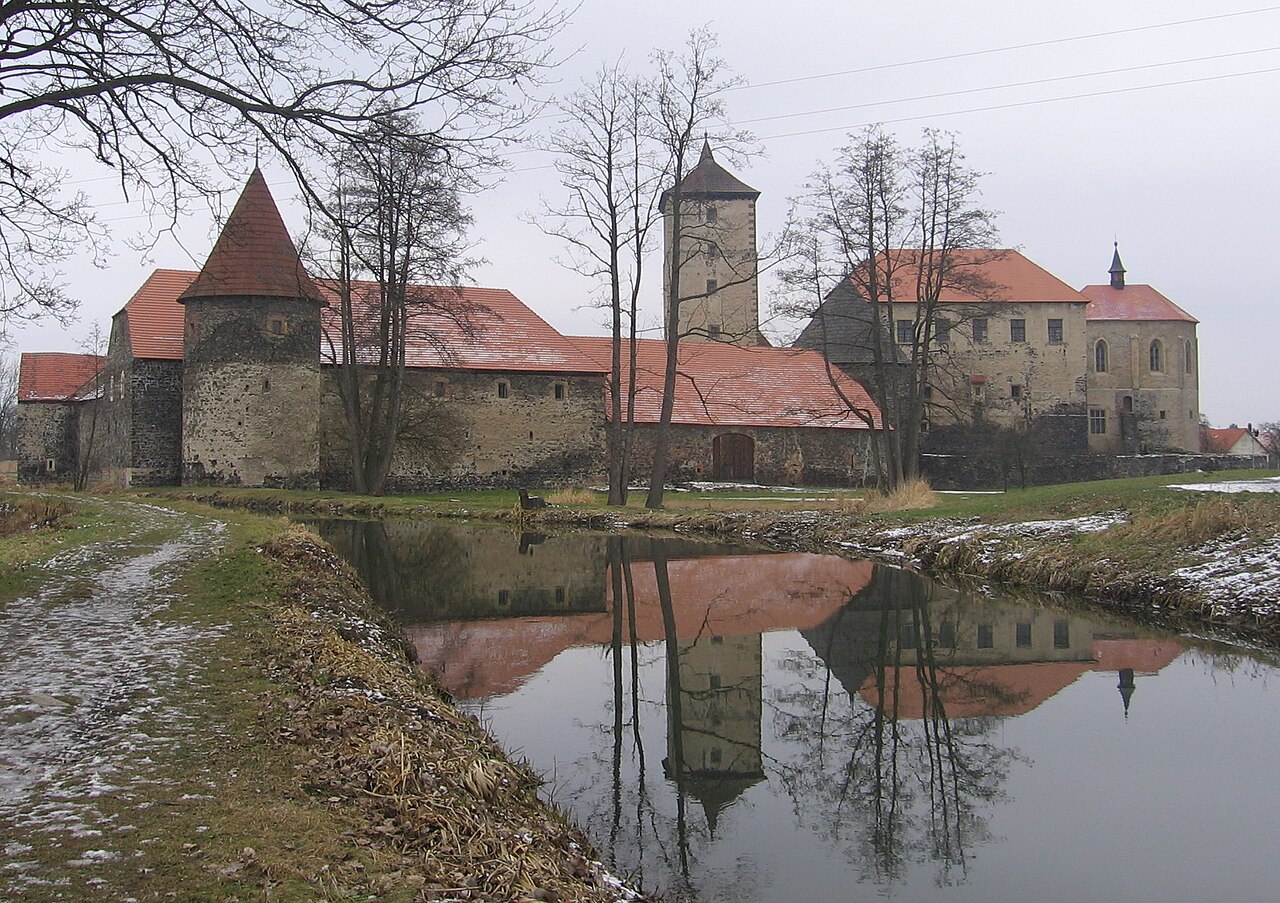
Castle Skála
Castle Skála stands as a significant medieval hill fortress located in the municipality of Příchovice-Přeštice in the modern-day Czech Republic. Established in the early 14th century, it was founded or acquired by the noble Švihovský family from Rýzmberk, with Vilém of Rýzmberk recorded as its possessor around 1318. The castle's origins are somewhat ambiguous, but its strategic location atop a rocky elevation underscores its role in regional defense and control.
During the late 14th and early 15th centuries, Castle Skála gained prominence as a military stronghold amidst the turbulent conflicts of Bohemia. It notably served as a base for armed factions loyal to King Sigismund during his disputes with King Wenceslaus IV. These forces, often described as a mix of soldiers and bandits, leveraged the castle's fortifications for operations in the surrounding region. The castle endured multiple sieges during this period, including a historically notable attack in 1399, which is reputed to have featured the first recorded use of firearms in Bohemia, marking a pivotal moment in the evolution of military technology.
Historical significance and military role
The castle's military importance is highlighted by the events of 1441 when it was captured and set ablaze by troops led by Hynek Krušina of Švamberk and Hanuš of Kolovrat. Following the siege, the defending garrison was executed, demonstrating the castle's strategic value and the brutal nature of regional power struggles. Despite this devastation, the Švihovský family restored the fortress and assigned it to Vilém the Younger of Rýzmberk, who managed the castle's affairs thereafter.
After the Hussite Wars, the fortress's strategic relevance diminished. Although it remained maintained for some time, Castle Skála was gradually abandoned during the first half of the 16th century. Documentation indicates it was still habitable around the mid-1500s but was described as deserted by 1568. Subsequently, in 1658, Emperor Leopold I ordered the deliberate demolition of the castle to prevent its reuse by hostile forces or bandits, sealing its fate as a ruin.
Architectural layout and surviving structures
The remains of Castle Skála cover an extensive area approximately 200 by 400 meters. The complex is divided into two principal sections: the upper castle situated on higher ground to the west, and the lower castle positioned northeast of the upper part. This division reflects a typical medieval castle arrangement combining defensive and residential functions.
Upper castle features
Access to the upper castle was gained via a bridge crossing a moat, leading to a fortified tower gate. Beyond the gate, a staircase or steep ramp ascended to the main courtyard, where parts of the curtain wall survive up to the height of the battlement walkway. A curtain wall extends northeast along the rock edge, partially intact, enclosing a fortified yard known as a parkán, likely used for stabling horses and additional defense.
A notable structure in the upper castle, referred to as the "rear gate," featured a double moat and may have been a later fortification addition rather than a traditional gatehouse. On the western side of the central area, a timber construction is evidenced by beam holes, indicating galleries or balconies connected to the battlement walkway and a bridge over a rock crevice leading to the southern side of the palace core.
The palace core itself consisted of two separate palaces flanking a small courtyard. Entry was through the southeast side of the western palace, including access to a basement secured by a barred gate. This dual-palace layout is characteristic of castles from the period, with some interpretations suggesting the courtyard chamber in the northeast palace may be the remains of an original tower.
Lower castle and defensive elements
The lower castle corresponds to a donjon type, centered around a roughly square tower likely serving both residential and defensive purposes. A narrow entrance connected this tower to the courtyard's outer wall. Behind the tower stood a palace with a rectangular northern corner, while the western curtain wall contained a later gateway accessible by stairs from the outer bailey.
A polygonal curtain wall enclosed an area on the northeast side of the courtyard, probably designated for economic buildings or additional structures. A fresco from the chapel of Švihov castle has been interpreted by some as depicting Castle Skála, possibly reflecting this enclosed space. Two small postern gates pierced the curtain wall, leading to nearby Radkovice and to a small earthwork fortification on an eastern promontory. One postern was securely barred with three crossbars, while only remnants remain of the other.
Additional defensive features include moats and ramparts in the northeast sector, which may represent an outer bailey or military camp area, though their exact period of construction remains uncertain. Today, visitors can observe surviving portions of walls, moats, and earthworks, with some castle walls preserved up to the original battlement walkways, providing valuable insights into the fortress's defensive capabilities and medieval architecture.
Notable historical figures and cultural heritage
Throughout its history, Castle Skála was associated with prominent figures such as Vilém II. of Skála, Břeňek Švihovský, and Půta of Skála. These individuals appear in contemporary chronicles and military records, underscoring the castle's role in regional power dynamics during the late 14th and early 15th centuries. Since 1963, the site has been protected as a cultural monument, reflecting its enduring historical and cultural significance despite its ruined condition.
Visiting castle skála today
Today, the ruins of Castle Skála offer a remarkable glimpse into medieval fortification architecture and the complex history of Bohemia. The site is accessible to visitors interested in exploring its extensive remains, including well-preserved battlements, moats, and the layout of both the upper and lower castles. Its location on a hill provides scenic views of the surrounding landscape, enhancing the visitor experience.
While the castle is primarily a ruin, the preservation of key architectural elements allows for an educational and engaging visit. Interpretive signage and local guides often provide context about the castle's military history, architectural features, and the notable figures who shaped its story. Castle Skála remains a valuable destination for those fascinated by medieval history, military architecture, and Czech cultural heritage.
Frequently asked questions (FAQ)
- When was Castle Skála built and by whom?
- Castle Skála was established in the early 14th century by the noble Švihovský family from Rýzmberk, with Vilém of Rýzmberk recorded as its possessor around 1318.
- What historical events is Castle Skála known for?
- Castle Skála played a military role during the late 14th and early 15th centuries, notably serving as a base for armed groups loyal to King Sigismund and enduring sieges including the first recorded use of firearms in Bohemia in 1399.
- What remains can visitors see at Castle Skála today?
- Visitors can explore extensive ruins including the upper and lower castles, curtain walls, moats, battlements, and earthworks, offering insight into medieval defensive architecture.
- Is Castle Skála accessible to the public?
- The castle ruins are accessible to visitors, providing a historical site for exploration and education about medieval fortifications and Bohemian history.
- Why was Castle Skála demolished in 1658?
- Emperor Leopold I ordered the deliberate demolition of Castle Skála in 1658 to prevent its reuse by hostile forces or local bandits, reflecting its strategic importance even in ruin.
Information
Current owner
State monument protection
Loading map...
Visitor reviews
No reviews yet. Been here? Write the first review and help other travelers!
Write the first reviewVisited this castle? Share your experience
Your review helps other travelers and adds first-hand knowledge to our encyclopedia.