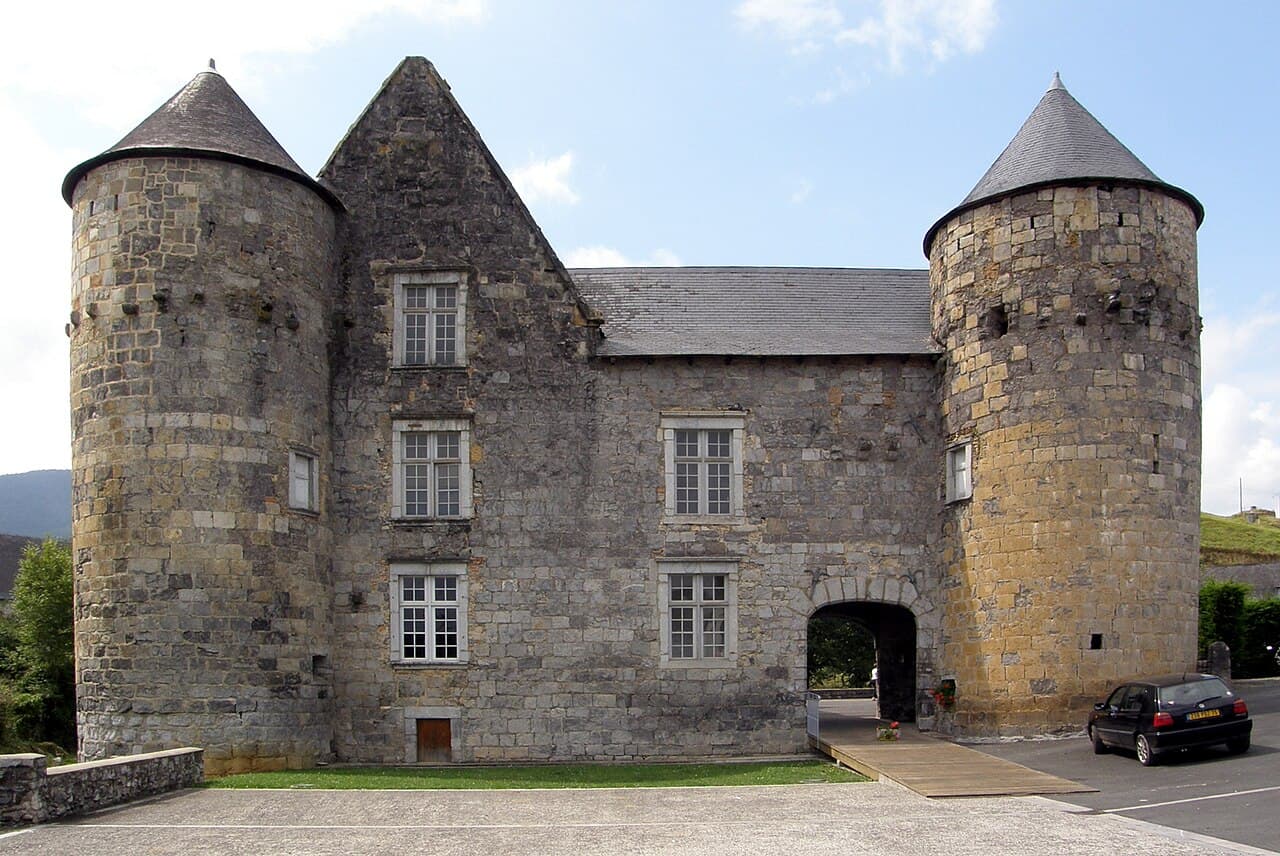
Castle Ruthie
Castle Ruthie stands as a remarkable example of medieval fortification nestled in the village of Aussurucq, located in the Pyrénées-Atlantiques department of southwestern France. Situated near the Spanish border, this hill castle has witnessed centuries of regional history, from its origins in the 11th century through its evolution into a significant noble residence and administrative center. The castle's strategic position reflects its historical role in overseeing and protecting the surrounding Basque territory.
The initial construction of Castle Ruthie dates back to the High Medieval period, specifically the 11th century, when the abbey of Roncesvalles established a hospital nearby to serve pilgrims journeying to Santiago de Compostela. This early phase laid the foundation for a fortified site that would grow in prominence. The castle's medieval origins are closely tied to the noble Urrutia family, known in French as De Ruthie, with Peyrot Urrutia, a notable figure who served as counselor to King Louis XII and captain of nearby fortresses, credited with early development of the castle.
Medieval origins and feudal significance
Castle Ruthie's early history is deeply intertwined with the feudal dynamics of the region. The castle was not only a defensive stronghold but also a symbol of the Urrutia family's power and influence. In the 15th century, significant rebuilding efforts reflect the turbulent political landscape of the time, as noble families consolidated power through strategic marriages and territorial control. Documentation from 1422 highlights a marriage alliance between the Urrutia and Ahetzere families, underscoring the castle's role as a noble seat and its integration into regional power networks.
Architectural features from the medieval period
The most enduring architectural remnants from the medieval era are two large circular towers dating from the 15th century. These towers exemplify the defensive design typical of the period, constructed primarily from stone with thick walls to withstand sieges. Their imposing presence dominates the castle's silhouette and serves as a tangible link to its fortified past. Although much of the original medieval structure was damaged in the 16th century, these towers have survived as key archaeological features.
Destruction and rebuilding in the early modern period
The 16th century was a challenging time for Castle Ruthie. The castle suffered considerable damage when the Baron of Senegas was dispatched to set fire to noble houses in the region, a reflection of the broader conflicts and unrest that affected southwestern France. Despite this destruction, the castle was not abandoned; instead, it underwent substantial reconstruction in the 17th and 18th centuries.
17th and 18th-century architectural developments
The current appearance of Castle Ruthie largely derives from this period of rebuilding. The castle now comprises two main buildings from the 17th or 18th century, which are flanked by the surviving medieval towers. These newer structures showcase the architectural transition from purely defensive fortifications to more comfortable noble residences. Inside, the castle features a large dining room adorned with exquisite 18th-century oak decorations and a superb oak fireplace in the great hall, highlighting the blend of functionality and artistry characteristic of the era.
Castle ruthie’s role in the community and heritage preservation
Castle Ruthie has long been a focal point for the local community of Aussurucq, known in Basque as Altzürükü. Beyond its military and residential functions, the castle played an important role in religious and administrative affairs, particularly as members of the Urrutia family held ecclesiastical positions from the 17th century onward. This multifaceted significance contributed to the castle’s enduring presence in regional history.
In recognition of its historical and cultural value, Castle Ruthie was officially designated a historic monument on 30 April 1925. This status protects not only the castle’s architectural fabric but also its interior decorations, ensuring the preservation of its artistic heritage. Today, the castle is owned by the local commune and serves as the town hall of Aussurucq, integrating its medieval legacy into contemporary civic life.
Cultural events and public access
The castle remains a vibrant cultural landmark, hosting events such as a pastoral play in 2002 that celebrated local traditions and history. Its location at the heart of the village underscores its ongoing importance as a center for community identity and heritage tourism. Visitors can appreciate the castle’s unique combination of medieval fortifications and early modern residential architecture, along with its well-preserved interior elements.
Architectural analysis and materials
Constructed primarily of local stone, Castle Ruthie exemplifies the robust fortress architecture typical of the Basque region. The two surviving circular towers feature thick masonry walls designed for defense, while the later buildings incorporate more refined elements such as large windows and decorative woodwork. The oak used in the interior, especially in the dining room and great hall, reflects high craftsmanship and the availability of quality timber in the region during the 18th century.
The castle’s layout, combining medieval towers with later residential wings, illustrates the evolution of castle design from purely military to multifunctional noble estates. Its position on a hill enhances its defensive capabilities and offers commanding views of the surrounding landscape, characteristic of hill castles built for strategic oversight.
Frequently asked questions (FAQ)
- How do I get to Castle Ruthie?
- Castle Ruthie is located in Aussurucq, France, and can be accessed by car or public transport. If traveling by car, there is parking available nearby. For public transport, check local bus or train schedules for routes that stop in Aussurucq.
- What is the historical significance of Castle Ruthie?
- Castle Ruthie dates back to the 12th century and has served various purposes throughout its history, including as a fortress and a noble residence. It is an important example of medieval architecture and reflects the region's rich history. The castle has been preserved to showcase its historical importance to visitors.
- When was Castle Ruthie built?
- Castle Ruthie was constructed in the early 12th century, making it one of the oldest castles in the region. Its architecture has evolved over the centuries, reflecting the changing styles and needs of its inhabitants. The castle has undergone several restorations to maintain its structural integrity and historical features.
- Can I take guided tours of Castle Ruthie?
- Yes, guided tours of Castle Ruthie are available and provide a comprehensive overview of its history and architecture. Tours are conducted by knowledgeable guides who share fascinating stories about the castle's past. It is recommended to book your tour in advance to ensure availability.
- Why is Castle Ruthie a popular tourist destination?
- Castle Ruthie attracts visitors for its stunning architecture, rich history, and beautiful surrounding landscapes. The castle offers a glimpse into medieval life and provides educational experiences for all ages. Its picturesque setting makes it a favorite spot for photography and leisurely exploration.
- Is it possible to host events at Castle Ruthie?
- Yes, Castle Ruthie does offer facilities for hosting special events such as weddings and corporate gatherings. The unique ambiance of the castle provides a memorable backdrop for any occasion. It is advisable to contact the management for detailed information regarding bookings and services.
- What are the opening hours of Castle Ruthie?
- Castle Ruthie is open to visitors from 10 AM to 6 PM, Tuesday through Sunday, with extended hours during the summer months. It is closed on Mondays and certain public holidays, so it is best to check the official website for any updates. Arriving early can help you avoid crowds and make the most of your visit.
- What are the ticket prices for visiting Castle Ruthie?
- Ticket prices for Castle Ruthie vary based on age and group size, with discounts available for children, seniors, and students. A standard adult ticket is reasonably priced, making it accessible for most visitors. Check the official website for the most current pricing and any special promotions.
- What is the best time to visit Castle Ruthie?
- The best time to visit Castle Ruthie is during the spring and early fall, when the weather is mild and the surrounding gardens are in full bloom. Summer can be busy with tourists, while winter may limit access due to weather conditions. Plan your visit to coincide with local festivals for a unique experience.
- Are there any nearby attractions to Castle Ruthie?
- Yes, there are several attractions near Castle Ruthie, including local museums, scenic parks, and charming villages. Visitors can explore the beautiful countryside and enjoy outdoor activities such as hiking and cycling. Additionally, nearby historical sites provide further insights into the region's heritage.
Photo gallery

Information
Website
Visit websiteSources & official resources
Verify the information above using these authoritative references.
Loading map...
Visitor reviews
No reviews yet. Been here? Write the first review and help other travelers!
Write the first reviewVisited this castle? Share your experience
Your review helps other travelers and adds first-hand knowledge to our encyclopedia.



