Castle Pinckney
Castle Pinckney is a historic coastal fortress located on Shutes Folly Island at the entrance to Charleston Harbor in South Carolina. Constructed in 1810 as part of the United States' early 19th-century efforts to fortify its coastline, it served as a strategic defense point guarding one of the most important ports on the southeastern Atlantic coast. The fort's compact size and island location made it a unique example of early American military architecture designed specifically for harbor defense.
Historical context and strategic role
During the post-revolutionary period, the young United States government prioritized strengthening its coastal defenses against potential European naval threats. Castle Pinckney was built alongside other fortifications such as Fort Sumter and Fort Moultrie to create a layered defense system for Charleston Harbor. Its position on Shutes Folly Island allowed it to monitor and control maritime access to the harbor, crucial for protecting trade and military interests.
The fort gained particular significance during the American Civil War. In December 1860, South Carolina militia seized the fort from the federal government, marking one of the first acts of rebellion leading to the war. It was briefly used by the Confederate forces as an artillery position and a prison for Union soldiers during the early months of the conflict. Although its military role was limited compared to larger forts, Castle Pinckney contributed to the overall defense network of Charleston during this turbulent era.
Architectural design and features
Castle Pinckney is classified as a water castle due to its island setting surrounded by water, which enhanced its defensive capabilities. The fort's design reflects early 19th-century military engineering principles, featuring thick masonry walls constructed from locally sourced brick and stone. These walls were built to withstand naval artillery bombardment, a common threat at the time.
The fort's layout is compact and functional, consisting of a roughly square plan with bastions at the corners to allow overlapping fields of fire. Inside, a central courtyard provided space for troops and supplies, while gun emplacements faced the harbor entrance. The fort's modest size was dictated by the limited area of Shutes Folly Island, requiring efficient use of space without sacrificing defensive strength.
Over the decades, Castle Pinckney underwent several modifications to adapt to evolving military technology and tactics. These included updates to its artillery and structural reinforcements to counter increasing firepower. Despite these changes, the fort retained its original character as a small but robust harbor defense installation.
Preservation and current condition
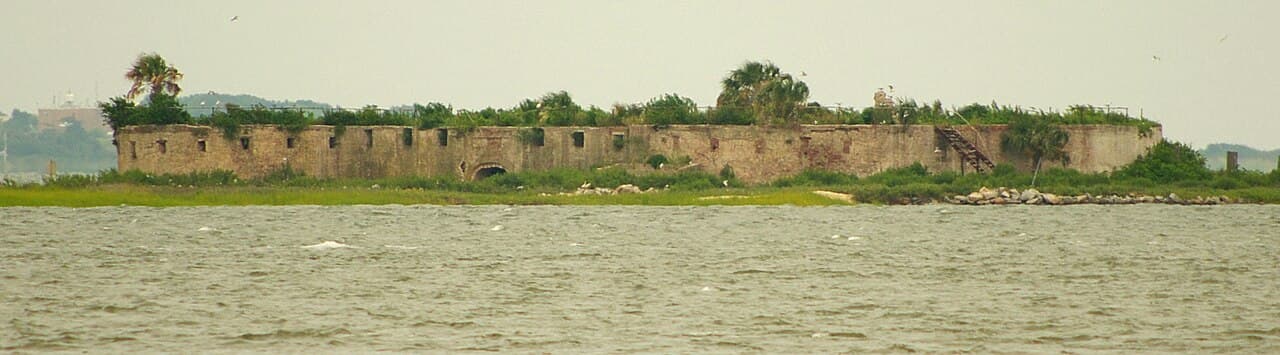
Today, Castle Pinckney is recognized as a significant historic site and is listed on the National Register of Historic Places since 1970. The fort is partially preserved, with much of its masonry walls and structural elements still standing, though some areas have deteriorated due to exposure to harsh marine conditions and lack of continuous maintenance.
The site is maintained by the Castle Pinckney Historical Preservation Society, which works to protect the ruins and promote awareness of the fort's historical importance. However, public access is limited because the island is difficult to reach and the structure is not fully restored or stabilized for regular tours.
Preservation efforts highlight the challenges of maintaining a coastal fortress exposed to saltwater erosion, storms, and rising sea levels. The remaining ruins offer valuable insights into early American coastal defense strategies and construction techniques.
Educational significance and visitor information
Although Castle Pinckney is not generally open to the public, it remains a subject of interest for historians, military enthusiasts, and visitors to Charleston. Research and educational programs facilitated by the preservation society help deepen understanding of the fort's role in American history and coastal defense.
Visitors to Charleston can view the fort from the water during harbor tours or from vantage points on the mainland. Nearby historic sites such as Fort Sumter National Monument and Charleston's historic district provide additional context for the region's military past and cultural heritage.
The fort's story is intertwined with the broader narrative of Charleston's strategic importance from the early 19th century through the Civil War, offering a tangible connection to the maritime defense systems that shaped the city's history.
Frequently asked questions (FAQ)
- How do I visit Castle Pinckney?
- Castle Pinckney is located on Shutes Folly Island and is not generally open to the public due to its condition and location. However, it can be viewed from harbor tours or from the Charleston waterfront.
- What is the historical significance of Castle Pinckney?
- Castle Pinckney was built in 1810 as part of the United States' coastal defense system and played a role in the early stages of the American Civil War, including serving as a Confederate prison for Union soldiers.
- When was Castle Pinckney built and by whom?
- Castle Pinckney was constructed in 1810 by the United States government as a coastal fortification to protect Charleston Harbor from naval threats.
- Is Castle Pinckney accessible for educational programs?
- While public access is limited, the Castle Pinckney Historical Preservation Society facilitates research and educational programs to promote awareness of the fort's history and significance.
- What architectural style characterizes Castle Pinckney?
- Castle Pinckney reflects early 19th-century military engineering with thick masonry walls, bastions, and gun emplacements designed for harbor defense.
- Why is Castle Pinckney important in the context of the American Civil War?
- Castle Pinckney was one of the first federal properties seized by South Carolina militia in 1860 and was used by Confederate forces as a prison and artillery position during the Civil War.
Photo gallery

Information
Current owner
Castle Pinckney Historical Preservation Society
Address
Shutes Folly Island, Charleston Harbor, Charleston, SC 29464, United States
Loading map...
Visitor reviews
No reviews yet. Been here? Write the first review and help other travelers!
Write the first reviewVisited this castle? Share your experience
Your review helps other travelers and adds first-hand knowledge to our encyclopedia.