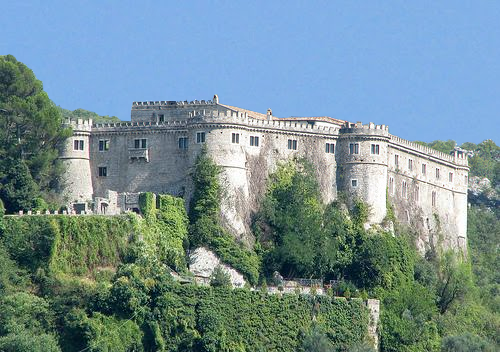
Castle of Vicalvi
The Castle of Vicalvi is a notable example of a hill castle with a complex history dating back to the early medieval period. Situated strategically on a hill overlooking the Comino Valley in the town of Vicalvi, Italy, the castle's location was chosen for its natural defensive advantages and long-standing military significance. Archaeological evidence reveals that this site was fortified as early as the 5th or 4th century BCE, indicating its importance well before the medieval era.
Originally constructed by the Lombards, the castle served as a stronghold for the Lombard princes of Capua. Its earliest documented mention appears in records from 937 CE. By 1017, control of the castle passed to the powerful Abbey of Montecassino, a Benedictine monastery that maintained ownership through the early 13th century. During this period, the castle played a dual role under both secular and ecclesiastical authority, reflecting the complex power dynamics of medieval Italy.
Historical ownership and architectural evolution
Abbey of montecassino and early medieval period
Under the Abbey of Montecassino, the Castle of Vicalvi was an important defensive site securing the abbey's territorial interests. The Benedictine monks, known for their administrative and military influence, likely oversaw maintenance and fortification efforts to protect the monastery's holdings during turbulent times.
The aquino family enhancements
Following the abbey's tenure, the castle came under the ownership of the Aquino family, who initiated significant defensive improvements. They constructed a double line of protective walls around the castle, enhancing its ability to withstand sieges and attacks. This expansion reflected the growing military importance of the fortress in the region.
14th-century gothic renovation by the étendard family
In the 14th century, the Étendard family undertook a major renovation of the castle, introducing Gothic architectural elements. The remodeling included distinctive features such as an inward-sloping single-pitched roof, a rare roofing style in the region. The castle's stone construction was typical of medieval fortifications, providing durability and defense.
Later ownership and decline
The Cantelmo family eventually acquired the castle but abandoned it in favor of their nearby fortress at Alvito. This shift led to the gradual decline and ruin of the Castle of Vicalvi. In the early 19th century, ownership transferred to the Celli family, linked to the Marsella family, marking the transition of the castle into private hands during the modern era.
Architectural features and surviving structures
Today, the Castle of Vicalvi remains a ruin but retains substantial evidence of its former defensive strength. The fortress is enclosed by two nearly complete polygonal walls forming broad protective rings around the core area. These walls define a large fortified space, allowing visitors to discern the various building phases and the castle's evolving military functions.
The 14th-century Gothic renovations are particularly visible in the surviving architectural elements. The inward-sloping single-pitched roof stands out as a unique feature, along with other horizontal and vertical design details consistent with Gothic style. The castle's robust stone walls and fortifications reflect typical medieval construction methods aimed at maximizing defense.
Beneath the medieval layers, remnants of earlier fortifications from the pre-Roman period are preserved on the site. These ancient structures highlight the hilltop's long-term strategic value, used continuously as a defensive position for over a millennium.
Cultural significance and local legends
The Castle of Vicalvi is not only significant for its military history but also for its place in local folklore. One of the castle's towers is associated with the legend of the "Lady in Chains", an 18th-century courtesan who was reportedly immured alive after being convicted of murdering her lovers. This tale adds a layer of cultural narrative to the castle's historical fabric, linking the physical ruins to stories passed down through generations.
The castle was part of a wider interconnected defensive network that included nearby fortifications such as the castles of Alvito and Picinisco. This network played a crucial role in regional defense, controlling access through the Comino Valley and surrounding areas.
Visiting the castle today
Visitors to the Castle of Vicalvi can explore the extensive remains of the double polygonal walls and observe the various architectural phases visible in the ruins. The site offers insight into medieval military architecture and the historical layers that shaped the fortress over centuries.
While the castle is largely in ruin, its preservation allows for an understanding of the construction techniques and strategic considerations of the time. The combination of archaeological remains and local legend provides a multifaceted experience for those interested in medieval history, architecture, and Italian cultural heritage.
Frequently asked questions (FAQ)
- How do I get to the Castle of Vicalvi?
- The Castle of Vicalvi is located in the town of Vicalvi in the Lazio region of Italy. It is accessible by local roads, and visitors can reach it by car or regional public transport services that connect to nearby towns.
- What is the historical significance of the Castle of Vicalvi?
- The Castle of Vicalvi has a long history dating back to the early medieval period, originally built by the Lombards and later controlled by the Abbey of Montecassino and noble families such as the Aquino and Étendard. It played a key role in regional defense and administration.
- Can I visit the castle ruins?
- Yes, the castle ruins are open to visitors. While the site is largely in ruins, the extensive defensive walls and architectural features are accessible for exploration, providing insight into medieval fortifications.
- What architectural styles are visible at the Castle of Vicalvi?
- The castle features primarily Gothic architectural elements from a 14th-century renovation, including an inward-sloping single-pitched roof and polygonal defensive walls, built on earlier medieval and pre-Roman foundations.
- Is there any legend associated with the castle?
- Local legend tells of the "Lady in Chains," an 18th-century courtesan who was immured alive in one of the castle's towers after being found guilty of killing her lovers, adding a layer of folklore to the site.
Information
Website
Visit websiteSources & official resources
Verify the information above using these authoritative references.
Loading map...
Visitor reviews
No reviews yet. Been here? Write the first review and help other travelers!
Write the first reviewVisited this castle? Share your experience
Your review helps other travelers and adds first-hand knowledge to our encyclopedia.