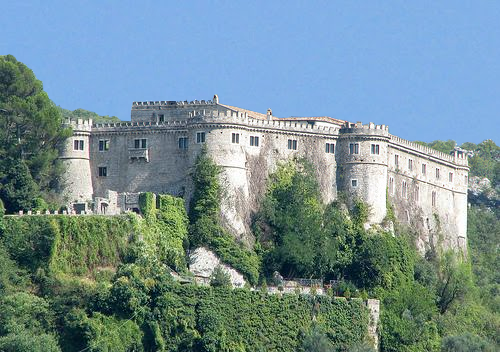
Castello Boncompagni – Viscogliosi
The Castello Boncompagni – Viscogliosi stands as a remarkable example of a hill castle that has evolved through centuries of Italian history. Located in Isola del Liri, Italy, this fortress occupies a naturally strategic island formed by the bifurcation of the Liri River. Its unique setting amidst the river and adjacent to the dramatic Cascata Grande and Cascata del Valcatoio waterfalls, each approximately 30 meters high, underscores the castle’s original defensive purpose and scenic prominence.
The castle’s origins trace back to the early medieval period, with the earliest documented mention appearing around the year 1100 in a papal decree by Pope Paschal II. Referred to as the "castellum insulae," this designation highlights its position on the island and its role as a fortified bastion protecting the surrounding Sora plain. Initially, the castle likely functioned under the authority of the local diocese, serving military and administrative needs in a turbulent era marked by feudal conflicts and territorial disputes.
Medieval origins and strategic importance
The early medieval fortress was constructed to exploit the natural defenses provided by the river island, with a central tower forming the core of the complex. The castle’s fortifications included robust curtain walls and defensive towers designed to repel invaders and control access to the valley. The location was critical for overseeing the Liri valley and the approaches to the Kingdom of Naples, making it a valuable military asset.
During the late 15th century, the castle’s political and military significance intensified. It became a focal point of resistance against Aragonese domination in the Kingdom of Naples. In 1496, the fortress was used by the Cantelmo and Della Rovere families as a stronghold in support of Charles VIII of France during his campaign to claim Naples. This period of conflict reflects the castle’s dual role as both a military bastion and a seat of local power.
Transition to ducal residence under della rovere and boncompagni families
With the rise of the Della Rovere family as dukes of Sora, the castle underwent a transformation from a purely defensive structure into a ducal residence and administrative center. This shift marked the castle’s integration into the governance of the surrounding territories, emphasizing its importance beyond military functions.
Ownership later passed to the Boncompagni family, who further enhanced the castle’s residential character. In the 17th century, Costanza Sforza initiated significant renovations that softened the fortress’s martial appearance. She commissioned biblical frescoes and bas-reliefs depicting the municipalities of the Duchy of Sora, enriching the castle’s interior with artistic and symbolic elements that celebrated its political heritage.
Architectural and artistic enhancements
The renovations included the creation of a landscaped park surrounding the castle, reflecting contemporary tastes for elegant noble residences. These enhancements preserved the castle’s imposing presence while introducing refined aesthetic qualities. The use of regional construction materials, typical of the medieval and early modern periods, helped the castle blend harmoniously with its natural island environment.
Architectural features and preservation
The castle’s layout retains much of its original fortified design, characterized by thick walls, defensive towers, and a commanding central keep. The integration of residential quarters within the fortress demonstrates the layered history of the site, from military stronghold to noble palace.
Today, the Castello Boncompagni – Viscogliosi is recognized as a national monument, with well-preserved towers and façades that testify to its historical and architectural significance. The frescoes and bas-reliefs remain valuable cultural artifacts, offering insight into the castle’s role as a center of ducal power and artistic patronage.
Setting and natural surroundings
The castle’s location on an island formed by the Liri River’s split provides natural defense and a picturesque setting. Overlooking two spectacular waterfalls, the site combines strategic military advantages with scenic beauty, making it a unique example of a fortified residence harmoniously integrated with its environment.
Historical legacy and cultural significance
The Castello Boncompagni – Viscogliosi embodies the complex history of the Liri valley region, reflecting the shifts from medieval military fortifications to Renaissance and Baroque noble residences. Its association with prominent families such as the Della Rovere and Boncompagni highlights its importance in regional politics and culture.
As a site that witnessed significant historical events, including the resistance against Aragonese rule and the artistic flowering under Costanza Sforza, the castle represents a valuable heritage asset. It continues to attract interest for its architectural features, historical narratives, and natural setting, contributing to the cultural tourism of central Italy.
Frequently asked questions (FAQ)
- When was Castello Boncompagni – Viscogliosi originally built?
- The castle dates back to around the year 1100, with its earliest mention in a papal decree by Pope Paschal II.
- What architectural style characterizes the castle?
- The castle features a blend of early medieval defensive architecture with later Renaissance and Baroque artistic enhancements.
- Can visitors see the frescoes inside the castle?
- Yes, the 17th-century biblical frescoes commissioned by Costanza Sforza are preserved and can be viewed during visits.
- What is the significance of the castle’s location?
- Situated on an island formed by the Liri River’s bifurcation, the castle’s location provided natural defense and strategic control over the Liri valley.
- Is the castle accessible to the public?
- Information about public access and visiting hours is limited; visitors should check locally for current opening times and tour availability.
Information
Website
Visit websiteSources & official resources
Verify the information above using these authoritative references.
Loading map...
Visitor reviews
No reviews yet. Been here? Write the first review and help other travelers!
Write the first reviewVisited this castle? Share your experience
Your review helps other travelers and adds first-hand knowledge to our encyclopedia.