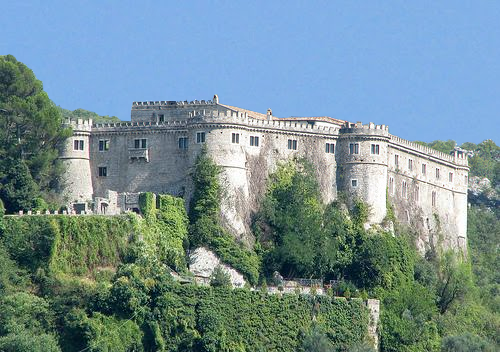
Castello di Monte San Giovanni Campano
The Castello di Monte San Giovanni Campano is a remarkable medieval hill castle located in the town of Monte San Giovanni Campano in the Lazio region of Italy. Constructed in the 11th century, this fortress stands as a testament to the military architecture and turbulent history of central Italy during the High Medieval period. The castle's strategic position on a hilltop allowed it to dominate the surrounding landscape, serving as a critical defensive stronghold guarding the southern borders of the Papal States.
Famed historically as the place where Saint Thomas Aquinas was imprisoned by his own family around 1244 to 1245 to prevent his entry into the Dominican Order, the castle holds significant religious and cultural importance. This episode is commemorated within the fortress, where two rooms linked to his imprisonment survive, including a chapel adorned with a 16th-century Neapolitan triptych altar and a distinctive checkerboard floor of blue and white majolica tiles.
Historical significance and military role
Built at the end of the 10th century and completed in the 11th, the castle was initially designed to protect the southern frontier of the Papal States. Its position and formidable construction made it a key military asset for centuries. In 1157, control passed to the Counts of Aquino, papal vassals who maintained the fortress's defensive role. The castle endured an earthquake in 1184 that caused significant damage, requiring repairs and strengthening.
Monte San Giovanni Campano was renowned for its resilience, reputedly withstanding a siege lasting seven years, a testament to its robust fortifications and strategic design. However, its defenses were ultimately overcome in 1494 during the Italian Wars when Charles VIII of France employed portable artillery to breach the walls. This event marked the first recorded instance of a fortress being breached by gunpowder artillery, revolutionizing siege warfare and signaling the decline of traditional medieval fortifications.
The siege lasted only eight hours before the castle fell, leading to widespread destruction of the fortress and the adjacent town. This defeat had broader consequences, as the fall of Monte San Giovanni undermined the defenses of the Kingdom of Naples, which quickly succumbed to the French invasion.
Architectural features and layout
The castle originally comprised a large fortified complex enclosing a ducal palace and a supporting town, surrounded by robust defensive walls. The walls, constructed from local stone, exceed two meters in thickness at the base, designed to withstand both siege engines and natural disasters such as earthquakes.
Towers and defensive structures
Five towers once punctuated the castle's perimeter, of which only two main towers remain today. The quadrangular tower, dating from the 12th century, rises approximately 20 meters and features walls 3.3 meters thick at the base. This tower is surrounded by a bastion with sloped walls and embrasures for firearms, indicating adaptations made for the introduction of gunpowder weaponry in later centuries.
The pentagonal tower, constructed in the 13th century, contains two stacked rooms connected by a spiral staircase and is distinguished by a large ogival (pointed) arched window facing inward. The interior houses antique furniture, reflecting its dual role as both a defensive and residential space.
Ducal palace and residential quarters
The ducal palace originally rose five stories, surpassing the height of the main towers, but suffered damage from earthquakes in 1703 and 1915, resulting in the demolition of the upper three floors. The remaining structure includes a basement with prison cells that still bear prisoner graffiti, and former jailer quarters now intended for use as a library.
Two rooms within the palace are directly associated with Thomas Aquinas's imprisonment. The innermost cell was converted into a chapel in the 16th century, featuring a checkerboard floor of blue and white majolica tiles and a Neapolitan triptych altar depicting scenes from the saint's life. This chapel is accessed by a steep staircase, emphasizing its secluded and contemplative nature.
Subterranean passage and additional buildings
A notable architectural feature is the subterranean passage that once connected the two main towers and extended approximately 400 meters to an external exit. This underground corridor exemplifies the fortress's sophisticated defensive planning, allowing for secret movement and potential escape during sieges.
Adjacent to the pentagonal tower stands a Renaissance-style palace building, separate from the main fortress. This structure contains large banquet halls, music and game rooms, and a tavern decorated with period furnishings. A marble staircase leads from the atrium to the noble apartments, highlighting the castle's role as a residence of high status and comfort.
Damage, restoration, and current condition
The 1494 siege by Charles VIII's forces resulted in the destruction of much of the castle and the surrounding town. Only two of the original five towers and two of the five palace buildings remain, along with three of the original five town gates. Subsequent earthquakes further damaged the structure, necessitating the removal of parts of the ducal palace.
Restoration efforts began in 1942 under Luigi Mancini and continued after 1990 by the Mastrantoni family. These works have aimed to preserve the castle's historical character, although some modern materials such as reinforced concrete were introduced, affecting the authenticity of certain sections. A reconstructed fountain featuring a statue of a woman holding a basin stands in front of the palace entrance, symbolizing the blend of historical preservation and modern restoration.
Today, the castle is partially preserved, offering visitors a glimpse into medieval military architecture and the layered history of this important Italian fortress. The site includes a restaurant where the grand piano donated by composer Pietro Mascagni is displayed, connecting the castle's historical legacy with cultural heritage.
Cultural significance and visitor experience
The Castello di Monte San Giovanni Campano holds a unique place in Italian history, not only for its military importance but also as a site of religious and cultural memory. The imprisonment of Thomas Aquinas within its walls links the castle to one of the most influential theologians and philosophers of the Middle Ages.
Visitors to the castle can explore the surviving towers, the ducal palace remains, and the chapel dedicated to Aquinas. The site’s extensive fortifications, including thick walls, battlements, and the subterranean passage, provide insight into medieval defensive strategies and the evolution of military architecture in response to gunpowder technology.
The castle's location within the Lazio region offers additional opportunities to experience the rich cultural and historical landscape of central Italy. Nearby towns and landmarks complement a visit to Monte San Giovanni Campano, making it a worthwhile destination for history enthusiasts and architectural scholars alike.
Frequently asked questions (FAQ)
- When was the Castello di Monte San Giovanni Campano built?
- The castle was constructed in the 11th century to serve as a defensive fortress for the Papal States.
- What is the historical significance of the castle?
- It is known for imprisoning Saint Thomas Aquinas and being the first fortress breached by portable artillery in 1494.
- Can visitors see the rooms where Thomas Aquinas was held?
- Yes, two rooms linked to his imprisonment survive, including a chapel converted in the 16th century with period decorations.
- What remains of the original castle today?
- Two of the five main towers, two palace buildings, and three town gates remain after destruction in 1494 and later earthquakes.
- Is the castle open to the public?
- Visiting hours and ticket prices vary; visitors should check local sources or the castle's official site for current information.
Information
Website
Visit websiteSources & official resources
Verify the information above using these authoritative references.
Loading map...
Visitor reviews
No reviews yet. Been here? Write the first review and help other travelers!
Write the first reviewVisited this castle? Share your experience
Your review helps other travelers and adds first-hand knowledge to our encyclopedia.