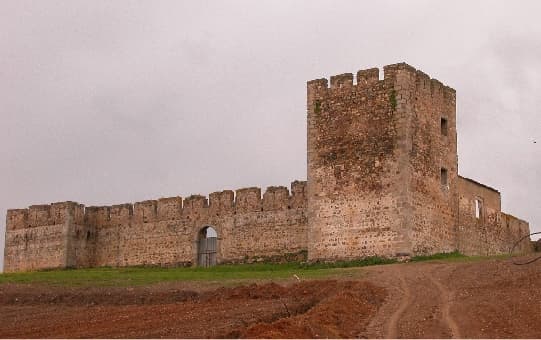
Castle of Valongo
The Castle of Valongo is a significant high medieval hill castle located in Nossa Senhora de Machede, within the municipality of Évora, Portugal. This fortress stands as a testament to the region's complex history, reflecting layers of occupation from the Roman era through the Visigothic and Muslim periods, culminating in its role during the Christian Reconquest of the Iberian Peninsula. Strategically positioned on a gentle hillside near the Ribeira de Valongo stream, the castle overlooks a landscape of natural cork and holly oak trees and cultivated farmland, emphasizing its historical importance in controlling local estates and routes.
The earliest documentary reference to the castle dates to 1283, found in letters of sale involving Infanta D. Leonor Afonso, daughter of King D. Afonso III. This record confirms the castle’s significance within the medieval Portuguese nobility and its role as a fortified residence and military stronghold. Archaeological and architectural evidence suggests that a tower existed on the site prior to this date, likely part of earlier fortifications from the Muslim occupation, as indicated by Arabic inscriptions discovered within the castle walls.
Historical evolution and military significance
The castle’s history is deeply intertwined with the shifting political and military landscape of the Iberian Peninsula. After the Roman and Visigothic periods, the site was fortified by Muslim forces, who enhanced its defensive capabilities. The presence of Islamic inscriptions serves as a tangible reminder of this era, highlighting the castle’s role as a frontier fortress during the Muslim rule of the region.
During the late 14th or early 15th century, the castle underwent significant reconstruction as part of the Christian Reconquest efforts. This rebuilding transformed the castle into a robust defensive stronghold for the Portuguese kingdom, adapting its structure to contemporary military needs. The castle's rectangular layout, reinforced by four square corner towers, was designed to maximize defensive coverage and control over the surrounding territory.
15th and 16th-century renovations
Between the 15th and 16th centuries, the castle’s central keep tower was extensively renovated. Architectural enhancements included the addition of pointed tiled roofs, brick staircases, and bay windows, which not only improved the castle’s defensive functions but also its residential comfort. These modifications reflect the castle’s dual role as both a military fortress and a noble residence during this period.
Architectural features and layout
The Castle of Valongo exhibits a classic medieval military architecture with a rectangular plan fortified by four square towers at each corner. These towers are connected by curtain walls topped with parapets featuring square battlements. The parapets form a chemin de ronde, a walkway used historically by guards for surveillance and defense.
The main entrance faces east and is marked by a large arched gateway, which would have been heavily defended. The most prominent feature is the keep tower located at the northeast corner, oriented westward. Access to the keep is gained via a staircase, emphasizing its role as a last refuge and command post within the castle.
Inside the keep, there are three storeys supported by ogival rib vaults, a hallmark of Gothic military architecture. The top floor is crowned with battlements, providing defenders with elevated positions to repel attackers. The keep’s interior halls are illuminated by narrow vertical slits known as meurtrières or arrow slits, which allowed archers to fire while remaining protected.
Additional defensive elements include a smaller tower attached to the western wall with a lateral entrance, narrow vertical openings throughout the walls and towers, and corbels supporting the parapets. The construction combines robust masonry walls with brick vaulting in the keep, showcasing the use of durable materials and advanced medieval building techniques.
Decorative and cultural elements
Later architectural additions such as the pointed tiled roofs and bay windows from the 15th and 16th centuries add a distinctive character to the castle, blending military functionality with aesthetic refinement. The presence of Islamic inscriptions within the castle walls highlights the cultural interactions and historical layers that define the site’s unique heritage.
Preservation and current condition
Today, the Castle of Valongo stands as a ruined fortress, with conservation efforts undertaken to stabilize and preserve its remains. In 1989, cracks and faults in the fortifications were cleaned and repaired, and subsequent interventions focused on consolidating fractures and reconstructing vulnerable sections. These preservation activities have been crucial in maintaining the structural integrity of the castle and allowing visitors to appreciate its historical and architectural significance.
The castle remains privately owned, having passed from the Marquesses of Valada in the 19th century to its current proprietors. Its location amidst natural vegetation and farmland continues to offer a picturesque setting that reflects the castle’s historical role as a guardian of the surrounding landscape.
Visitor information and cultural importance
The castle's rich history and architectural features make it an important cultural landmark in the Évora region. Visitors can explore the ruins to gain insight into medieval military architecture and the complex history of Portuguese frontier fortifications. The site’s combination of Roman, Visigothic, Muslim, and Christian influences provides a fascinating narrative of historical continuity and change.
While the castle is in ruins, its well-preserved defensive structures, including towers, battlements, and the keep, offer a vivid glimpse into the past. The castle’s strategic location and historical significance contribute to its status as a valuable heritage site, attracting historians, architects, and tourists interested in Portugal’s medieval legacy.
Frequently asked questions (FAQ)
- What is the historical significance of the Castle of Valongo?
- The Castle of Valongo is a remarkable example of medieval military architecture in Portugal, reflecting the strategic importance of the region during the Middle Ages. It played a key role in the defense against invasions and served as a royal residence, showcasing the power of the local nobility.
- When was the Castle of Valongo built?
- The construction of the Castle of Valongo dates back to the 12th century, during the period of the Reconquista. It has undergone various renovations over the centuries, preserving its historical essence while adapting to the needs of its time.
- Can I visit the Castle of Valongo?
- Yes, the Castle of Valongo is open to visitors, allowing them to explore its rich history and stunning architecture. Guided tours are available to enhance your experience and provide deeper insights into the castle's significance.
- What are the opening hours for the Castle of Valongo?
- The Castle of Valongo typically opens daily from 9:00 AM to 6:00 PM, but hours may vary during holidays or special events. It's advisable to check the official website or contact local tourism for the most current information before your visit.
- Is it possible to access the Castle of Valongo with mobility challenges?
- The Castle of Valongo has some limitations regarding accessibility due to its historical structure. Visitors with mobility challenges may find it difficult to navigate certain areas, so it's recommended to contact the site in advance for specific accessibility options and assistance.
- What is the best time to visit the Castle of Valongo?
- The best time to visit the Castle of Valongo is during the spring and fall months when the weather is mild and the tourist crowds are smaller. This allows for a more enjoyable exploration of the castle and its surrounding landscapes.
- Are there any nearby attractions to the Castle of Valongo?
- Yes, there are several nearby attractions, including the picturesque village of Nossa Senhora de Machede and other historical sites in the region. Visitors can enjoy local cuisine and experience the rich culture of Portugal while exploring these nearby points of interest.
- What are the ticket prices for the Castle of Valongo?
- Ticket prices for the Castle of Valongo are typically affordable, making it accessible to a wide range of visitors. Discounts may be available for students, seniors, or groups, so it's worth inquiring at the ticket office upon arrival.
Photo gallery

Photo by Celta at Portuguese Wikipedia•Public domain
Information
Website
Visit websiteSources & official resources
Verify the information above using these authoritative references.
Loading map...
Visitor reviews
No reviews yet. Been here? Write the first review and help other travelers!
Write the first reviewVisited this castle? Share your experience
Your review helps other travelers and adds first-hand knowledge to our encyclopedia.



