Castle of the Counts of Modica, Alcamo
The Castle of the Counts of Modica, located in Alcamo, Sicily, is a remarkable example of medieval military architecture that has played a significant role in the region's history since the 14th century. Constructed beginning around 1340 under the direction of Raimondo Peralta, Count of Caltabellotta, the castle was completed by 1350 during the rule of Enrico and Federico Chiaramonte. This fortress was conceived as both a noble residence and a strategic defensive stronghold, reflecting the turbulent feudal dynamics of medieval Sicily.
The castle's importance is underscored by its frequent mention in royal documents and its association with prominent historical figures. In 1391, King Martino I confirmed the grant of the castle and surrounding lands to Enrico Ventimiglia, following an earlier concession by King Federico III. The subsequent year, after the Chiaramonte family's defeat, King Martino I and his wife resided at the castle, highlighting its role as a royal residence and symbol of sovereign authority.
Ownership of the castle passed to the Cabrera family, Counts of Modica, from 1410 until 1812, lending the castle its enduring name. During this period, the fortress was a formidable military installation, capable of housing thirty companies of soldiers and enduring sieges lasting up to one and a half months when adequately supplied. Its strategic value was tested in 1534 when it faced an assault by the infamous pirate Barbarossa.
One of the castle's notable historical moments occurred on September 1, 1535, when Emperor Charles V stayed in one of its towers with his court and the infanta Eleonora d’Aragona after his victorious campaign in Tunis. This event emphasizes the castle's function as a place of refuge and political significance during the Renaissance.
The castle underwent significant restorations between 1583 and 1589 to maintain its dual defensive and residential purposes. Following the death of the last Countess of Modica in the early 19th century, the castle was sold at auction to the Stuart family. In 1828, ownership was transferred to the municipality of Alcamo by court ruling, after which the castle served various civic functions including municipal offices, a prison until 1968, and a stable.
Restoration efforts in 1870 and again between 2000 and 2010 have helped preserve the castle's structure. It now houses cultural institutions such as the Ethnographic Museum, the Regional Historical Wine Cellar, and exhibitions featuring Sicilian puppets and sculptures. The castle also serves as a venue for civil weddings in a designated hall on the first floor. However, it has experienced closures due to structural concerns, notably from 2011 to 2013 and again until December 2015, with some areas remaining inaccessible for safety reasons.
Architectural layout and features
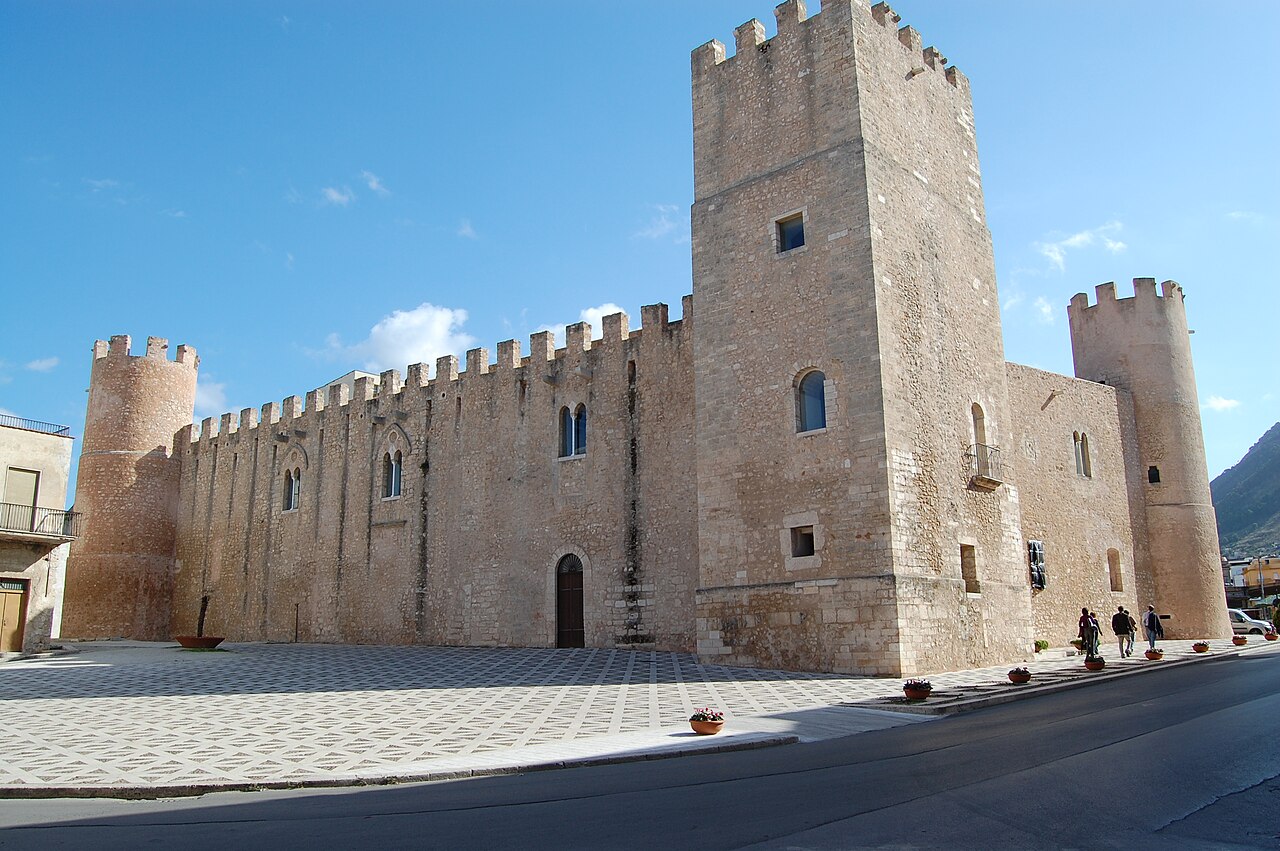
The castle is characterized by a distinctive rhomboidal plan enclosing a nearly rectangular central courtyard. Its construction predominantly employs roughly cut stone blocks, with the corners of towers and window openings crafted from precisely squared and interlocked stones, demonstrating advanced masonry techniques of the period.
Four battlemented towers anchor the corners of the fortress: two are square and two circular. The tallest square tower, positioned at the southeast corner and known as the "main tower," historically functioned as a prison and torture chamber. The lower square tower at the northwest served as a lookout point for sentinels. One circular tower on the northeast side was reserved for distinguished guests, while the other circular tower to the southwest prominently displays the marble coat of arms of Alcamo, symbolizing the castle's civic importance.
The castle walls were designed to withstand siege engines and originally enclosed the entire fortress. Access was controlled through three gates located on the south, west, and north sides, each opening onto a distinct square. The southern square served as the militia headquarters, the western square was known as the "citadel," and the northern square's specific function remains unclear.
Interior spaces and architectural details
The ground floor of the castle contained essential functional spaces including a chapel, rooms for the chaplain and servants, and an isolation cell. The first floor was more residential and administrative, featuring a reception hall with an antechamber, the count's study, several bedrooms connected by a corridor, and another isolation cell. The windows throughout the castle are notable for their Gothic-Catalan style double and triple lancet designs, reflecting the architectural influences prevalent in Sicily during the medieval period.
Historical mysteries and preservation
There is an unconfirmed hypothesis regarding the existence of prison ditches beneath the castle, which may have been used for royal imprisonment from the late 14th to the 18th centuries. While several restorations have preserved much of the castle's fabric, ongoing structural concerns have led to restricted access in some areas to ensure visitor safety.
Historical significance and cultural legacy
The Castle of the Counts of Modica stands as a testament to the complex feudal history of Sicily and the strategic importance of Alcamo throughout the medieval and Renaissance periods. Its role as a noble residence, military fortress, royal refuge, and later a civic institution illustrates the multifaceted uses of such castles over centuries.
Today, the castle is not only a significant architectural monument but also a cultural hub, hosting museums and exhibitions that celebrate Sicilian heritage. Its preservation and adaptive reuse underscore the importance of maintaining historical structures as living parts of community life.
Frequently asked questions (FAQ)
- When was the castle of the Counts of Modica built?
- Construction of the castle began around 1340 and was completed by 1350 under the direction of Raimondo Peralta and the Chiaramonte family.
- What architectural style characterizes the castle?
- The castle features Gothic-Catalan architectural elements, particularly visible in its double and triple lancet windows.
- Can visitors access all areas of the castle?
- Some areas of the castle remain closed due to structural concerns, but many parts are open to the public, including museums and exhibition spaces.
- What historical events is the castle known for?
- The castle hosted King Martino I and his wife in 1392, endured a pirate attack by Barbarossa in 1534, and sheltered Emperor Charles V in 1535 after his Tunis victory.
- What are the current uses of the castle?
- The castle houses the Ethnographic Museum, the Regional Historical Wine Cellar, exhibitions of Sicilian puppets and sculptures, and serves as a venue for civil weddings.
Information
Sources & official resources
Verify the information above using these authoritative references.
Loading map...
Visitor reviews
No reviews yet. Been here? Write the first review and help other travelers!
Write the first reviewVisited this castle? Share your experience
Your review helps other travelers and adds first-hand knowledge to our encyclopedia.