Castle of Soutomaior
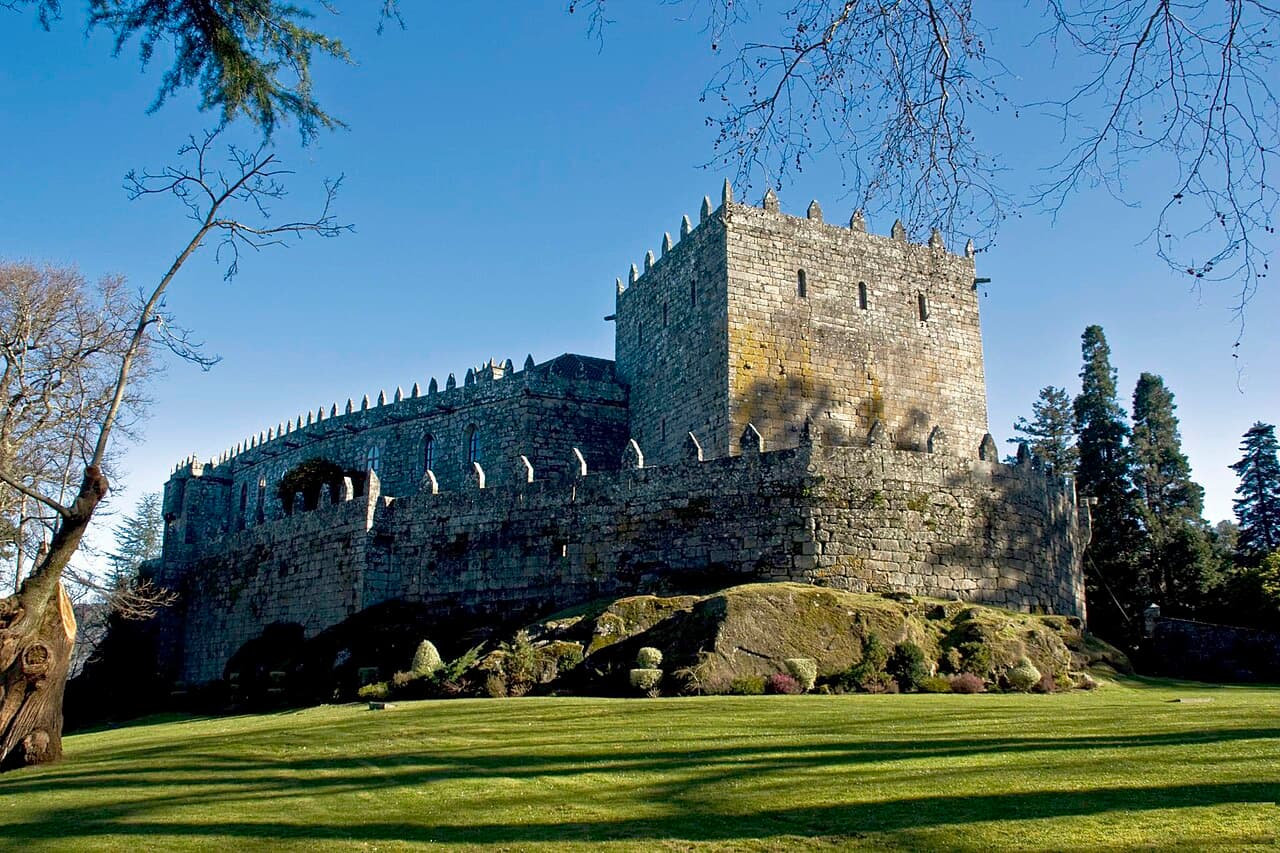
The Castle of Soutomaior is a prominent medieval fortress located in the province of Pontevedra, within the autonomous community of Galicia, Spain. Perched approximately 119 meters above sea level atop Mount Viso, the castle commands strategic views over the confluence of the Oitavén and Verdugo rivers. Its position on a hill classifies it as a hill castle, a common defensive choice in medieval fortifications to maximize visibility and control over surrounding territories.
Founded in the 12th century during the reign of Alfonso VII of Galicia, the castle was originally established by Paio Méndez Sorrede. It soon became the ancestral seat of the Soutomaior family, a powerful noble lineage that played a significant role in the political and military history of medieval Galicia. The castle's long history is marked by its involvement in regional conflicts, noble power struggles, and architectural evolution reflecting changing military technologies.
Historical significance and medieval conflicts
Throughout the High and Late Medieval periods, the Castle of Soutomaior was a focal point in the turbulent history of Galicia. It was notably involved in the civil war between Pedro I and Enrique II of Castile, reflecting its strategic importance in broader Iberian conflicts. The fortress also played a critical role in border disputes with neighboring Portugal, underscoring its military and political significance.
One of the most dramatic episodes in the castle's history was during the Irmandiña revolts (1467-1469), a popular uprising against the feudal nobility. The castle suffered partial destruction during these revolts but was subsequently rebuilt with enhanced fortifications. The addition of a double wall system exemplifies the medieval architectural response to evolving siege warfare and the need for layered defense mechanisms.
Architectural evolution and fortification enhancements
Original medieval structures
The castle's oldest and most significant architectural element is the rectangular keep, known as the Torre del Homenaje. This imposing tower covers approximately 150 square meters and rises to a height of 15 meters, with walls up to 3.5 meters thick. Its original access via a drawbridge to the first floor was a typical defensive feature designed to hinder attackers.
15th-century expansions by Pedro Madruga
In the 15th century, the castle underwent significant modernization under Pedro Álvarez de Soutomaior, also known as Pedro Madruga. He expanded the fortress to accommodate the advent of firearms, incorporating gunports and installing bronze cannons. These adaptations reflect the transitional military architecture bridging medieval and early modern warfare.
Pedro Madruga also commissioned the construction of the Torre del Conde, a second tower adjacent to the outer wall protecting the original entrance. This tower was later repurposed in the 19th century as a library during the castle's neogothic restoration.
Later modifications and neogothic restoration
Following the 15th century, the castle experienced punitive modifications under the Catholic Monarchs, who ordered the reduction of the tower heights as a sanction against Pedro Madruga. Despite this, the castle maintained its strategic importance along the Portuguese border well into the early modern era.
By the late 18th century, the fortress had fallen into decline, with damaged structures and deteriorated roofing. Between 1869 and 1870, Antonio Aguilar y Correa, Marquis of la Vega de Armijo and Mos, undertook a comprehensive restoration. This restoration transformed the castle into a neogothic summer residence, introducing architectural features such as parapets, battlements, stone corbels, and gargoyles, typical of the Romantic Neo-Gothic style.
The palace adjoining the keep was rebuilt with ovoid arches, galleries opening onto the courtyard, new staircases, a chapel with carved walnut doors, wood-beamed ceilings, and fireplaces. The Galería de las Damas, a neogothic gallery with pointed arches and stone columns, replaced an earlier wooden structure, enhancing the castle's residential and aesthetic qualities.
Gardens and landscape features
The castle is surrounded by extensive gardens covering approximately 15,700 square meters. These gardens feature around 175 tree species, including cedars of Lebanon, eucalyptus, firs, pines, chestnuts, magnolias, and sequoias, some of which are over 800 years old. The gardens are especially renowned for their camellia collection, boasting more than 300 specimens across 22 varieties. This collection earned the prestigious "Jardín de Excelencia Internacional" award in 2012 from the International Camellia Society, marking it as the only garden in Spain with this distinction.
Additional garden features include the Fuente de la Marquesa fountain, the Estanque da Ría pond shaped like the Vigo estuary, a pavilion for unmarried guests, a gazebo, and a small theater. The grounds also contain the former Hotel Sanatorio de Lluria, established in 1913 for therapeutic treatments and now operating as the Posada del Castillo de Soutomaior.
Modern use and cultural significance
After changing ownership several times in the 20th century, the castle was acquired by the Provincial Council of Pontevedra in 1982. Restoration work was completed by 1987, preserving its medieval character while maintaining the neogothic additions. Archaeological excavations conducted in 2010 further enriched understanding of the castle's historical layers.
Since May 2018, the castle operates as a museum dedicated to showcasing its rich history, the legacy of the Soutomaior family, the life of Pedro Madruga, and the cultural contributions of María Vinyals. It also hosts the Escola da Igualdade María Vinyals, a school promoting equality established in 2016, reflecting the castle's ongoing role as a cultural and educational center.
Despite numerous restorations and adaptations, the Castle of Soutomaior remains a well-preserved example of medieval military architecture combined with 19th-century romantic neogothic style, offering visitors a unique insight into Galicia's history and heritage.
Frequently asked questions (FAQ)
- How do I visit the Castle of Soutomaior?
- The Castle of Soutomaior is open to visitors as a museum. It is advisable to check the official website or local tourist information for current opening hours and any guided tour options.
- What is the historical significance of the Castle of Soutomaior?
- The castle was a major medieval fortress and the seat of the powerful Soutomaior family. It played a key role in regional conflicts, including the Irmandiña revolts and border disputes with Portugal.
- Can I explore the castle gardens?
- Yes, the castle gardens are extensive and feature a unique collection of camellias and other tree species. They are open to the public and provide a scenic complement to the historical visit.
- When was the castle restored to its current form?
- Significant restoration took place between 1869 and 1870, transforming the castle with neogothic architectural elements while preserving medieval structures.
- Is the castle accessible for people with reduced mobility?
- Access to some parts of the castle may be challenging due to its medieval hilltop location and historic construction. Visitors with reduced mobility should inquire in advance about available accommodations.
Photo gallery

Information
Sources & official resources
Verify the information above using these authoritative references.
Loading map...
Visitor reviews
No reviews yet. Been here? Write the first review and help other travelers!
Write the first reviewVisited this castle? Share your experience
Your review helps other travelers and adds first-hand knowledge to our encyclopedia.