Castle of Şebinkarahisar
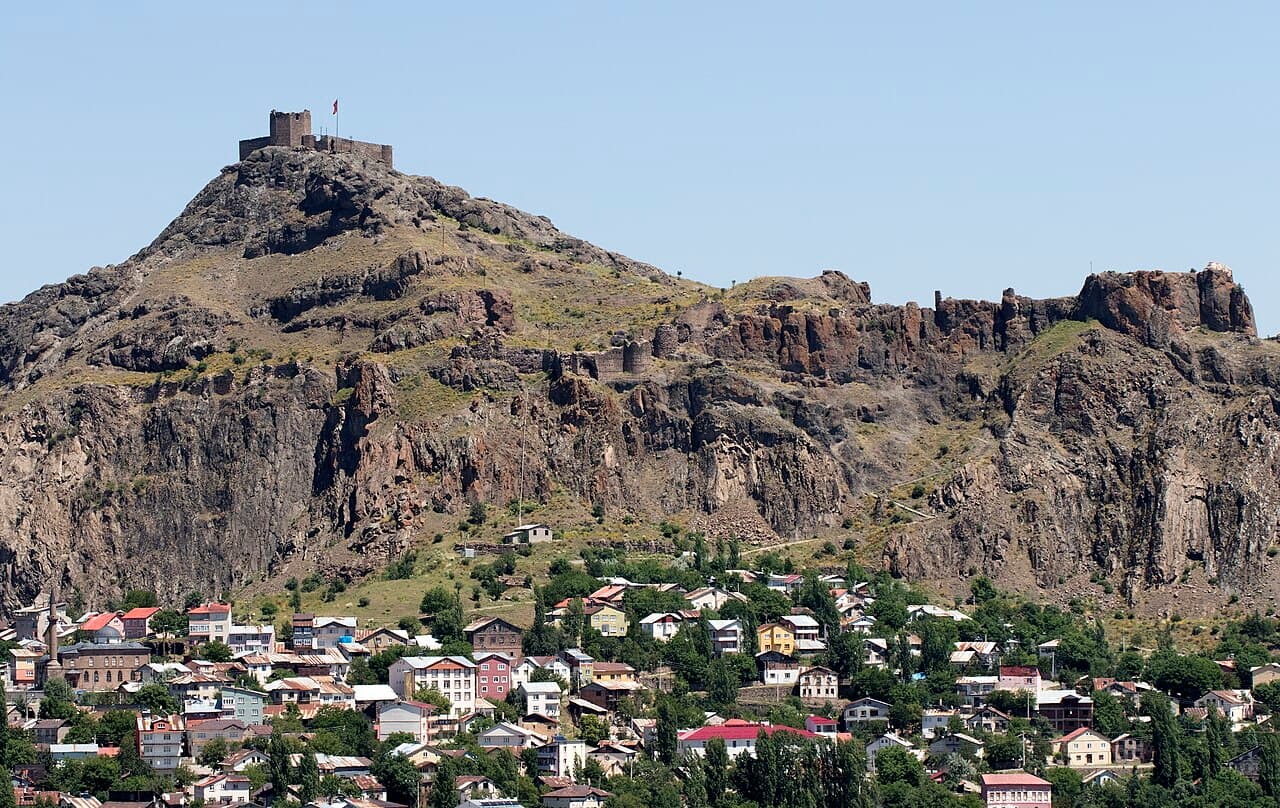
Şebinkarahisar Castle (Turkish: Şebinkarahisar Kalesi) is a historic hill castle located in the Şebinkarahisar district of Giresun Province in northern Turkey. Perched atop the 1,360-meter-high Hacikayası hill, the castle overlooks the surrounding landscape with strategic prominence. Its origins are ancient, with archaeological and architectural evidence suggesting that the fortress existed during the era of the Kingdom of Pontus, predating the Roman Empire's control over the region.
Historical background and construction phases
The castle's long history spans multiple civilizations and rulers. During the reign of the Byzantine Empire, particularly under Emperor Justinian I (r. 527–565), significant repairs and fortifications were made to the northern and southeastern walls, reflecting the castle's ongoing military importance. The most substantial construction, however, occurred during the rule of the Mengujekids, an Anatolian beylik that governed the area in the 12th and 13th centuries. Notably, Fahreddin Behram Shah (1162–1225), a Mengujekid ruler, commissioned major additions to the castle in 1184, strengthening its defenses and expanding its facilities.
An inscription from the Mengujekid period, featuring a distinctive relief of a double-headed eagle, was originally positioned above the castle's main gate. Although it was stolen in 1896, the artifact was later recovered and transferred to the Governor of Sivas Province for preservation.
Architectural features and layout
The castle complex consists of two interconnected sections: the outer castle and the inner castle. The main entrance, known as the Seljuk Gate, is characterized by its pointed arches and is accessed via a staircase. This gate is flanked by two semicircular towers that provided defensive coverage. A secondary entrance, dating back to the Byzantine period, lies approximately 10 to 15 meters northeast of the Seljuk Gate. This entrance was later sealed off, indicating changes in the castle's defensive strategy over time.
One of the notable structures within the outer castle is a large, oval-shaped bastion to the northwest, known locally as Kızlar Kalesi or "The Girls Castle." This bastion served as a key defensive position. The inner castle, constructed on the highest and most secure part of the hill, features an irregular rectangular plan. It includes an octagonal palace tower, which was built by Muzafferiddin Mehmed, son of Behram Shah, further enhancing the castle's residential and defensive capabilities. Stonemasonry marks from the 13th century are visible at the inner castle gate and on the palace tower walls, reflecting the craftsmanship of the period.
Defensive structures and water management
The castle's fortifications include thick walls, towers, and bastions designed to withstand sieges. Inside the castle, numerous rock-carved cisterns were constructed to collect and store water, essential for sustaining inhabitants during prolonged attacks. The most significant of these is the Kırk Badal ("Forty Steps"), a water tunnel that provided a secure water supply. This sophisticated water management system highlights the castle's strategic design for defense and survival.
Historical events and periods of conflict
Şebinkarahisar Castle witnessed several periods of conflict and rebellion throughout its history. It suffered damage during the suppression of uprisings led by Şehzade Murad in 1515 and Abaza Mehmed Pasha in 1622. The castle also played a role during the Armenian Shabin-Karahisar uprising in 1915, after which it sustained significant destruction. Despite these damages, the castle underwent multiple restorations and repairs during the Ottoman era, which contributed to the preservation of its current walls and entrance structures, predominantly reflecting Seljuk and Ottoman architectural influences.
Life within the castle and archaeological remains
According to the 17th-century travelogue Seyahatnâme by Evliya Çelebi, the castle housed about seventy residences, numerous cisterns, wheat storage facilities, and the Küçük Fatih Mosque. These details suggest that Şebinkarahisar Castle functioned as a fortified settlement with a vibrant community, not merely a military outpost. Unfortunately, many of these structures were destroyed during the 1915 uprising.
Archaeological traces of rock-carved graves to the east of the castle indicate human activity predating the Turkish settlement of the region, possibly dating back to pre-Turkic or early medieval periods. These graves add to the site's historical depth and cultural significance.
Current condition and preservation
Today, Şebinkarahisar Castle is classified as a partially preserved hill castle. While much of the original structure remains, some sections are in ruins due to centuries of warfare and natural decay. The castle is an important cultural heritage site, attracting visitors interested in medieval fortifications and Anatolian history.
Frequently asked questions (FAQ)
- How do I get to Şebinkarahisar Castle?
- Şebinkarahisar Castle is located on Hacikayası hill southeast of Şebinkarahisar town in Giresun Province, Turkey. Visitors can reach the castle by local road transport followed by a hike up the hill.
- What is the historical significance of Şebinkarahisar Castle?
- The castle dates back to the Kingdom of Pontus and has been fortified through Byzantine, Seljuk, Mengujekid, and Ottoman periods, reflecting a rich military and cultural history.
- Are there guided tours available at the castle?
- Guided tours may be available through local tourism offices or the municipality. These tours provide detailed insights into the castle's architecture and history.
- What architectural styles are present in Şebinkarahisar Castle?
- The castle exhibits a mix of architectural styles including Byzantine repairs, Seljuk gates, and Ottoman restorations, showcasing its long historical evolution.
- Is the castle accessible for visitors with mobility issues?
- Due to its hilltop location and uneven terrain, access to Şebinkarahisar Castle may be challenging for visitors with mobility issues.
Photo gallery

Information
Opening hours
9:00-18:00, daily
Ticket prices
Free
Current owner
Municipality
Loading map...
Visitor reviews
No reviews yet. Been here? Write the first review and help other travelers!
Write the first reviewVisited this castle? Share your experience
Your review helps other travelers and adds first-hand knowledge to our encyclopedia.